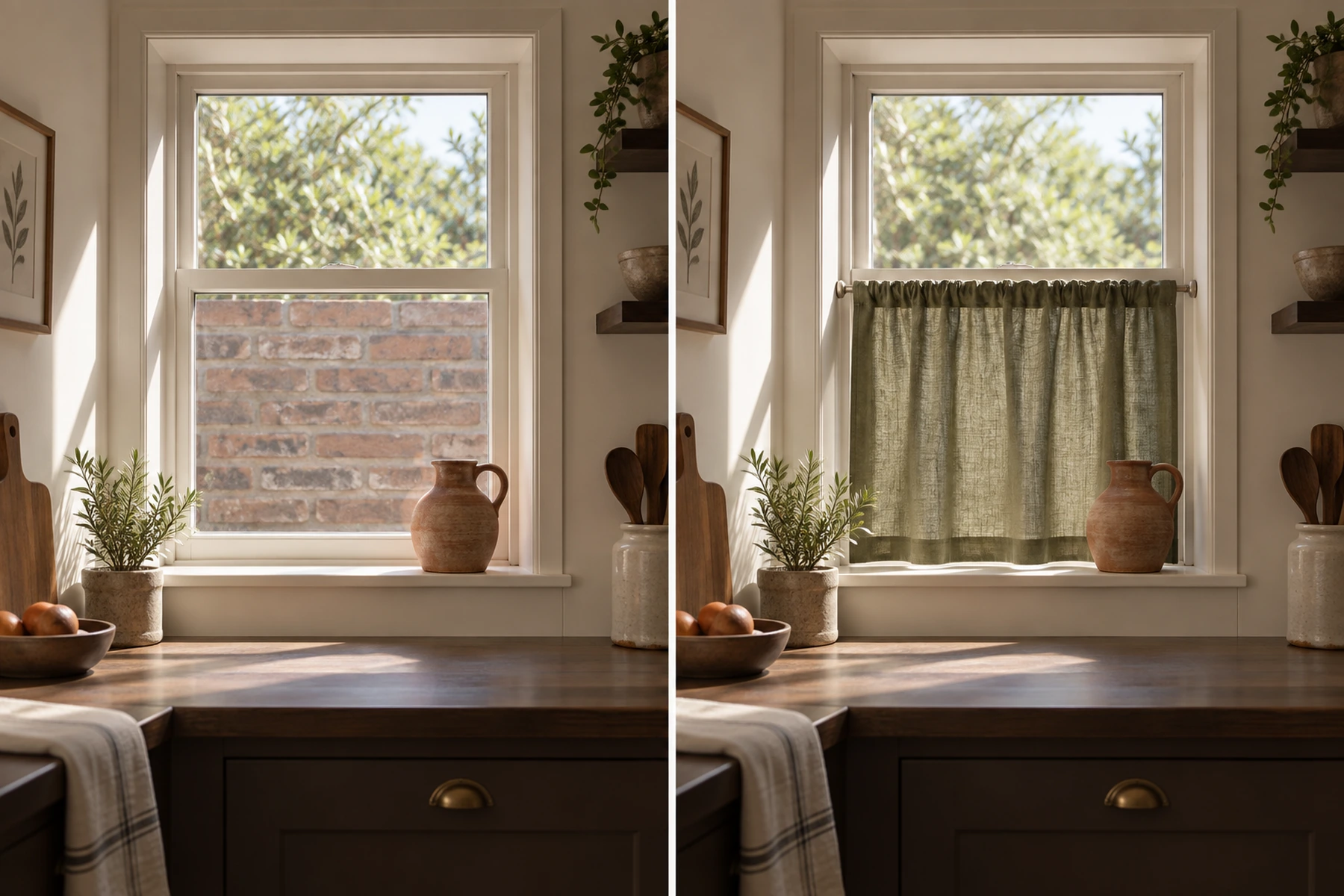
Cover the half of the window people can see into. Leave the other half alone.
A cafe curtain on a tension rod, twenty five minutes, and nothing screwed into the frame.

By NoraRenter DIY · Checked Sep 19, 2026
Some links on this page go to Amazon. As an Amazon Associate I earn from qualifying purchases, which is how the site pays for itself. How this works
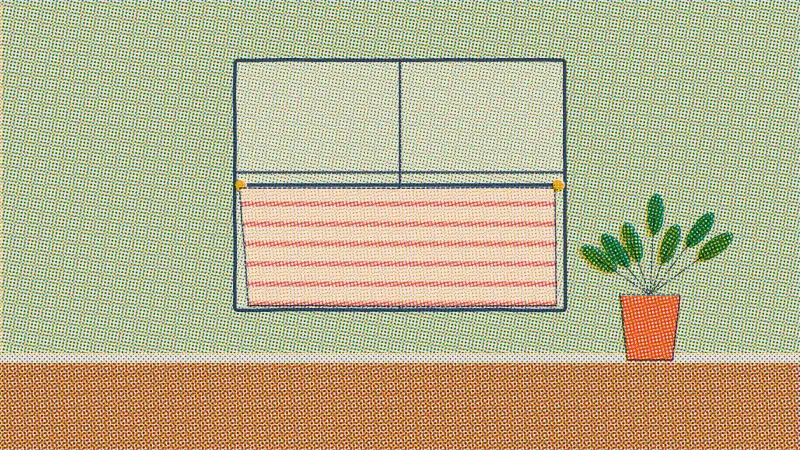

Quick change 1 of 3 rolls
Renter DIY · deposit risk: none · drill: no
The kit
A rod, a panel, and a tape measure you own
Every link here was opened on Sep 19, 2026. Name, variant, why it is that one, and what is wrong with it.
The concession, and it halves the order: buy one panel, not two. Pairs are a habit from full length curtains, where two panels meet in the middle. A half window at one and a half times gather is one panel wide, and the spare goes in a drawer forever.
-
MIULEE cafe curtains, 24 in length
26 × 24 in · 2 panels · rod pocket · chocolate brownLinen semi sheer, the fabric that screens a sightline without turning the room gray. The 24 in drop is the standard half window length, and brown sits warmer against a white jamb than any gray.
The catchRod pocket only, so the top edge gathers tight and you cannot slide it open in a hurry. If your window is over a sink you reach across, take the clip rings instead.
See the 26 × 24 pair on Amazon Opens Amazon in a new tab -
KOUFALL tier curtains, 24 in length
30 × 24 in · 2 panels · rod pocket · whiteThe wider panel, for an opening past about 26 in. Four extra inches per panel is what keeps the gather from going flat.
The catchWhite shows a kitchen faster than anything else in this list. If the window is over the stove, take the brown.
See the 30 in wide pair on Amazon Opens Amazon in a new tab
-
Amazon Basics spring tension curtain rod
36 to 54 in · black · spring loadedThe range to reach for when the opening measures around 42 in, which puts it square in the middle third where the spring still has work left in it.
The catchWrong rod for a small window. At 36 in it is already at the bottom of its range and the tube ends up so thick the pocket will barely take it.
See it above Opens Amazon in a new tab -
Umbra Chroma tension rod
54 to 90 in · nickel · for windowsFor the wide opening, and the one I would pay up for on a window you look at every morning. The slim nickel tube stops it reading as a shower rod, which is where cheap rods give themselves away.
The catchOver about 70 in any tension rod will bow in the middle under gathered fabric. Past that width, this project is the wrong project.
See the 54 to 90 in rod on Amazon Opens Amazon in a new tab
-
Metal curtain clip rings
42 pack · 1.26 in interior · fits a 1 in rod · blackThese turn any flat panel, a tea towel, or a yard of hemmed fabric into a cafe curtain that slides. Above a sink that matters more than the header style. Space them about 5 in apart.
The catchCheck the ring against your rod before you thread forty of them. A 1.26 in ring will not pass the thick end of a heavy duty tension rod.
See the 42 clip rings on Amazon Opens Amazon in a new tab -
Stanley 25 ft tape measure
25 ft · chrome case · lockThe three measurements in step one are the whole project, and a soft sewing tape sags across an opening and reads long.
Already have this?Then you are done buying. Anything rigid works, including a folding ruler or the tape in the drawer with the paint samples.
See the 25 ft tape on Amazon Opens Amazon in a new tab
What goes wrong
A rod at the end of its travel is a rod on the floor
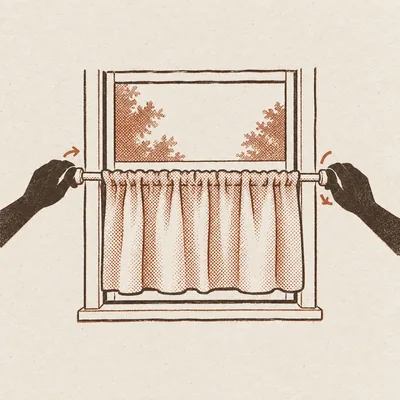
A tension rod does not hold by being long enough. It holds because a spring inside it is still compressed, pushing the rubber feet into the jamb. Wind it out near the end of its range and the spring has nothing left to give, so the friction is nearly zero. It looks fine. It stays up a week. Then somebody tugs the fabric sideways to see who is at the door and it drops into the sink.
So you choose the rod by its range and ignore its maximum. Measure the opening, then buy the rod whose adjustment range puts your number in the middle third of it. A 30 in window wants the 28 to 47 rod, not the 30 to 54 one. Sideways pull is the load that kills these, and sideways pull is the only load nobody tests for.

it held for a week. that is not the same as holding
Five steps
Measure inside the opening, not around the frame
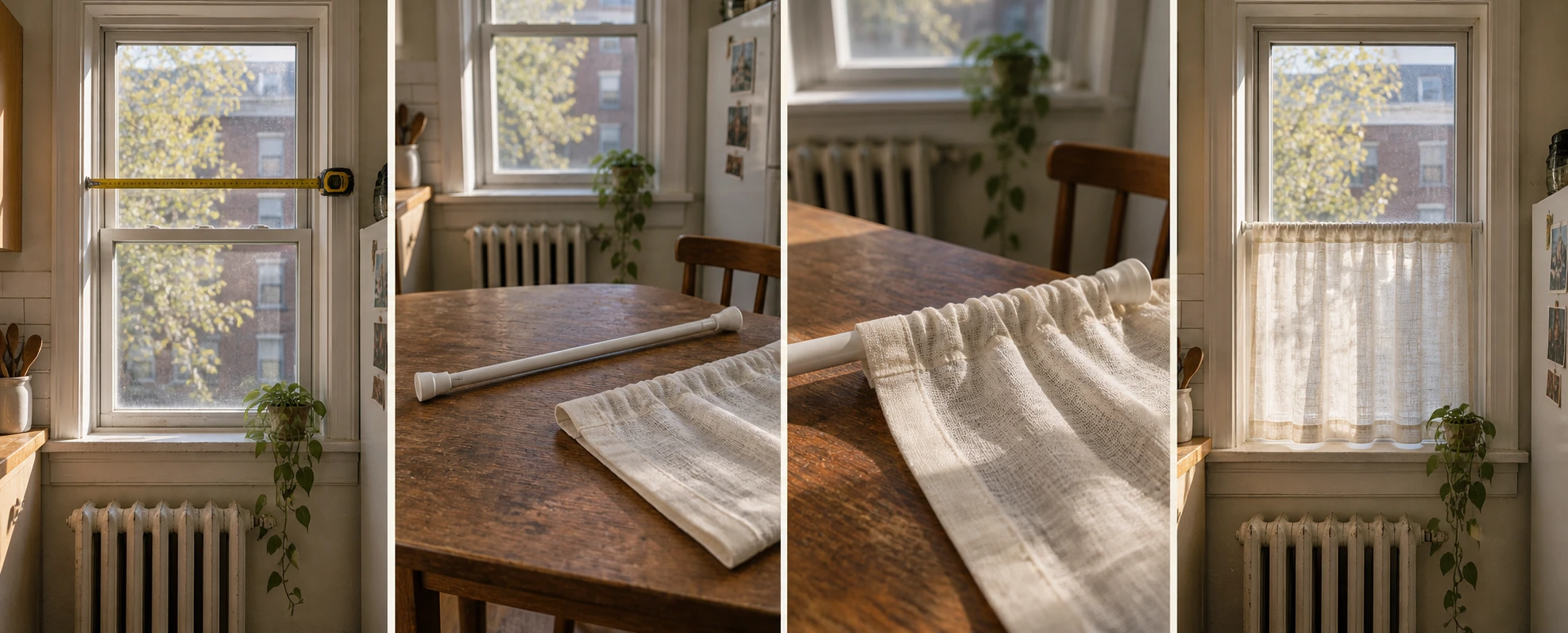
All of it happens standing at the window with a tape measure.
-
01
Measure the inside of the opening at three heights
Top, middle and bottom, jamb to jamb. Rental openings are rarely square, and the number you want is the smallest of the three.
What goes wrongMeasuring around the outside of the trim. That number is two inches too big and the rod will not go in.
-
02
Pick the rod whose range puts your number in the middle
Read rod ranges, not rod lengths. If your number lands in the last inch or two of a range, that is the wrong rod even though it fits.
What goes wrongBuying the longest rod because it covers every window you own. It covers none of them well.
-
03
Decide the top line, which is not always halfway
The rod goes where privacy starts, which is rarely the mathematical middle. Stand where a neighbor stands and see where the sightline crosses the glass. In most kitchens that is a little above the middle rail.
What goes wrongSplitting the window exactly in half. It reads as a mistake, and it usually leaves your face visible.
-
04
Thread the panel before the rod goes anywhere near the wall
Rod pocket panels slide on; anything else goes on clip rings, one at each end and the rest evenly between. Gather to about one and a half times the opening. Full length curtains want double; a half window does not.
What goes wrongHanging the rod first and then trying to feed fabric onto it in mid air.
-
05
Set it, then pull it sideways on purpose
Wipe the jamb dry, wind a full turn past snug, press it level. Then pull the fabric along the rod the way you would to look outside. If it slips at all, wind another turn or go down a rod size.
What goes wrongTesting it by tugging downward. Nothing ever pulls a cafe curtain down; it pulls it sideways.
Why half
The light you keep is the whole point

A window facing a wall eight feet away has one usable asset, and it is the sky at the top of it. A roller blind takes that away every time you want privacy. A cafe curtain covers only the part that was looking at brick anyway.

she found the gap in every curtain in this apartment. every one.
- Materials$30 to 70
- Takes25 minutes
- To undo2 min
- Deposit riskNone
- DrillNo
- LadderNo
The low end is one rod and one panel. The high end is two windows done properly with clip rings.
How to undo it
2 minTwist, lift, done
The fastest reversal on the site, and the reason to start here if you have never touched a rental before.
- 01Twist the rod counterclockwise two turns until it goes slack
- 02Lift it out with the fabric still on it
- 03Wipe the two spots on the jamb with a damp cloth
What is left on the wall: nothing, most of the time. A rod wound far too tight for a year leaves two faint gray rings where the rubber sat, and they wipe off. No holes to fill, and nothing to explain to the landlord.
Rod and panel go in the box, and they fit the next window if you bought for the range rather than the length.
Quick answers
Five questions, and the honest answers
A spring tension rod inside the window opening, with the panel threaded on before the rod goes up. Nothing goes into the frame and nothing goes into the wall.
Almost always because it is near the end of its adjustment range, where the spring has nothing left to push with. Buy the rod whose range puts your opening in its middle third, and wipe the jamb dry first.
Twenty four inches is the standard drop and it suits most kitchen windows. Set the top where your privacy starts rather than at the exact middle of the glass.
About one and a half times the width of the opening. The double width rule belongs to floor length curtains; on a half window it makes a lump of fabric rather than a gather.
Not on painted wood or vinyl if you stop at a turn past snug. Overtightening for a year can leave two faint rings where the rubber feet sat, and a damp cloth takes them off.

Doing it this weekend?
Tick what you still need
Leave anything that is already in a drawer. The rest goes to your Amazon cart in one tap.
Amazon shows you the cart first; nothing is bought until you check out there. As an Amazon Associate I earn from qualifying purchases.
Where next