30numbers · checked Sep 15, 2026
The numbers.
Every measurement I use, in one place.
These are conventions, not laws. Where a small apartment breaks one, I say which one and why. Six of them are standing in the room below. Guess five before you read them → Or go the other way round and find the one thing wrong in six rooms, which is harder and tells you more.
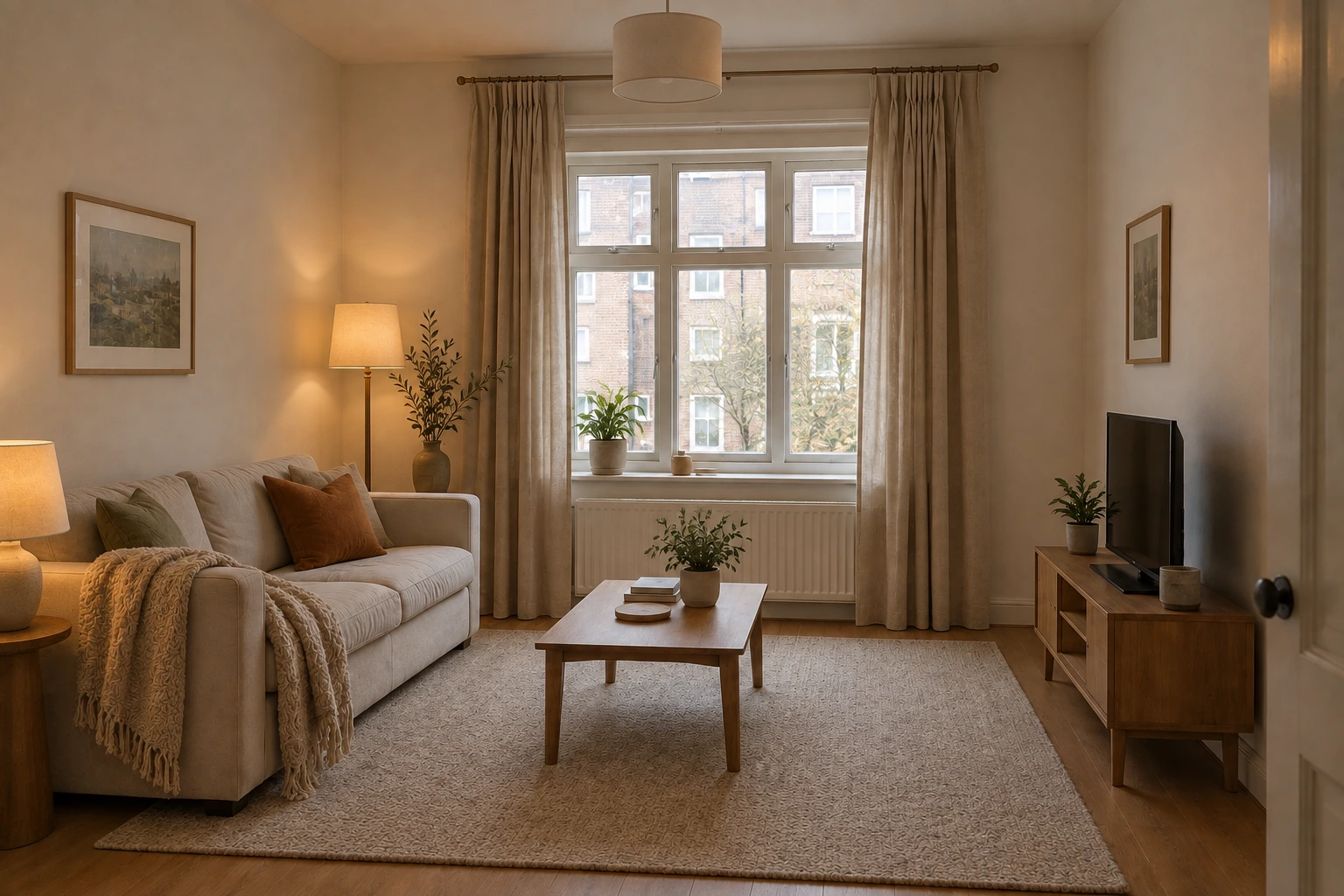 Art center · 57 to 60 in
Three layers of light
Rod · 4 to 6 in above
Screen center · 42 in
Hem · on the floor
Rug · front legs on
Art center · 57 to 60 in
Three layers of light
Rod · 4 to 6 in above
Screen center · 42 in
Hem · on the floor
Rug · front legs on
Some links on this page go to Amazon. As an Amazon Associate I earn from qualifying purchases, which is how the site pays for itself. How this works
Showing 30 of 30
The rug goes at least as wide as the sofa, and better 6 to 12 in wider on each side, with the front legs standing on it.
It connects the furniture instead of floating between it. If you can walk between your sofa and your rug without touching the rug, the rug is too small.
Renter noteThe washable low pile rug I link for every size in the guide arrives with a non-slip back already on it, so the 8 × 10 does not need a pad. Buy a pad for cushion on a hard floor, or skip it and keep the money.
18 in of bare floor around the rug in a large room. 8 to 10 in in a small one.
Less floor showing makes a small room read as one space. The 18 in version of this rule was written for rooms bigger than the one you rent, and following it in a narrow apartment is how you end up with a rug that reaches nothing.
Renter noteMark the whole footprint on the floor with painter’s tape and live with it for a day before you order forty pounds of rug. If you already own a roll of anything low tack, use that and skip this link.
A coffee table about two thirds the length of the sofa.
Proportion, and you can still reach the end cushions without climbing over anything.
Renter noteMeasure the sofa you own, not the one in the photograph. A 25 ft tape measure stands up on its own across a room, which matters when nobody is holding the other end. Any tape you already own does this job.
14 to 18 in between the sofa and the coffee table.
Close enough to reach a glass without standing up. Far enough to walk past without collecting a bruise on the same shin every time.
Renter noteNothing to buy. Sit down and put your feet flat: your shins are the tool. If your knees touch the table, it is too close, and no tape measure is going to talk you out of what your knees just said.
Coffee table top within 1 to 2 in of the seat cushion, above it or below it.
Elbows and glasses land where your arm already expects them to land.
Renter noteNothing to buy. Measure the cushion while you are sitting on it, because a cushion measured empty lies to you by a couple of inches.
1.5 to 2.5 times the screen diagonal. A 55 in screen wants 7 to 11 ft of room.
Closer than that and you watch pixels instead of the film. Further and you are squinting at subtitles.
Renter noteMost rentals have exactly one wall for a television and a lease that says no holes in it. A floor stand with a mount puts the center of the screen at 42 in, needs no drill, and comes with you. This floor stand with a mount takes a 55 in screen and swivels seventy degrees, which is the other half of the problem.
The center of the screen about 42 in from the floor.
That is seated eye level for most people on most sofas, and it is a lot lower than where a television usually ends up.
Renter noteSit on the sofa you own and have somebody measure your eye. A low mid century seat moves this number down and a firm armchair moves it up. The average is a starting point, not your living room.
36 in for a walkway. 24 in is the minimum where you squeeze between two pieces.
Two people pass each other at 36. One person turns sideways at 24. Below that you rearrange the room every time somebody visits.
Renter noteA laser measure does a whole apartment in ten minutes with nobody holding the other end of anything. A tape measure gives you the same numbers for a fraction of it, so this one is a convenience and I am not going to pretend otherwise.
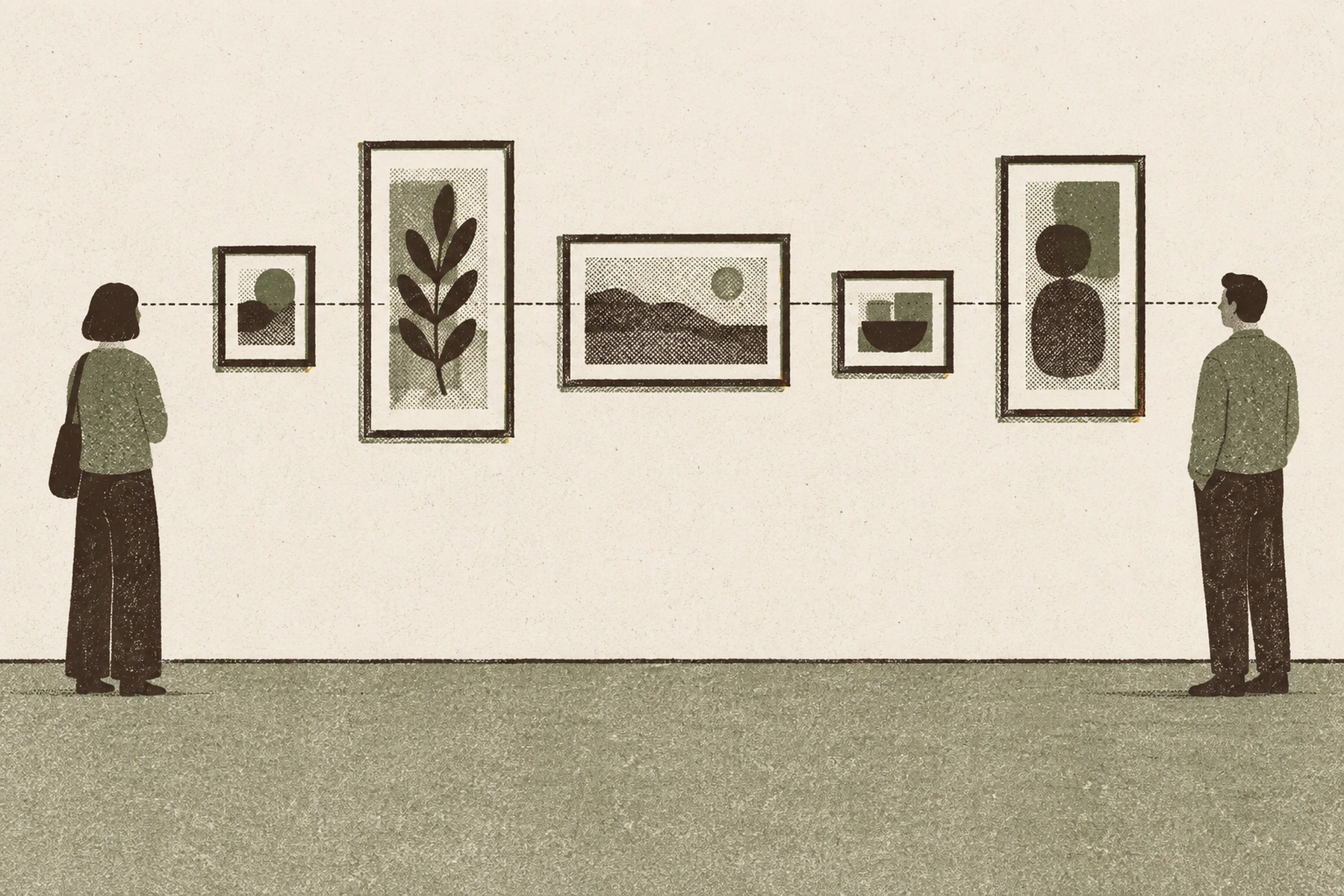
The center of the piece 57 to 60 in from the floor, as a starting point. Where you sit, go lower: about 50 to 54 in.
It sits between standing eye level (about 60 to 65 in) and seated eye level on a sofa (about 47 to 50 in). I could not find a museum rule that says 57. The Smithsonian’s guide centers wall labels at 54 in; two gallery guides I found say 58, or 58 or lower. It is also lower than where you were about to put it.
Renter noteCommand large picture hanging strips come 14 pairs to a pack and the pack is rated 15 lb, checked Sep 15, 2026. Weigh the frame on a kitchen scale first. Over 15 lb, skip the strips: that frame needs a nail and a conversation with your landlord.
6 to 8 in above the furniture, and two thirds to three quarters of its width. Same for a mirror over a console and for art over a headboard.
These are rules of thumb, not tested numbers: other guides say 8 to 10 in, or even 6 to 12. The part that holds up is the grouping: your brain reads things that sit close together as one piece. Hung a foot higher, they read as two unrelated objects that happen to share a wall.
Renter noteThe level app on your phone is free and good enough for one frame. For a whole wall, a 9 in magnetic torpedo level sits on the frame and leaves both your hands free, which is the only reason it beats the phone.
2 to 3 in between frames, with the whole group centered as one rectangle at 57 to 60 in, and lower above a sofa.
Tight gaps keep the group reading as one shape, which is grouping by proximity. One popular guide says 4 in, so treat the exact gap as taste. Wide spacing reads as frames that have drifted apart.
Renter noteCut a paper rectangle for every frame and stick them up with painter’s tape overnight. Wrapping paper or a grocery bag works the same and costs nothing. It is the only method I know that does not end in a wall of surplus holes.
Rod as close to the ceiling as the bracket allows, never less than 4 to 6 in above the frame. Brackets 4 to 10 in past the frame on each side.
The window reads taller and wider than it is, and the glass stays uncovered when the curtains are open. Hung on the frame itself, a curtain just makes the window smaller.
Renter noteKwik-Hang brackets tap into wooden window trim with a hammer: no drill, no holes in the wall. No trim, no brackets. Then it is a tension rod inside the frame, and you lose every inch of the lift this number is about.
The panels together add up to 2 to 2.5 times the window width.
That is what makes the folds. Flat panels look like bedsheets pinned over a window, because geometrically that is what they are.
Renter noteA 48 in window wants about 108 in of fabric across it, which is two panels and not one. A pair of 52 in wide linen panels covers that window and most others. Measure yours first: a wide window needs two pairs, and nobody tells you that until the curtains arrive.
Touching the floor, or half an inch above it. A 1 to 3 in puddle if you like the look.
Anything floating three inches up looks like a mistake, because it is the one length nobody chooses on purpose.
Renter noteMeasure from where the rod will sit down to the floor with a tape measure before you buy, because panels come in 84, 96 and 108 and nothing in between. If your number lands between two, buy long and hem with iron-on tape. Short cannot be fixed.
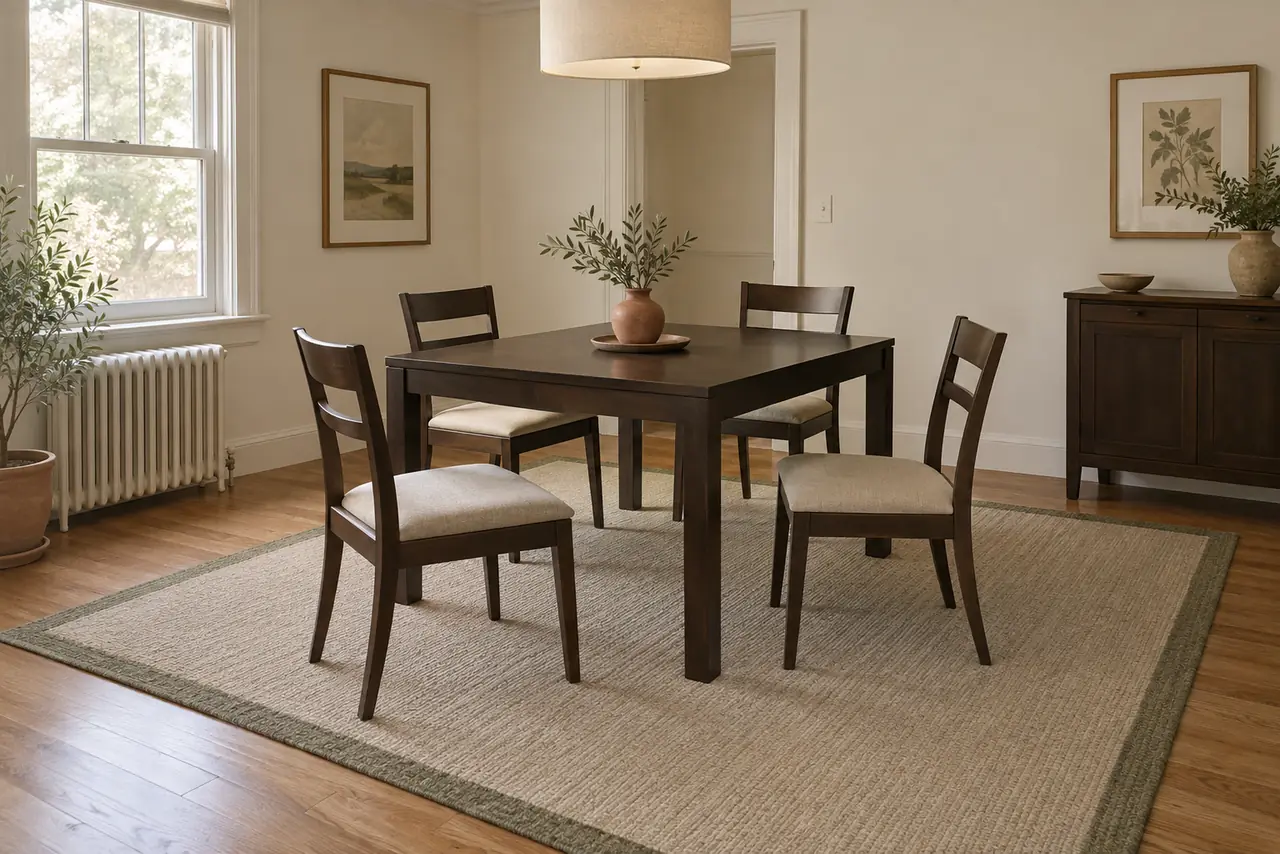
24 in of rug past the table edge on every side. Table plus 48.
A chair travels about two feet backwards when somebody stands up. If the back legs drop off the edge, the chair catches, the person stumbles, and everyone at the table looks up.
Renter noteA 36 by 60 table needs 84 by 108, so the 8 × 10 in low pile, because crumbs. If 24 in will not fit your nook, skip the rug: bare floor beats a small rug under a dining table every time.
36 in from the table edge to the wall. 42 to 48 in where somebody walks behind a seated person.
Someone always has to get past. Usually while carrying something hot.
Renter noteNothing to buy. If the room refuses to give you 36 on all four sides, give it to the side people walk down and take it from the side against the wall.
24 in of table edge per person. 30 is generous.
Elbows. Twenty four turns up twice in this room doing two completely different jobs, which is how you know nobody planned any of this.
Renter noteMeasure the chairs, not the table. Two 20 in chairs do not fit into 40 in of table edge once you count the gap you need between them to sit down.
Bottom of the pendant 30 to 36 in above the table, and half to two thirds of the table width across.
Light on the food and not in the eyes of the person sitting opposite you.
Renter noteNo ceiling box, or a box you are not allowed to touch: a 15 ft plug-in cord kit and a couple of swag hooks hang the same shade and unhook in a minute. The cord running to the wall is the price, and it is a fair one.

she checks every edge herself
18 to 24 in of rug past the sides and the foot, starting just below the nightstands.
Your feet land on something soft on the side you get out of. And nobody has ever seen the rug under a headboard, so stop paying for that part of it.
Renter noteA queen takes the 8 × 10 under the bottom two thirds. Or two runners, one each side, a 2 by 8 ft runner rug and a 2 by 6 ft runner rug, for a fraction of the price. They do not look as good. They are the same feet on the same cold morning.
Top of the nightstand level with the top of the mattress, give or take 2 in.
You reach for the glass in the dark without looking, and that is where your hand was already going.
Renter noteMeasure your mattress height with the bedding on it and buy to that number. A short table plus a stack of books is free, holds a lamp, and in the dark nobody can tell. If you would rather buy one, this narrow nightstand is 25 in tall and 10 in deep, so it clears the mattress and not the walkway.
Lamp about as tall as the nightstand, with the bottom of the shade at chin height when you sit up in bed. Dim it in the last hour before sleep.
Reading light on the page instead of a bulb pointed at the face of the person next to you.
Renter noteA pair of plug-in sconces hangs beside the bed and gives the nightstand back to the glass of water. They switch to 2700K, which is the next number down this page. If your nightstand already fits a lamp and a book, you do not need these.
24 in minimum on each side you get out of. 30 to 36 in is comfortable.
Making the bed needs that space, not just walking past it. Below 24 you shuffle sideways along the wall every morning of the lease.
Renter noteNothing to buy. In a small bedroom, push the bed against one wall and give both people the other side.

Bottom of the shade at or just below your seated eye level, often 38 to 42 in from the floor. Sit down and check that you cannot see the bulb. Side table within 2 in of the sofa arm.
You see the light and not the bulb. Two inches from the arm is where a mug goes down without anybody looking.
Renter noteSit where you read, hold a tape at the corner of your eye, and buy to that number. Lamps are sold by their own height, which tells you nothing until you add the table underneath. A 28 in table lamp with a white drum shade sits in the middle of the range, which is where I would start if your table is a normal height.
20 to 22 in on a normal sofa, 24 in on a deep sectional. Big at the back, small at the front.
Scale to the seat depth. An 18 in pillow on a deep sofa looks like a cushion that has lost its sofa.
Renter noteBuy covers and keep the inserts you own. A 22 in cover on a 20 in insert is the trick that makes a pillow look fed instead of tired, and covers go in the wash. These 22 in linen blend covers come as a pair in ivory.
24 to 26 in seat for a 36 in counter. 28 to 30 in for a 42 in bar. 26 to 30 in center to center.
Knees fit underneath and elbows do not touch. Measure the counter before you fall for a stool: counters and bars are six inches apart and look identical in photographs.
Renter noteBackless stools slide all the way under the counter and disappear, which in a rental kitchen is most of the argument. This backless saddle stool has the 26 in seat and comes as a pair, for counters 34 to 40 in high.
Hooks at 60 to 66 in, a second row at 40 to 48 in for bags and shorter people, and a console no deeper than 15 in in a narrow hall.
Coats clear the floor and you can still get past the console carrying a bag of shopping.
Renter noteCommand large utility hooks hold 5 lb each, checked Sep 15, 2026, and come off the wall with a straight pull on the tab. Five pounds is one coat. A wet winter coat and a backpack is two hooks, or the back of the door.
Sixty percent dominant, thirty secondary, ten accent.
It is the reason a room with three colors in it still looks calm. Plenty of decorators repeat it, and almost nobody can tell you where it came from.
Renter noteYou do not own the walls, so your sixty is whatever beige you were given. That puts the thirty and the ten into things you own: the sofa, a rug and curtains for the thirty, something the size of a chair for the ten, with pillow covers repeating it. See the pillow number for the size that works.
2700K, or dimmable 2200 to 3000K, for evening rooms. 3000 to 4000K in kitchens and baths, by taste. Brighter, cooler light, 4000K and up, for daytime desk work.
Warm light carries less of the wake-up blue per lumen, and it is what most homes grew up with. For faces, pick a bulb with a CRI of 90 or more. At night, brightness matters more than kelvin.
Renter noteThe 2700K bulbs I link are 800 lumens, 60 W replacement, eight to a pack, checked Sep 15, 2026. Do one room before you do the whole apartment. Kelvin looks different against beige rental walls than it does in a box on a shelf.
Add up the lumens on your bulbs: 10 to 20 per square foot in a living room, 20 to 40 in a kitchen. Then a reading light of its own, and under-cabinet light for the counters.
It is the usual rule of thumb, counted in bulb lumens, not in light that lands on the page. That is why reading and chopping still want a light of their own.
Renter noteA 12 by 14 living room is 168 square feet, so 1,700 to 3,400 lumens, which is two to four ordinary bulbs spread around the room. Count what you already own before you buy more: most rooms need the light moved, not multiplied.
Ambient, task and accent. At least three sources at different heights. The one in the middle of the ceiling works the day shift.
One ceiling light drops its shadows straight down, under every face. Several softer sources soften those shadows and put light on the walls, which research links to rooms feeling bigger and more relaxing. The idea goes back to the lighting designer Richard Kelly, in 1952.
Renter noteA pair of plug-in sconces counts as two of the three with no wiring and no holes, and cord clips take the cable down the wall so it reads as a fixture. You do not need three new lamps: a sconce, the lamp you own and something small on a shelf is already three.
Guess the number
Five of them, before you scroll back up
Pick one and I will tell you the number and why it is that number. Nothing is timed and nothing is held against you. Getting it wrong is how it sticks.
-
Living room
You sit down with a glass in your hand and the coffee table is already in front of you. Later you have to walk past it in the dark.
How much gap between the sofa and the table?
14 to 18 in
Close enough to reach a glass without standing up. Far enough to walk past without collecting a bruise on the same shin every time.
-
Walls
One frame, one empty wall, no furniture under it. You are holding it up while somebody stands back and says a little higher.
Where does the center of the picture go?
57 to 60 in
A starting point between where your eyes are standing up and where they are sitting down, a little closer to standing. It is also lower than where the person standing back is telling you to put it.
-
Windows
A standard rental window with wooden trim, and a rod that is still in the box.
How high above the frame does the rod go?
4 to 6 in
That is the minimum. Better: as close to the ceiling as the bracket allows, with the brackets 4 to 10 in past the frame on each side. The window reads taller and wider, and the glass stays uncovered when the curtains are open.
-
Dining room
Four chairs around a table, all of it on a rug, and somebody pushes their chair back to stand up.
How far past the table edge does the rug reach?
24 in
Table plus 48. A chair travels about two feet backwards when somebody stands up, and if the back legs drop off the edge the chair catches and the person stumbles.
-
Bedroom
You are buying a nightstand for a bed you already own, and the listing offers three heights.
Where does the top of it land?
Levelgive or take 2 in
You reach for the glass in the dark without looking, and level with the mattress is where your hand was already going. Measure yours with the bedding on it.
Five questions · answered 0 of 5
Where these come from
Who decided 57 inches
Nobody I could find. I looked for the museum rule that says 57 and did not find one: the Smithsonian’s guide centers wall labels at 54 in, and two gallery guides I found say 58, or 58 or lower. Standing, an average adult’s eyes are about 62 in from the floor; on a sofa, about 48 to 50 in. Fifty seven lands between the two, which is why it works as a starting point, and why it goes lower in a room where you sit.
The rest are interior design conventions, and the useful thing about them is that they agree with each other. Ask five designers how far a dining rug should reach and you get 24 inches five times. Ask about the gap between a sofa and a coffee table and you get 14 to 18 from all of them. That agreement is the evidence. Where they do not agree, I show you the range instead of picking a favorite and pretending it is a law.
Two rules about the ranges. In a small room, the low end wins: an apartment that leaves 18 inches of bare floor on every side ends up with a rug too narrow to touch the furniture. And when any of this conflicts with the one rule that always wins, that rule wins. The furniture has to connect to the rug.
Every number has a drawing next to it because a measurement you can see is a measurement you will remember at the store. Type your room into the calculator if you would rather have the answer than the theory.

she does not do the measuring either
Stay
The numbers, on one page
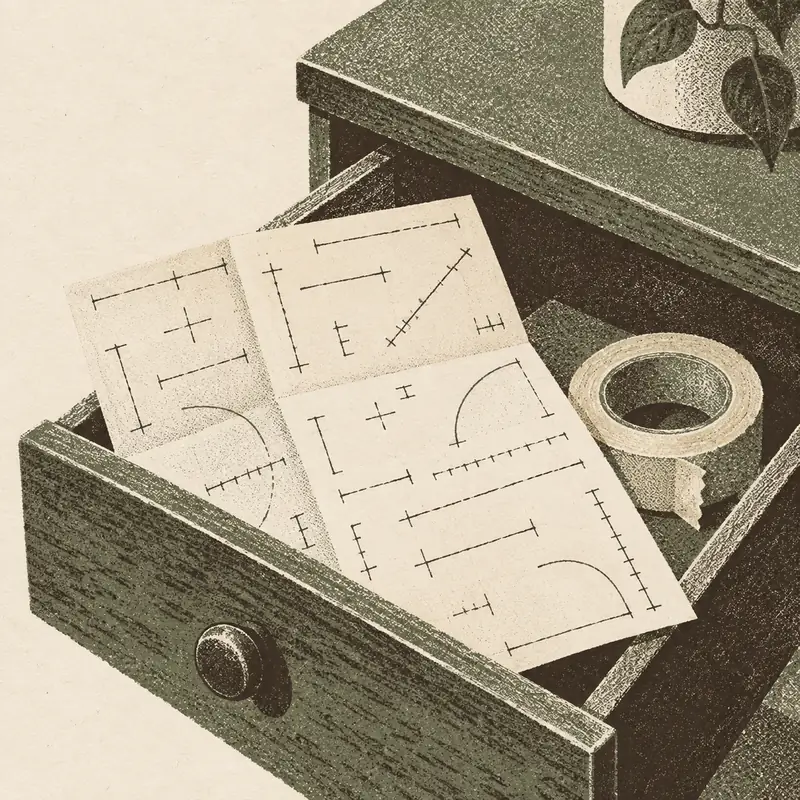
One sheet, thirty numbers, thirty drawings, no links to anything. Print it and tape it inside a cabinet door, because that is where it belongs. Then the next time you are holding a drill you do not own, the number is on the wall in front of you.
New guides go up on Pinterest the day they are finished. Nothing else, and no daily anything: Lease and Layer on Pinterest
Where next