A picture ledge on adhesive strips holds more than you think, and less than the pack says.
Forty minutes, no anchors, one number that decides whether it is still up at Christmas.

By NoraRenter DIY · Checked Sep 19, 2026
Some links on this page go to Amazon. As an Amazon Associate I earn from qualifying purchases, which is how the site pays for itself. How this works

Quick change 1 of 3 rolls
Renter DIY · deposit risk: none · drill: no
The kit
Five things, and one of them is in a drawer
Every link here was opened on Sep 19, 2026. You get the name, the variant, why it is that one, and what is wrong with it.
The concession first, because it costs me the sale: if there is already a sideboard against that wall, you may not need a ledge. Lean the frames on the furniture. From the sofa it looks identical and it costs nothing. The ledge earns its keep on a bare wall, or over a piece too shallow to lean on.
-
AZSKY 24 in floating wall ledge shelf, set of two
24 in · set of 2 · woodBuy the pair even if you planned on one: a second ledge 14 in above the first turns a shelf into a wall of art. And 24 in sits over most sideboards without running past the ends.
The catchThe listing publishes no weight capacity, which is a problem for a shelf and the reason step one exists. The screws and wall plugs in the box are packaging.
See it above Opens Amazon in a new tab
-
Command assorted picture hanging strips, 15 lb and 10 lb
16 pairs · mixed 15 lb and 10 lb · whiteBuy the mixed pack: you do not know how many pairs you need until the load is on the scale. Sixteen covers two ledges with a real margin and leaves spares.
The catchThe number on the front is per pair, tested on a flat picture. On a ledge it is not what you get. Halve it in your head first.
See the 16 pair assortment on Amazon Opens Amazon in a new tab -
Command small picture hanging strips, 5 lb
18 pairs · 5 lb per pair · whiteThese are for the frames, not the ledge. A leaning frame slides when a door slams, and one small pair at its top back corner stops that without stopping you swapping it later.
The catchSkip these if every frame is heavier than five pounds. At that weight nothing is sliding and the strip is only costing you money.
See the 5 lb pairs on Amazon Opens Amazon in a new tab
-
Empire 9 in magnetic torpedo level
9 in · magnetic · three vialsShort enough to sit on the ledge once it is up, which is the check that matters. A long level tells you about the wall; this one tells you whether a frame will walk to one end.
Already have this?The level app on your phone is accurate enough for a two foot shelf if you lay it flat rather than on edge.
See the 9 in torpedo level on Amazon Opens Amazon in a new tab -
Americanflat black frames with mat, 11 × 14
11 × 14 in · pack of 2 · matted to 8 × 10The back row. A mat makes a cheap print read as a picture instead of a poster, and at 11 in wide these lean back without tipping past the front lip.
The catchGlass, not acrylic, so these are the frames that push you into the next strip rating. If the arithmetic is tight, the same size in acrylic weighs about half.
See the 11 × 14 pair on Amazon Opens Amazon in a new tab
The front row is the row you should not be buying for: a postcard, a small mirror, a book face out.
What goes wrong
The pack rating is for a flat picture. A ledge is a lever.
A strip is tested with the load pressed flat against the wall, straight down the face of the adhesive. A ledge sticks out two or three inches, so every frame leaning on it pulls the top edge of the strip away from the paint instead of down it. Adhesive gives up in that direction first, and never on day one: it goes three weeks later, at night, when the room has warmed up, and it takes the glass with it.
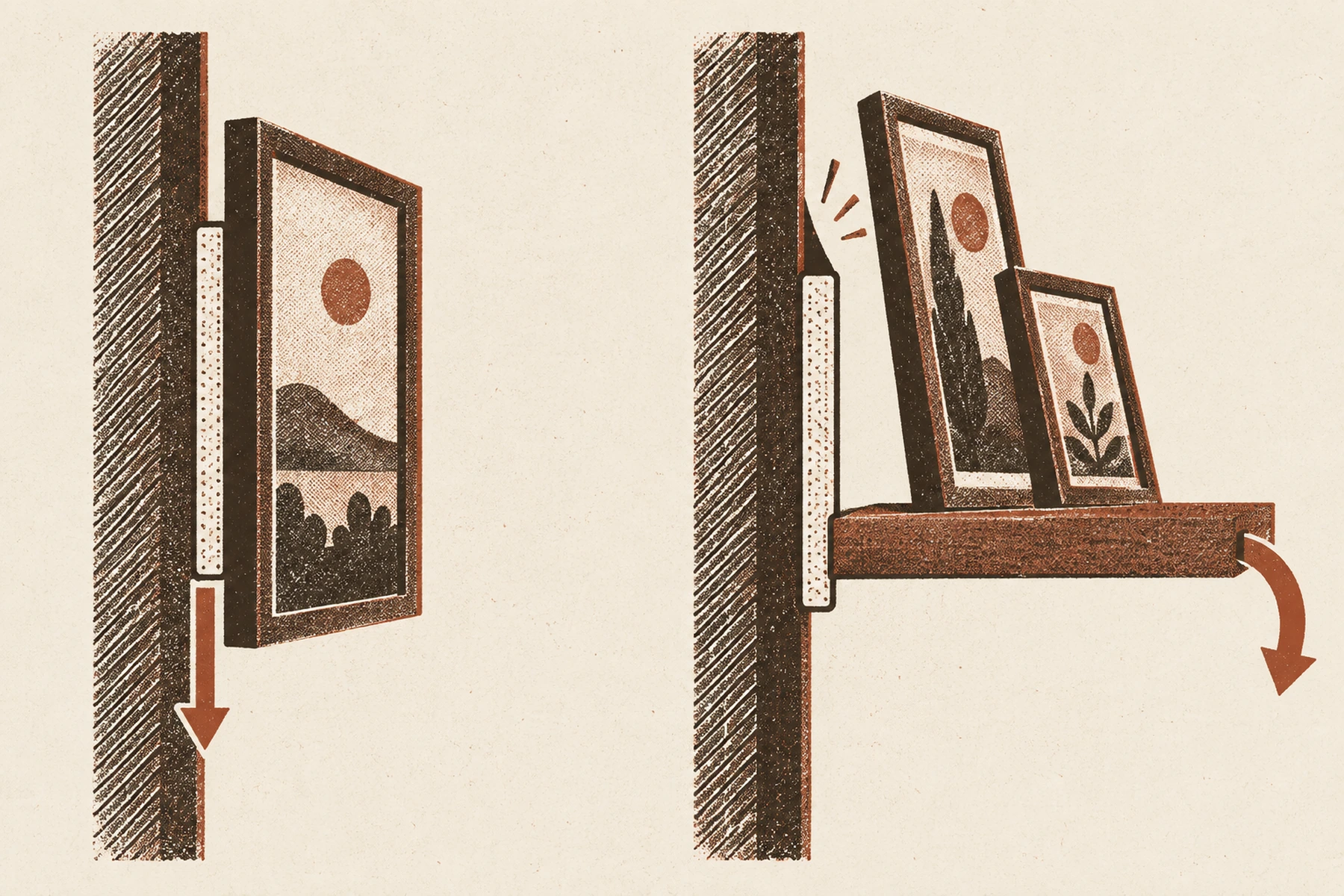
The fix is one line of arithmetic. Weigh the ledge with the frames on it, then buy strips rated for at least twice that. Not the same, twice. A 3 lb ledge carrying 5 lb of frames wants 16 lb of rating spread over four pairs, not one pair with 16 printed on the box.

the box says one thing and the wall does another
Five steps
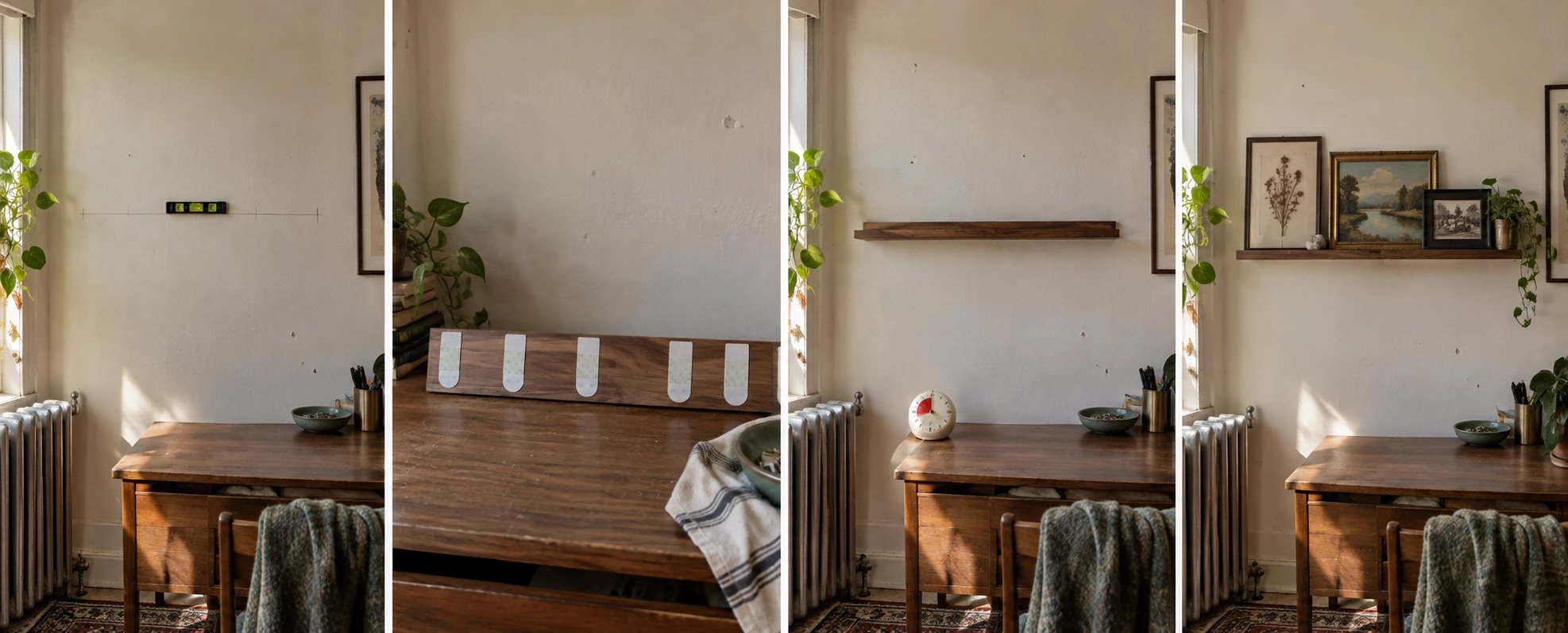
Weigh it, halve the label, then touch the wall
Do the arithmetic on the floor. The ledge goes up only once it has been weighed.
-
01
Weigh the loaded ledge, then double the number
Stack the ledge and every frame on the scale together and write it down; glass is heavy and a matted frame has two sheets of it. Then add strip pairs until their combined rating is at least twice that, spaced along the back edge. Four pairs of a 10 lb strip beats one pair of a 20 lb strip.
What goes wrongWeighing the ledge alone, then matching the rating exactly. That is the number where it holds for two weeks.
-
02
Set the height off the furniture, not off the floor
Off the furniture: the sideboard sets the number. The underside goes 9 in above a sideboard. Higher and the gap reads as a mistake; lower and no lamp fits under it. On a bare wall, aim for the middle of the frames at 57 in.
What goes wrongCentering the ledge on the wall. Center it on the furniture underneath it.
-
03
Wipe the wall with rubbing alcohol and draw a level line
Not a damp cloth, not soap. Alcohol, and let it dry. Then pencil a line along a level and mark where each pair lands. Uncleaned paint carries a film that adhesive grips for about a month.
What goes wrongTrusting the line of the ceiling. Rental ceilings are not level, and your eye will follow them.
-
04
Press each strip for thirty seconds, then leave the wall alone for an hour
Click the pairs together, press the ledge onto the line, pull it off, and press each strip to the wall on its own for thirty seconds. Hang the ledge back on empty and go away for an hour.
What goes wrongLoading it the same minute. The adhesive is still soft for the first hour and it will creep.
-
05
Load it back to front, heaviest at the wall
Big frame at the back against the wall, smaller ones overlapping in front by a third. Heavy at the back is not a style rule; it keeps the load close to the wall instead of out on the lever arm.
What goes wrongStanding a heavy frame at the front lip. That one frame can double the pull on the strips.

put the heavy one at the front. see what happens
The number
Three frames, a bathroom scale, and ninety seconds
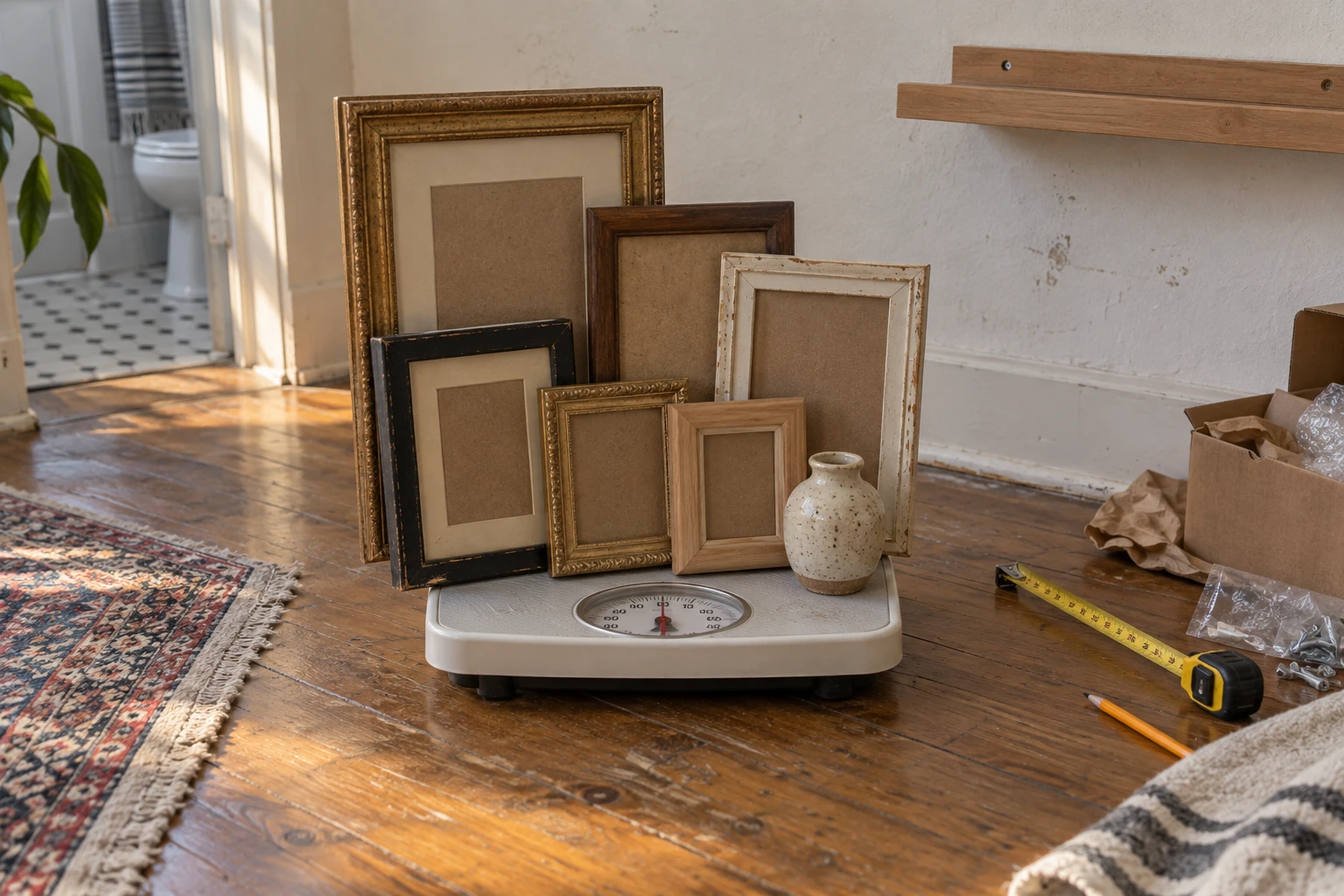
Most scales will not register a three pound ledge alone. Stand on it holding everything, note the number, put it down, stand on it again, subtract.
- Materials$25 to 60
- Takes40 minutes
- To undo5 min
- Deposit riskNone
- DrillNo
- LadderNo
The low end is a ledge and one pack of strips. The high end adds four frames you did not already own.
How to undo it
5 minEmpty it first. Every time, without exception.
The order is not negotiable: the moment the first strip lets go, the ledge is a diving board with your frames on it.
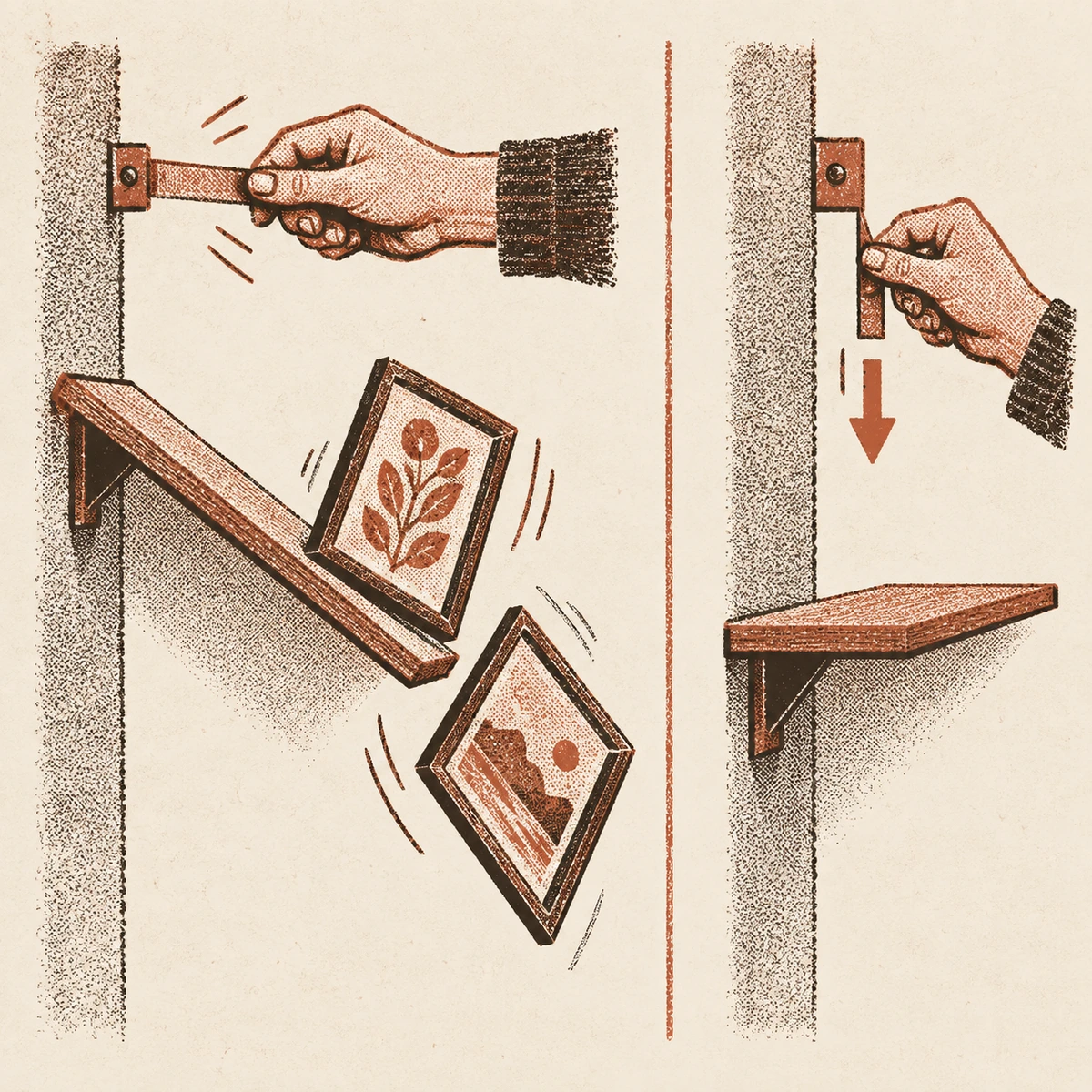
- 01Take every frame off and put them on the floor, not on the sofa
- 02Lift the empty ledge off its strips and set it down
- 03Pull each adhesive tab straight down the wall, slowly. Down, never out.
What is left on the wall: nothing, if you pulled down and took your time. A tab pulled outward takes a coin of paint with it. If one snaps off inside, warm the strip with a hair dryer and work dental floss behind it. In a building from before 1978, old paint can carry lead, so do not let a strip take paint at all: stand the frames on a shelf or a dresser instead.
The ledge goes in the box with the frames wrapped in a towel, and up again in the next place in forty minutes. The only thing you buy twice is the strips.
Quick answers
Five questions, and the honest answers
Yes, on adhesive picture hanging strips, as long as you weigh the ledge with its frames on it first and buy strips rated for at least twice that load.
Treat the printed rating as half. A ledge levers the top edge of the strip away from the paint instead of pressing it flat. Spread the load over more pairs rather than buying one heavier pair.
About nine inches from the top of the furniture to the underside of the ledge. On a bare wall, set it so the middle of the frames lands near 57 inches off the floor instead.
Not if you pull the tab straight down the wall, slowly, and only after the ledge is empty. Pulling outward is what tears paint.
About forty minutes of work. Weighing, marking and sticking take fifteen of them; then the wall wants an hour alone before anything is loaded onto it.

Doing it this weekend?
Tick what you still need
Leave anything that is already in a drawer. The rest goes to your Amazon cart in one tap.
Amazon shows you the cart first; nothing is bought until you check out there. As an Amazon Associate I earn from qualifying purchases.
Where next