What size lamp do you need?

By NoraLease and Layer · Checked Sep 15, 2026
Some links on this page go to Amazon. As an Amazon Associate I earn from qualifying purchases, which is how the site pays for itself. How this works

In this guide
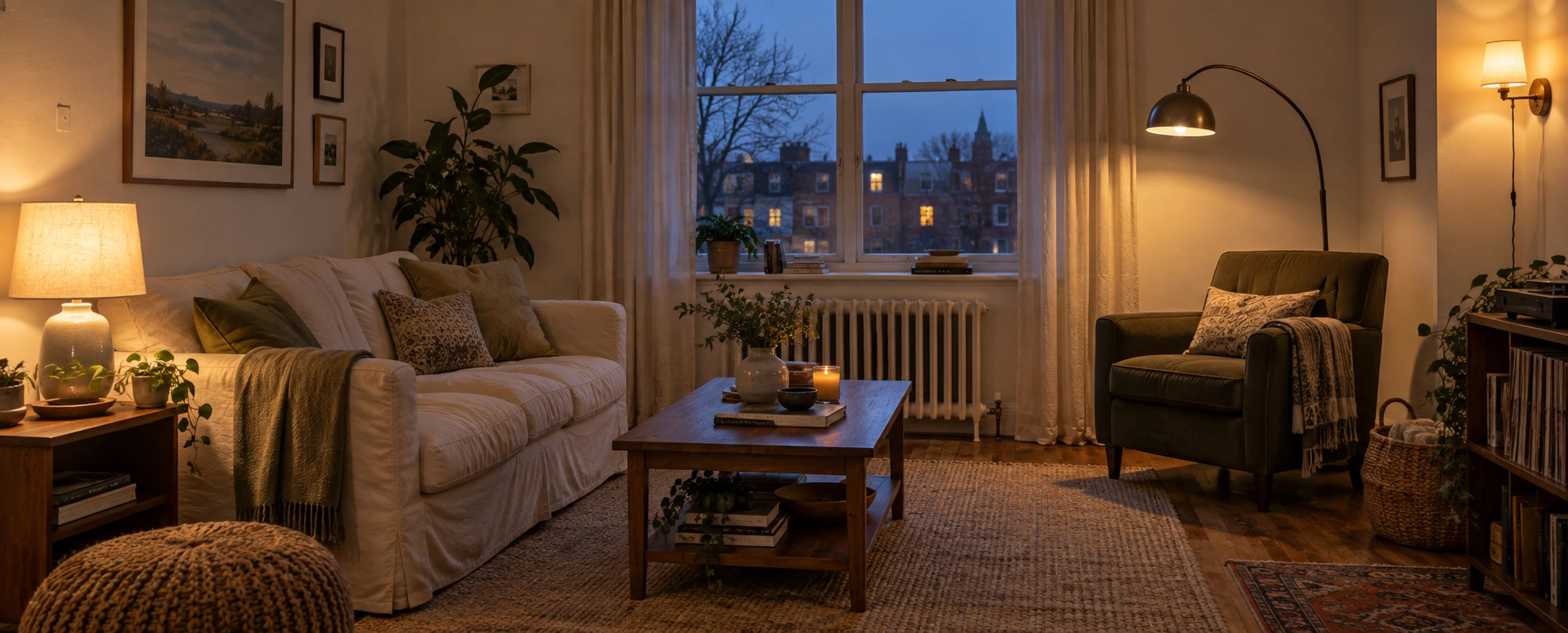
Almost every lamp problem is a height problem.
You liked it in the photo. It arrived, you plugged it in, and the room looked worse than it did with nothing there. Not wrong, exactly. Off. Like the furniture is standing on its toes.
Two things are usually happening. Either you are looking straight into the bulb from the sofa, which no amount of warm light will forgive, or the shade is sitting a foot above your head and throwing everything at the ceiling. Both are height. Neither is taste, and no one on the internet will tell you which one you have, because they are busy telling you about finishes.
So here is the whole page in one sentence: the bottom edge of the shade belongs at or just below your eye level when you are sitting down. For a table lamp that usually means about 40 in off the floor, but seats vary, so you check it from your own chair. Everything below is that one rule, applied to the four places a lamp goes.
Lamps are tall and miserable to repack. I would rather you measured twice than shipped one back, so there is a test at the end of the floor lamp section that costs nothing and takes four minutes. If you have done the rug measuring already, you know the drill: get the tape measure out.
The rule that covers almost everything
40 inThe bottom of the shade, at or just below your eyes, sitting down
Sit in the chair you collapse into at night; a dining chair will give you the wrong number. The bottom edge of the shade belongs at your eye level or a little under it. The number you will see everywhere is about 40 in off the floor, and it is a designer’s rule of thumb, not a study: seats vary. Sitting up straight on a standard sofa, your eyes are nearer 48 to 50 in, and they drop when you slouch. So the shade bottom wants to land somewhere between about 40 in and your own eye line. Above it is the one direction that does not work.
Why that line and not some other one: when the bottom of the shade sits above your eyes, you see the lit inside of the shade and the bulb, which is glare, and glare is the reason a room reads as harsh even when the bulb is warm. Sit down and check: if you can see the bulb, the shade is too high. Much lower, and the light lands on your knees instead of the page.
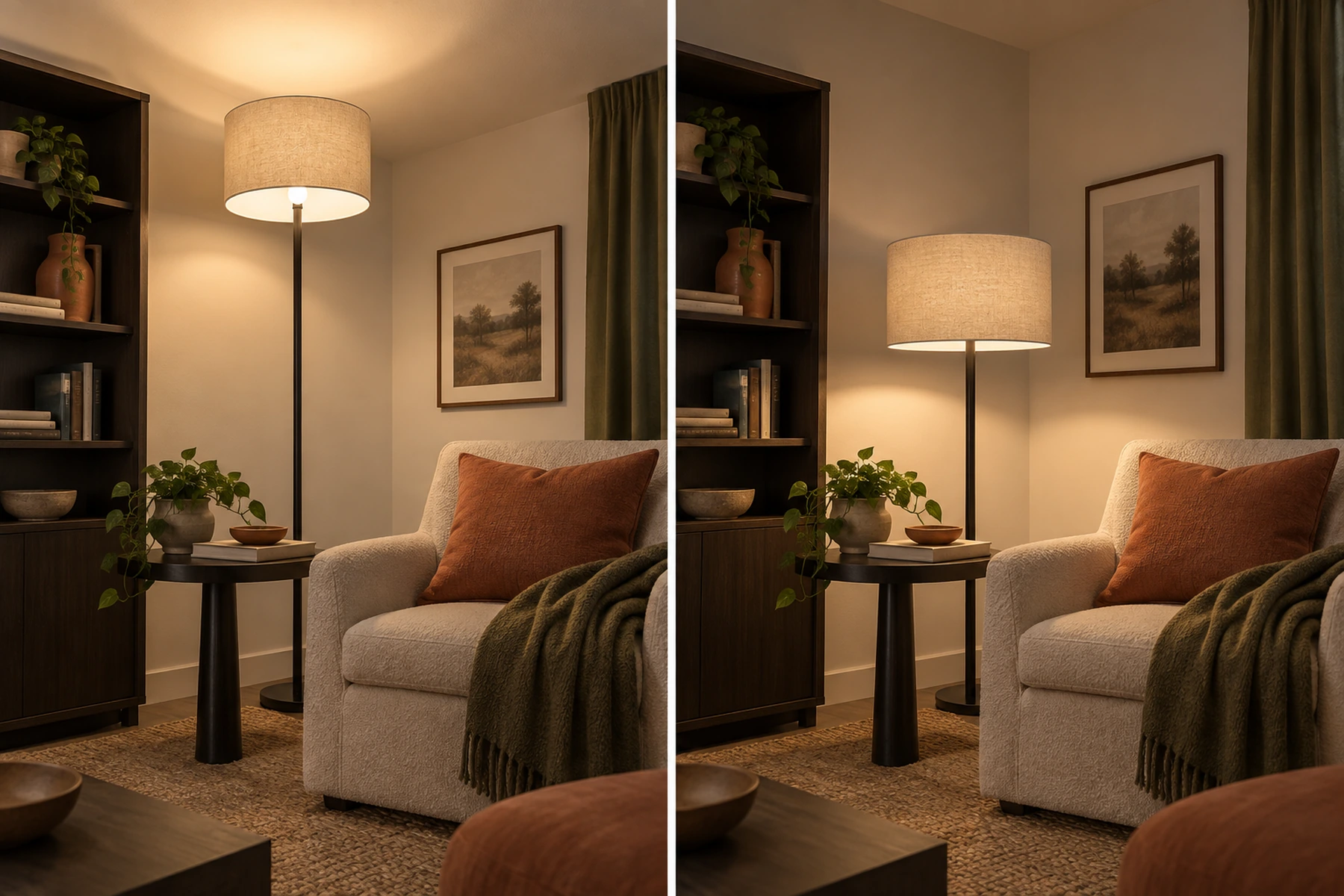
The numbers below run this rule through four situations, so you do not have to do the arithmetic standing in a store aisle with your phone out.
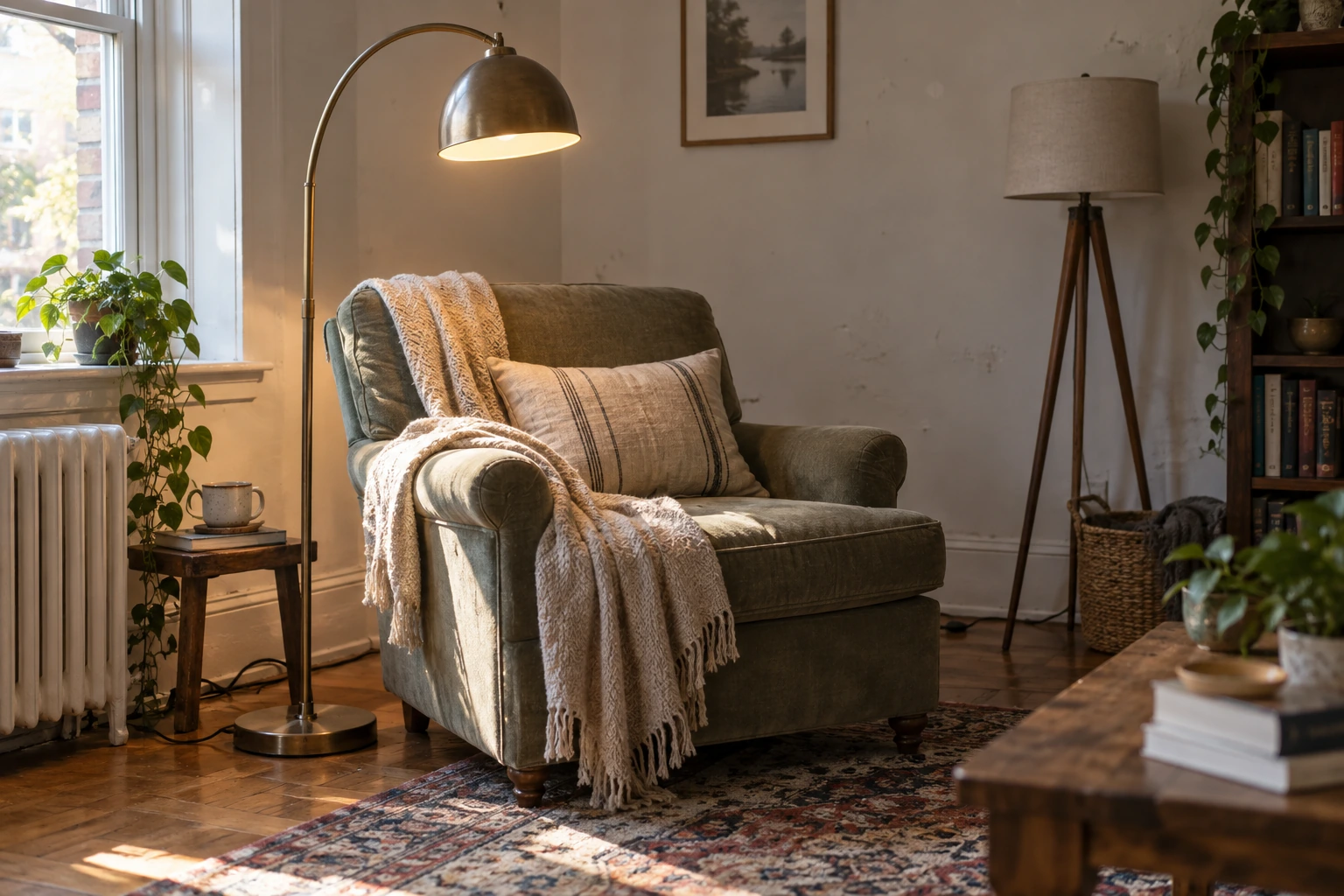
Floor lamps
58 to 64 inTall enough to clear your head, short enough to light your book
Total height, floor to the top of the shade. With a standard 10 to 14 in shade, that puts the bottom edge somewhere around 46 to 52 in: well under your eyes when you stand, and at or just below them when you sit up in a sofa or an armchair, where eyes land near 48 to 50 in. At 64 in you are at the top of the range: fine next to a high backed chair, too tall beside a low mid century one, where the light will sail over you.
Arc lamps play by a different rule, because the shade is not over the base. The pole goes beside the chair and the shade hangs 18 in in front of your shoulder, the way a reading light in a hotel does. Which brings us to the thing everyone gets backwards.
Put the base behind the chair and you sit in your own shadow. The light hits the back of your head, the page stays dark, and you will keep reaching for your phone torch without ever working out why. Beside the arm, 3 in of daylight between the shade and the upholstery so nobody knocks it over standing up, and the light arrives from the side, where your eyes expect it.
Five corners, five lamps
One row per situation, because you shop from the room you already have. Heights are floor to the top of the shade.
Look at some lamp examples according to shapes
Four minutes of painter’s tape instead of a return
Lamps are the worst thing to ship back. Tall box, fragile shade, and the return label never covers what it costs you in an afternoon. So do this before you order.
- 01Sit in the chair and have someone mark the wall behind it at your eye level
- 02Measure that mark. Sitting up on a sofa it is often 48 to 50 in; a low chair or a slouch brings it down. The shade bottom goes at that mark or a little under it.
- 03Add the shade height from the listing. For a floor lamp, the total should land between 58 in and 64 in.
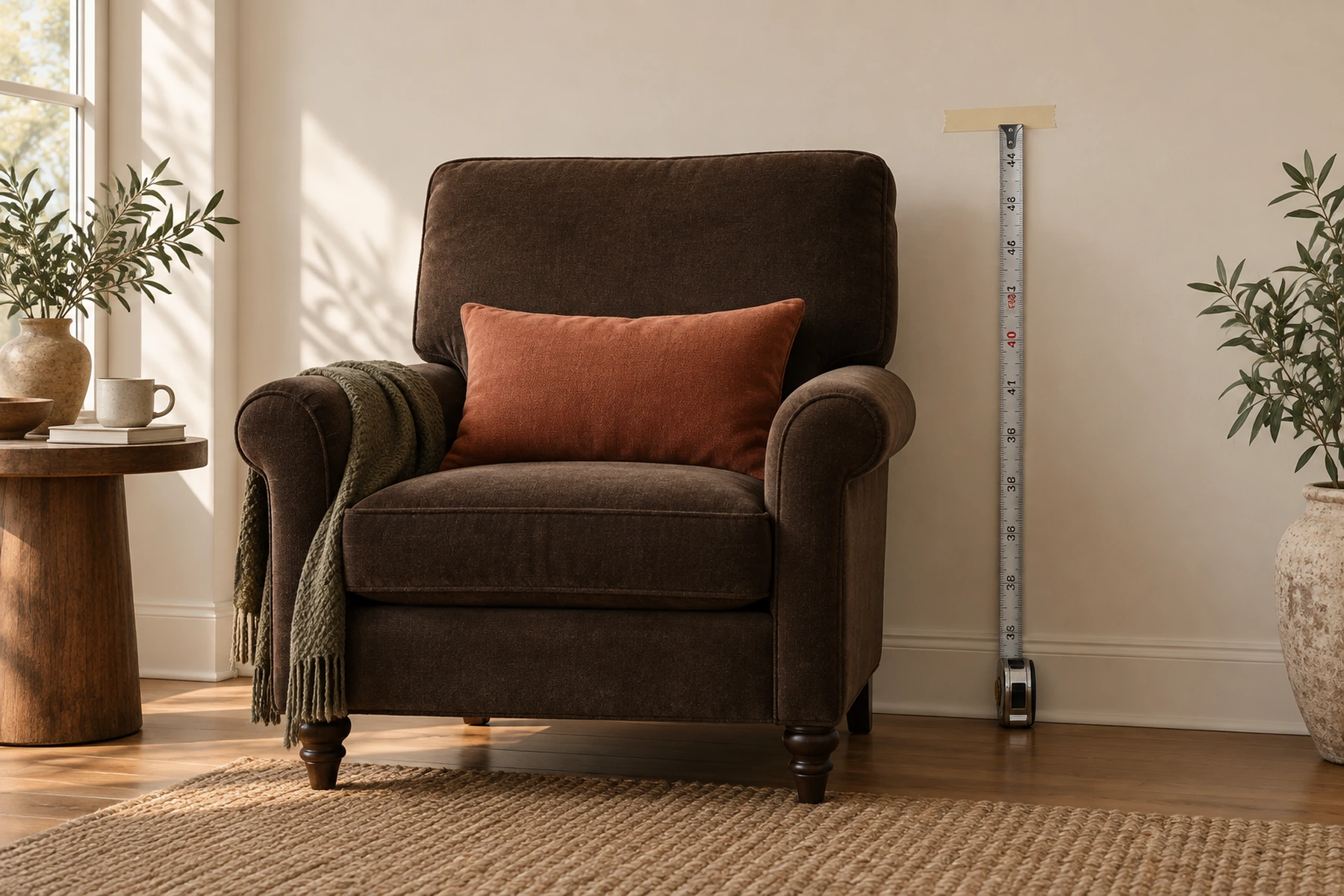
If your chair sits low, take the low end of every range on this page and stop worrying about it. If you are tall and your chair is tall, take the high end.
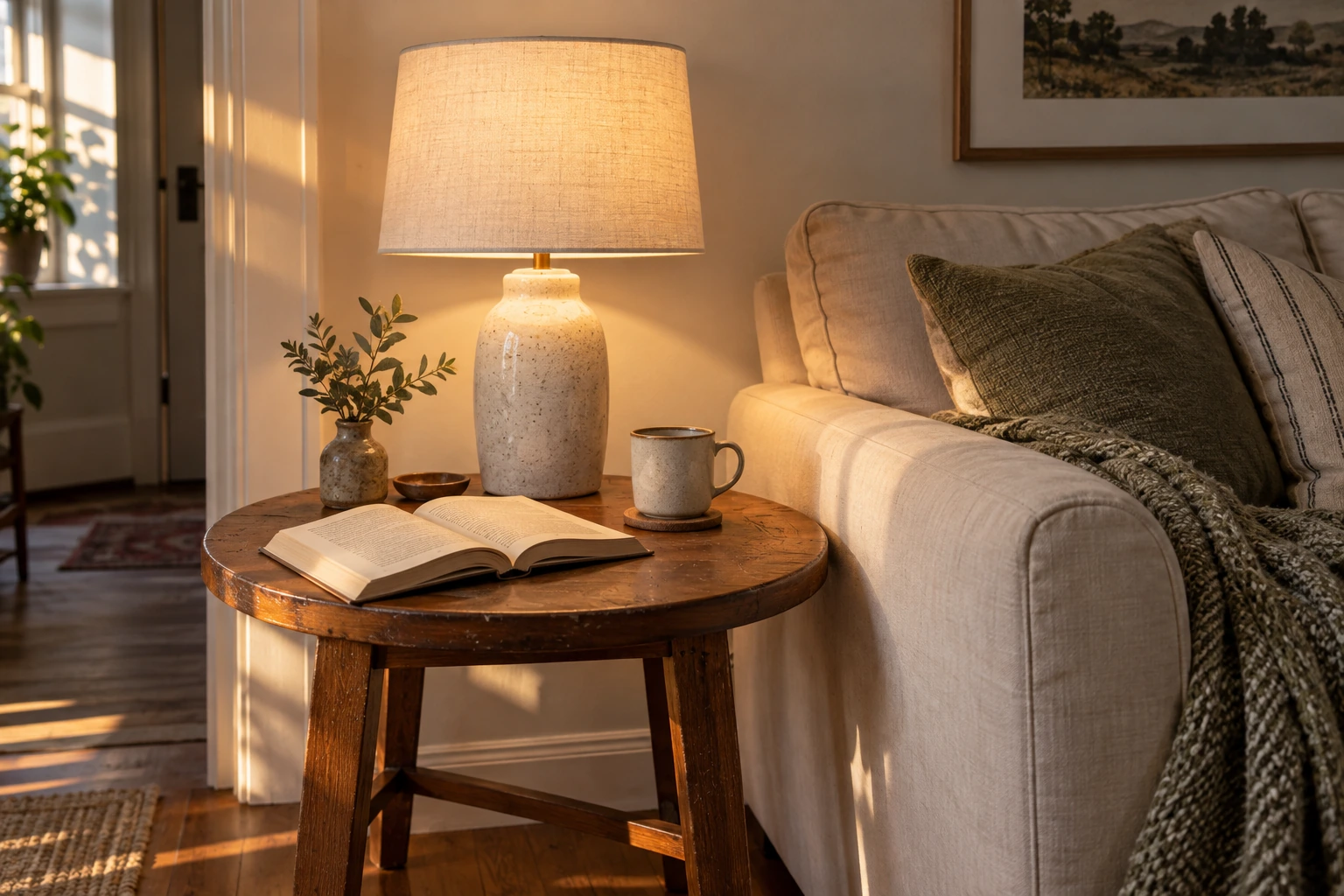
Table lamps
The lamp is half the measurement. The table is the other half.
This is where most people go wrong, and it is not their fault: the listing sells you a lamp height and says nothing about what it is standing on. A 30 in lamp is beautiful on a low table and ridiculous on a tall one, and the lamp is identical in both photos.
table height + lamp height = 52 to 58"
Land in that range and, with a normal shade, the bottom of the shade sits around 40 in: at or just below your eyes from the sofa, which is the rule from the top of the page. Standard side tables run 24 to 26 in, which is why 26 to 30 in is the answer you see everywhere. It is the right answer for a standard table and the wrong answer for yours if your table is a stack of books.
| Your table | The lamp | Why | Link |
|---|---|---|---|
| 24 to 26 in | If you buy one 29 in ceramic urn, linen drum shade | Tops out around 54 in, so the shade bottom lands near 40. The default for a sofa side table, and a ceramic base is heavy enough that the cord cannot drag it off. | See the 29 in ceramic lampMore lamps from 24 to 30 in, below |
| 27 to 30 in | 25 in pair | Taller table, shorter lamp, same eye line. Two matching lamps flanking a sofa or a bed is the cheapest thing that makes a rental look deliberate. | See the 25 in pair |
| Console, 30 to 34 in | A 21 in accent lamp | You stand at a console, you never sit at one. Standing eye level is near 60 in, so a tall lamp on a tall table puts the bulb straight in the face of whoever walks in. This one is 21 in, ceramic, and blue and white, which is a commitment rather than a neutral. | See the 21 in accent lamp |
| No side table | An arc floor lamp, not a table lamp | Do not buy a table so you can buy a lamp. Hang the light over the chair instead and keep the floor. | See the arc lamps |
Two width rules, and then you are done
The shade has to be wider than the widest part of the base, or the lamp looks like it is wearing a hat two sizes small. And it has to be narrower than the table, or it hangs over the edge and you will catch it with your elbow every time you put a mug down. Between those two numbers, anything works.
And one that breaks the rule on purpose. A lamp on a dresser or a shelf is there to be looked at, so the eye line stops mattering and the shade can be the whole point. A 16 in stained glass candlestick throws color rather than light, which is the right trade in a corner you walk past and the wrong one beside a reading chair.
One more from the numbers: the side table itself belongs within 2 in of the sofa arm. Further than that and you are leaning to reach the switch, which is how a good lamp ends up never being turned on.
Table lamps from 24 to 30 in
Every one is between 24 in and 30 in with a pale fabric shade, so on a standard side table the shade bottom lands near the eye line. Measured from each listing, not from a photo. Each sketch stands the lamp on a 25 in table; the dashed line is 40 in.
-
See it on Amazon
Ashley Shavon
26.25 in · ceramic, textured neutral glaze · off-white fabric drum shade · three way switchThe plain one, in the good sense. A three way switch means a low setting for the evening without buying a dimmer. The catch: the bulb is not included, and the textured glaze reads earthy rather than crisp.
-
See it on Amazon
Helene
26 in · cream glazed ceramic · tan linen tapered drum, 10.5 in tallA linen shade close to the third of the lamp that the shade section asks for, and an 8 ft cord, which reaches an outlet behind the sofa. The catch: the switch is on the socket, so you reach up under the shade to turn it on.
-
See it on Amazon
PoKat, a pair
27 in · textured ceramic · linen shade · set of twoTwo matching lamps for both ends of a sofa, at a height that suits a 24 to 26 in table. The catch: they arrive in pieces to put together, and the washed, distressed finish is farmhouse; it will not pass as modern.
-
See it on Amazon
CINSARY, a pair
27 in · white ceramic double gourd, brass foot · linen shade · set of two, bulbs includedThe gourd shape is the classic table lamp, and two of them flank a bed or a sofa without arguing with anything. The catch: the shade comes flat and you assemble it, and the built in USB ports put a phone cord on show if you use them.
-
See it on Amazon
Fairlee, brass candlestick
26 in · metal, antique brass finish · off-white fabric tapered drum, 10 in tallThe one that is not ceramic. A candlestick base is slim, about 6 in across, so it leaves room on a small side table for a mug and a book. The catch: it weighs about 3 lb, so a tugged cord can move it, and the switch is on the socket.
-
See it on Amazon
JUNNAI
24.5 in · white ceramic · white slub fabric shade · three way dimmableThe short end of the range, so it is the one for a table that runs a little tall, near 28 in. The catch: at this height on a low table, the shade bottom sits under 40 in and the light lands lower.
Isabella, ivory ceramic jar
28 in · ceramic, about 10 lb · fabric shade, 10.5 in tall · Regency Hill
About twice the weight of most single lamps in this list, which is what keeps it upright when a cord gets tugged, and a glazed ginger jar is a shape that still looks right two apartments from now. The shade is 16 in across the bottom, wider than the base, as the width rule asks. For a standard 24 to 26 in side table. The catch: the shade is polyester, not linen, and the switch is on the socket.

Wider than the base. Narrower than the table. She lost interest at "wider."
Bedside
As tall as the nightstand, give or take two inches
Bedside is the easiest one and the one people overthink. Measure the nightstand. Buy a lamp about that tall. Done.
The reason it works: sitting up in bed with a book, your eyes are lower than they are in a chair, so the whole assembly drops. What you are aiming for is the bottom edge of the shade at chin height when you sit up. A lamp roughly as tall as the table it stands on puts it there almost every time, which is a rare piece of luck in this business.
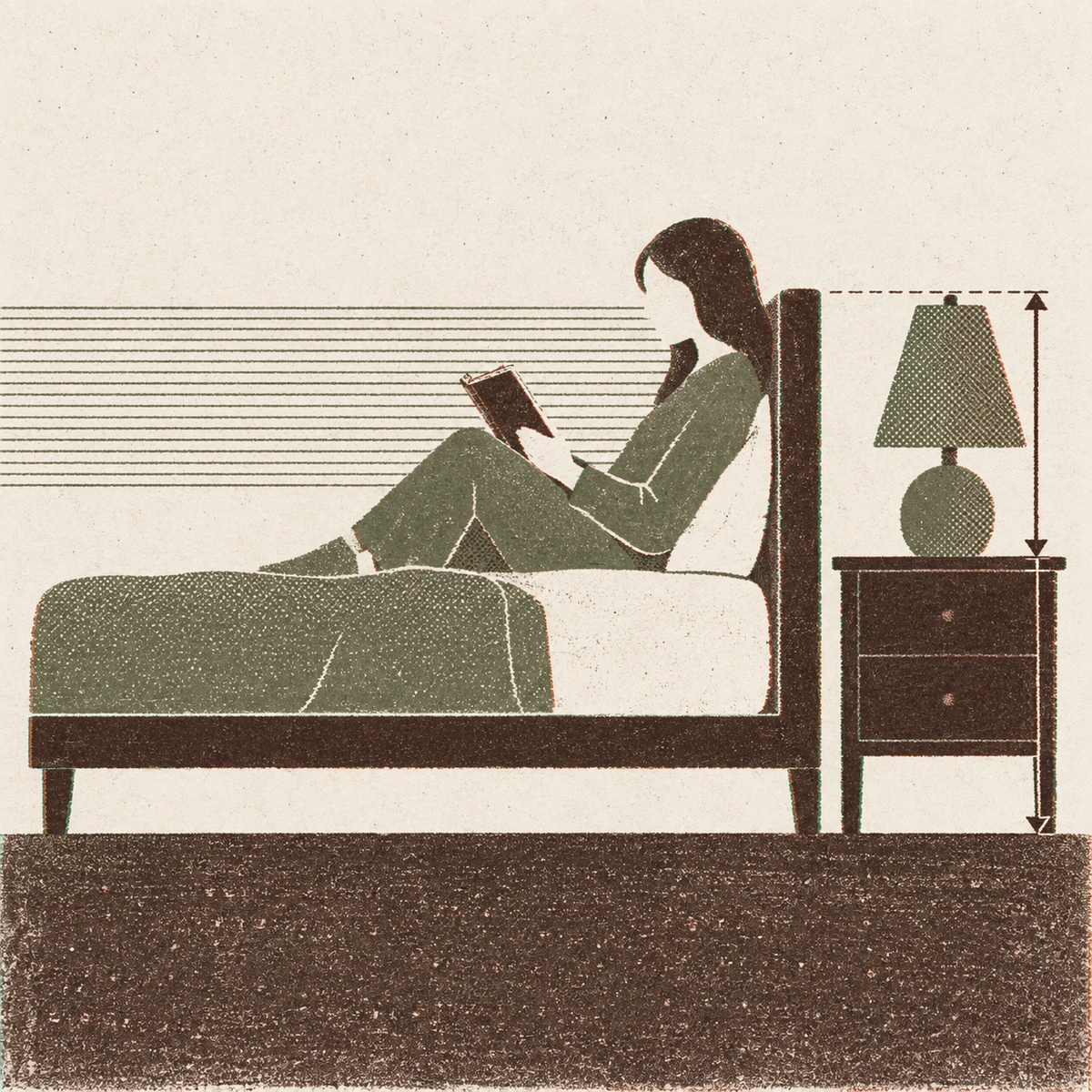
The other thing nobody mentions: put the switch where your hand already goes. A lamp with a switch on the cord, halfway down behind the bed, is a lamp you will leave on. Pull chains and base switches beat cord switches for anything you turn off lying down.
The shade
1/3The shade is a third of the lamp, and the reason it looks wrong
Measure the whole lamp, floor to top. The shade should be roughly a third of that. A 30 in table lamp wants a shade around 10 in tall; a 60 in floor lamp wants one closer to 18 in. Go much shorter and the socket and the harp peek out underneath, which is the visual equivalent of a hem coming down.
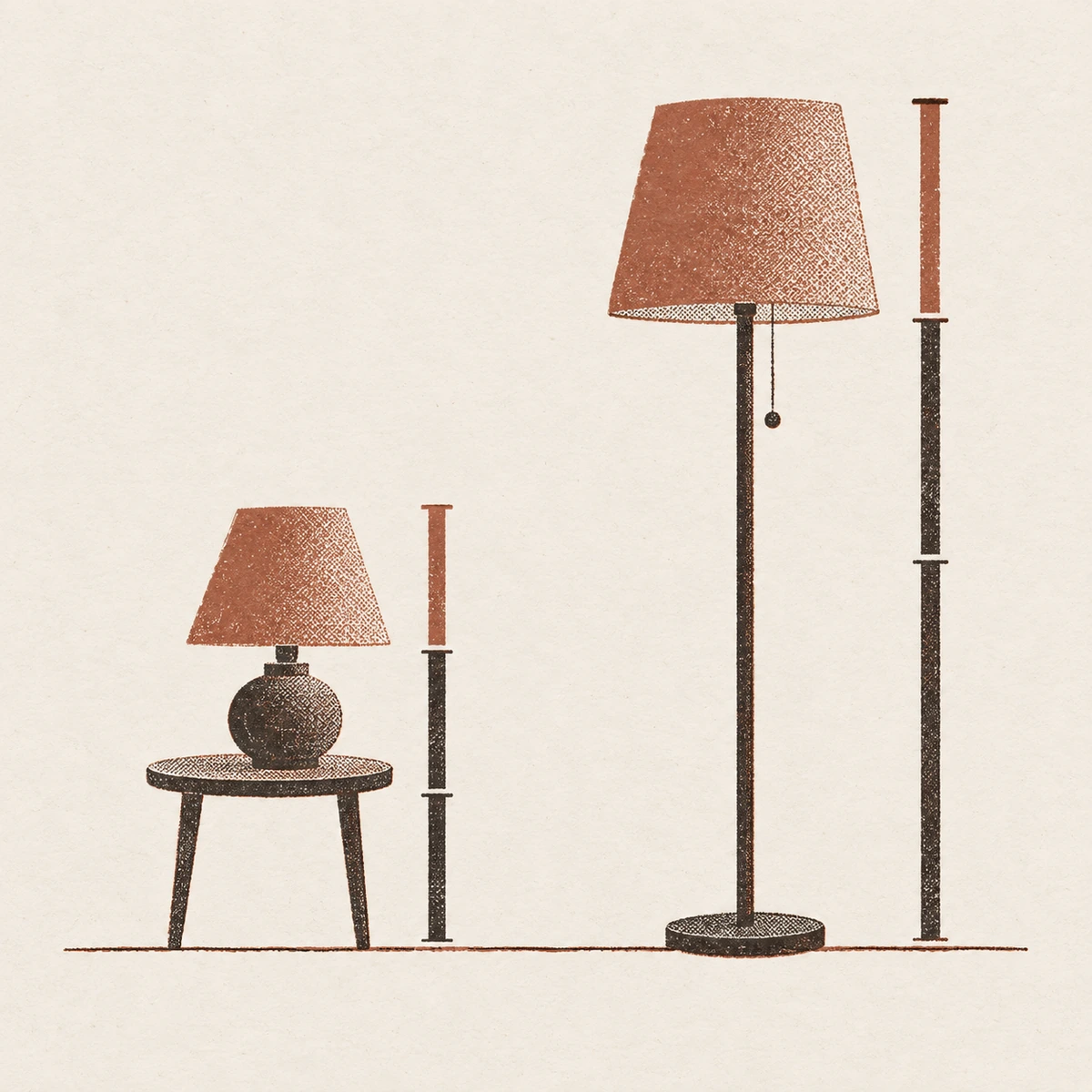
Wider than the base, narrower than the table
The bottom of the shade wants to be at least as wide as the widest part of the base, and ideally a little wider. Then check the table: if the shade hangs over the edge, your elbow will find it. Those two numbers are the whole width decision, and neither of them is on the listing photo, so measure your base with a ruler across its belly before you order.
Pale to read. Dark for mood. They are not interchangeable.
Listings show you the shade’s color and never tell you what it does to the light. A pale linen or white shade lets light through the fabric, so the whole lamp glows and you get usable light all around it. That is the reading lamp. A dark or opaque shade blocks the sides and pushes light straight up and down in two cones, which looks wonderful in a photograph and will not light a paperback.
So: pale shades where you read, dark shades where you want a pool of light and some drama. If you own one lamp in a room, make it pale. If you own four, one of them can be moody.
Eight patterns, for the lamp in a room that can afford to be moody rather than the one you read by. Drawn for this page: the square is the pattern, not a photograph of the made up shade. Under each one is what its listing declares.
-
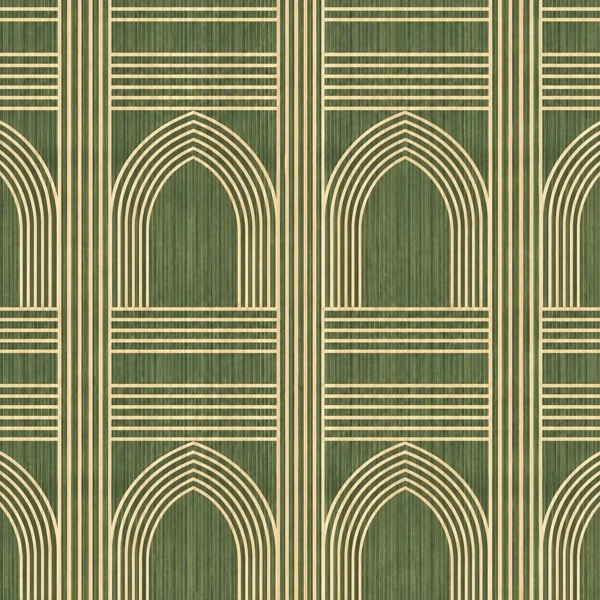
Bamboo, geometric green, 11.8 × 9 in
See it on Amazon -

Bamboo, Asian decorative art, 11.8 × 9 in
See it on Amazon -
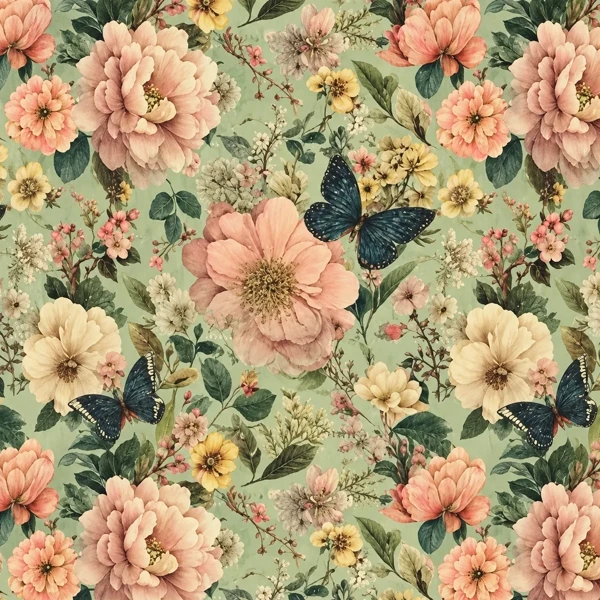
Bamboo, floral and butterfly, 11.8 × 9 in
See it on Amazon -
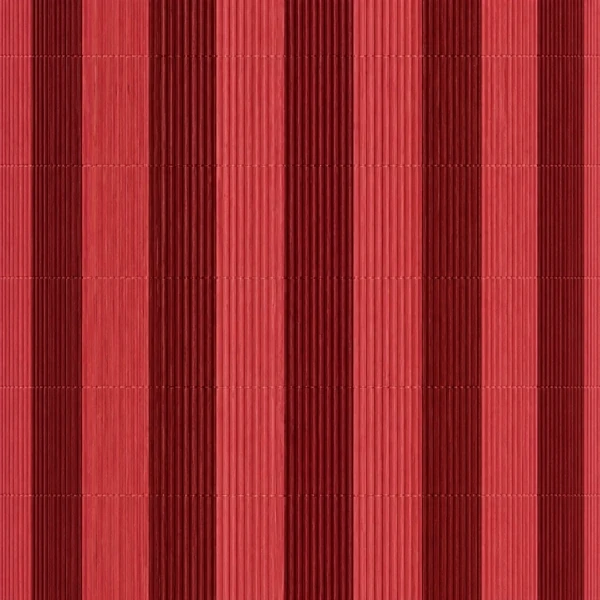
Bamboo, red stripes, minimalist, 11.8 × 9 in
See it on Amazon -

Alucset, trees, metal etching, 12 × 14 × 10 in
See it on Amazon -

Alucset, sky stars, spider fitter, 12 × 14 × 10 in
See it on Amazon -
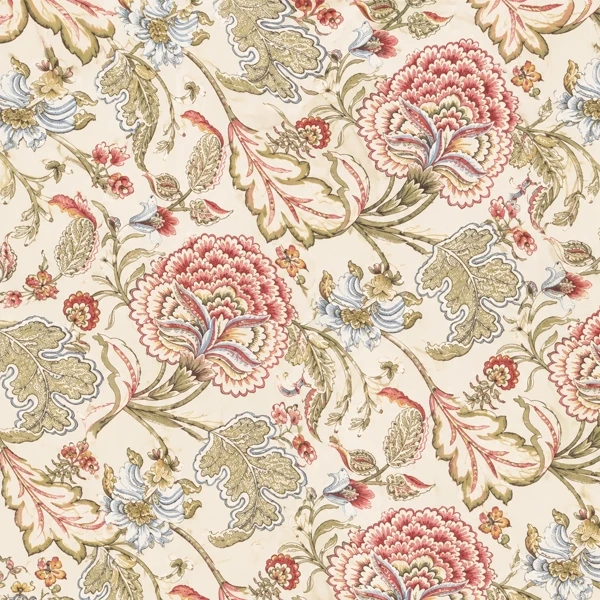
GO&SO, multicolored floral, 13 × 10 in, sold in twos
See it on Amazon -
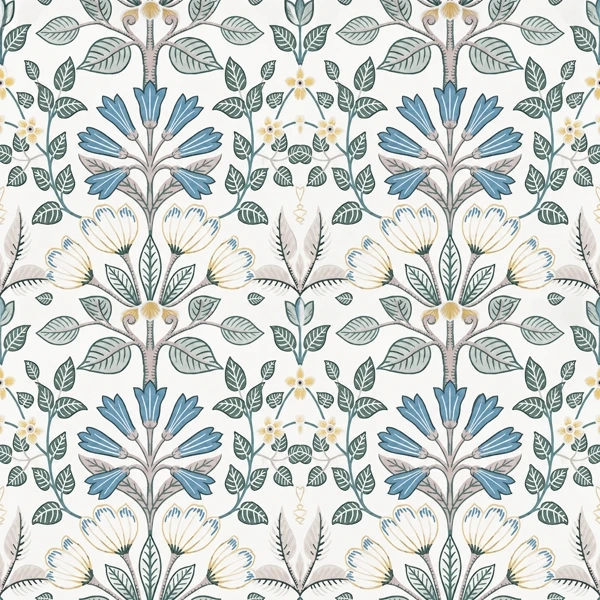
GO&SO, blue and green floral, 13 × 10 in, sold in twos
See it on Amazon
The bulb
You can buy the right lamp and still get this wrong in the last ten seconds
Two numbers on the box. One is the color of the light, the other is how much of it there is. Nobody reads either, everybody blames the lamp.
2700K, and almost nothing else
2700K, or dimmable 2200 to 3000K, in living rooms and bedrooms. 3000 to 4000K in kitchens and bathrooms, by taste, where you want to see what you are doing. 4000K and up is for daytime desk work. How skin looks depends more on the bulb’s spectrum than on its kelvin, so for faces look for a CRI of 90 or more. At night, brightness matters more than kelvin.
Ten to twenty lumens per square foot
A 12 by 14 living room is 168 square feet, so it wants somewhere between 1,700 and 3,400 lumens of light in total, split across three fixtures rather than blasted out of one. Kitchens want about double. Watts tell you what the bulb costs to run; lumens tell you what you get.
- 450 lmMood. A small lamp on a console you will never read by. Lovely, and not light.
- 800 lmThe default, and the old 60 watt bulb everyone remembers. This is your reading lamp.
- 1,600 lmA floor lamp asked to handle an entire corner on its own, or anything in a kitchen.
- 2,700 lmA whole living room, and never from one bulb. Three or four sources adding up.
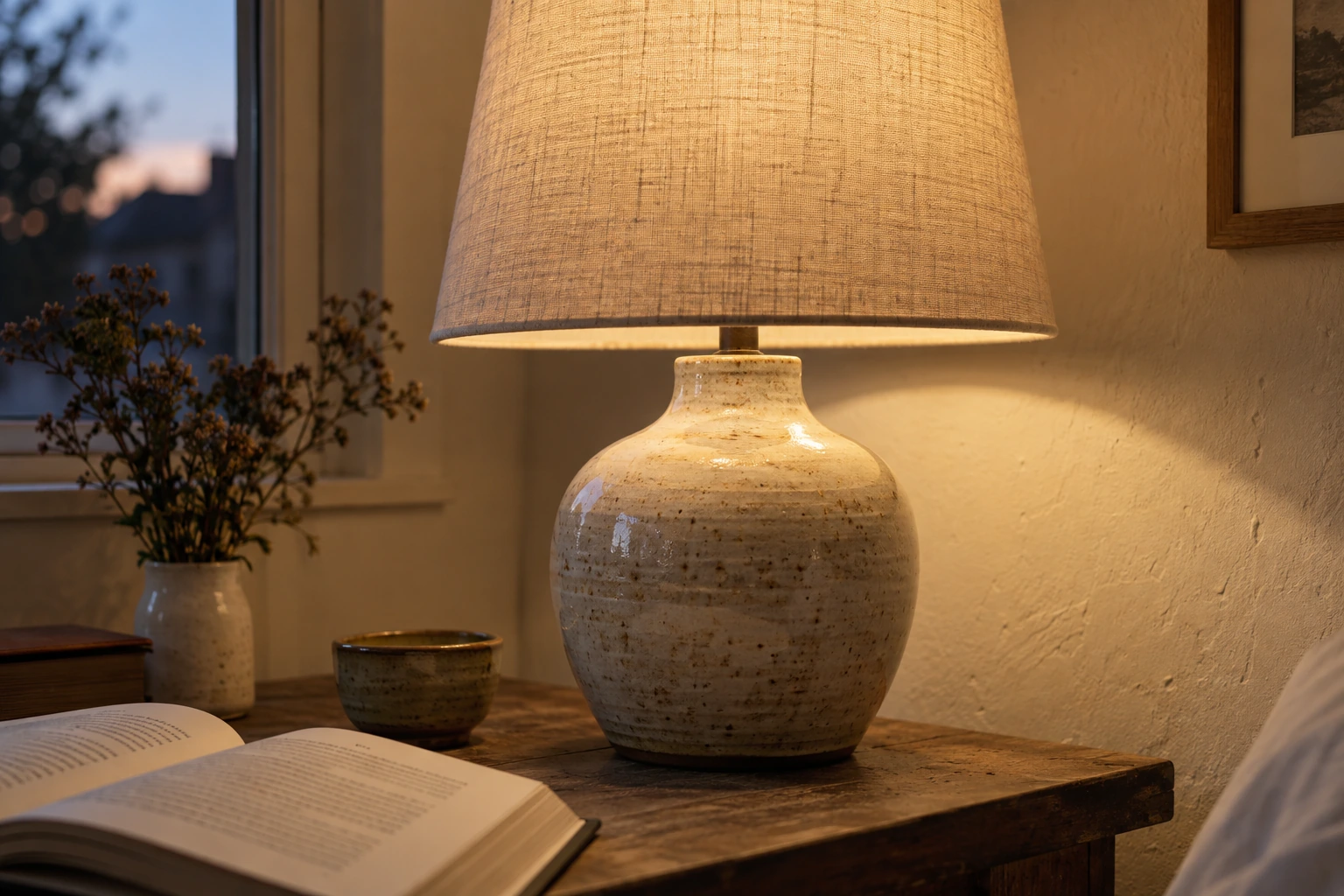
Warm, dimmable, sold in eights
2700K, 800 lumens, E26. Eight of them, which is most of an apartment in one box. Buying bulbs two at a time is how a place ends up with four different colors of white.
The catch: dimmable is only worth paying for if something in the circuit can dim.
The plain six pack
Same 2700K, same E26, fewer of them. Buy these if you have three lamps and no plans.
The catch: nothing clever happens here. It is a bulb, and that is the point.
The cord dimmer is the renter fix: it plugs into the outlet, the lamp plugs into it, and you get a slider on the floor by your foot. No wiring, no wall plate, no conversation with a landlord. It is the smallest thing on this page and the one that changes how late a room stays usable, because a lamp you can turn down is a lamp you leave on at eleven at night.
See the plug-in dimmer Opens Amazon in a new tab
One lamp is not a lighting plan. It is a lamp.
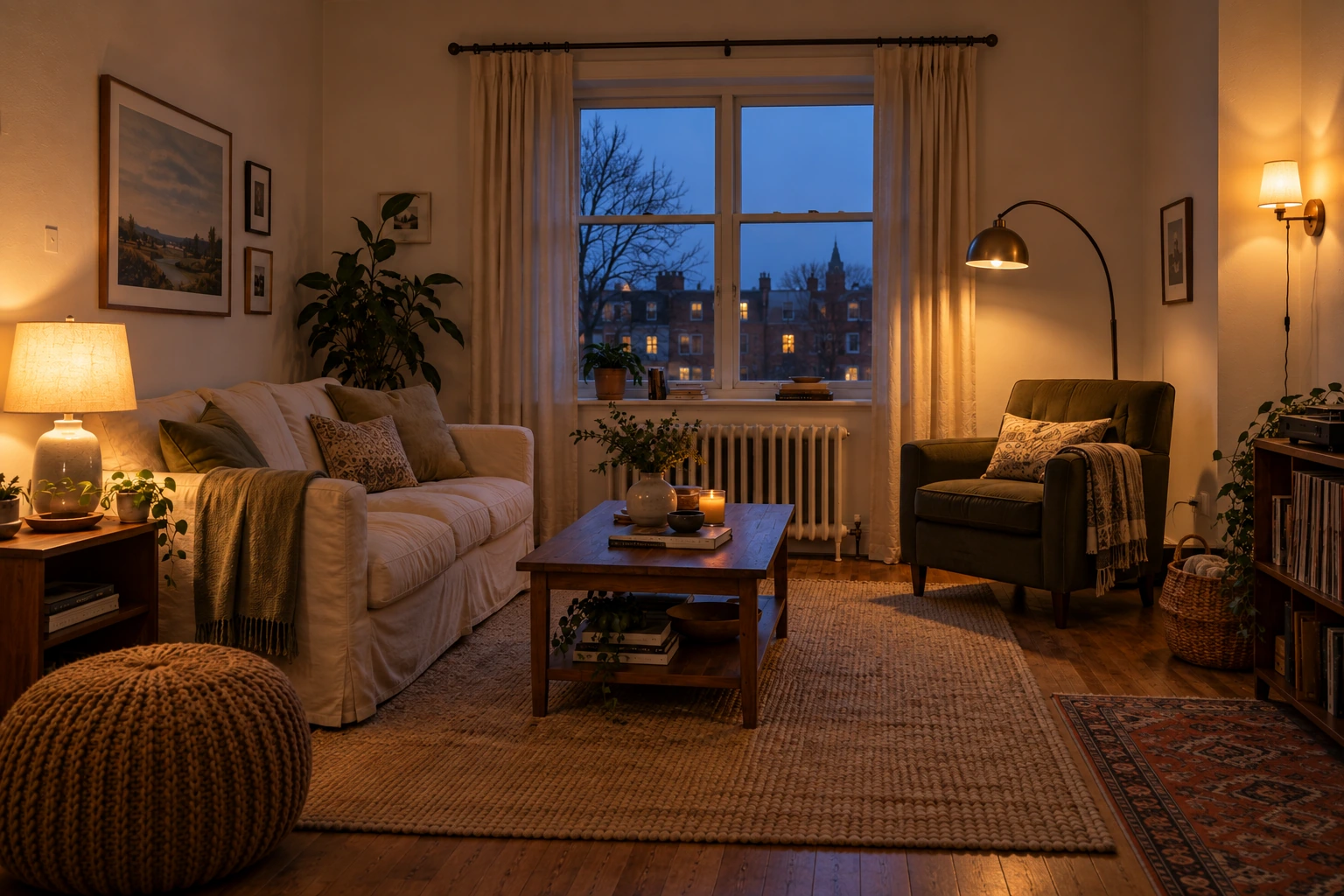
Every room wants at least three light sources at different heights. Ambient to fill it, task to work by, accent to give it corners. One ceiling fixture flattens a room into a photograph of a room, which is exactly what rental lighting feels like at seven in the evening.
If your place has no ceiling light at all, and plenty of rentals do not, you are already halfway there: the plan below never turns the ceiling on.
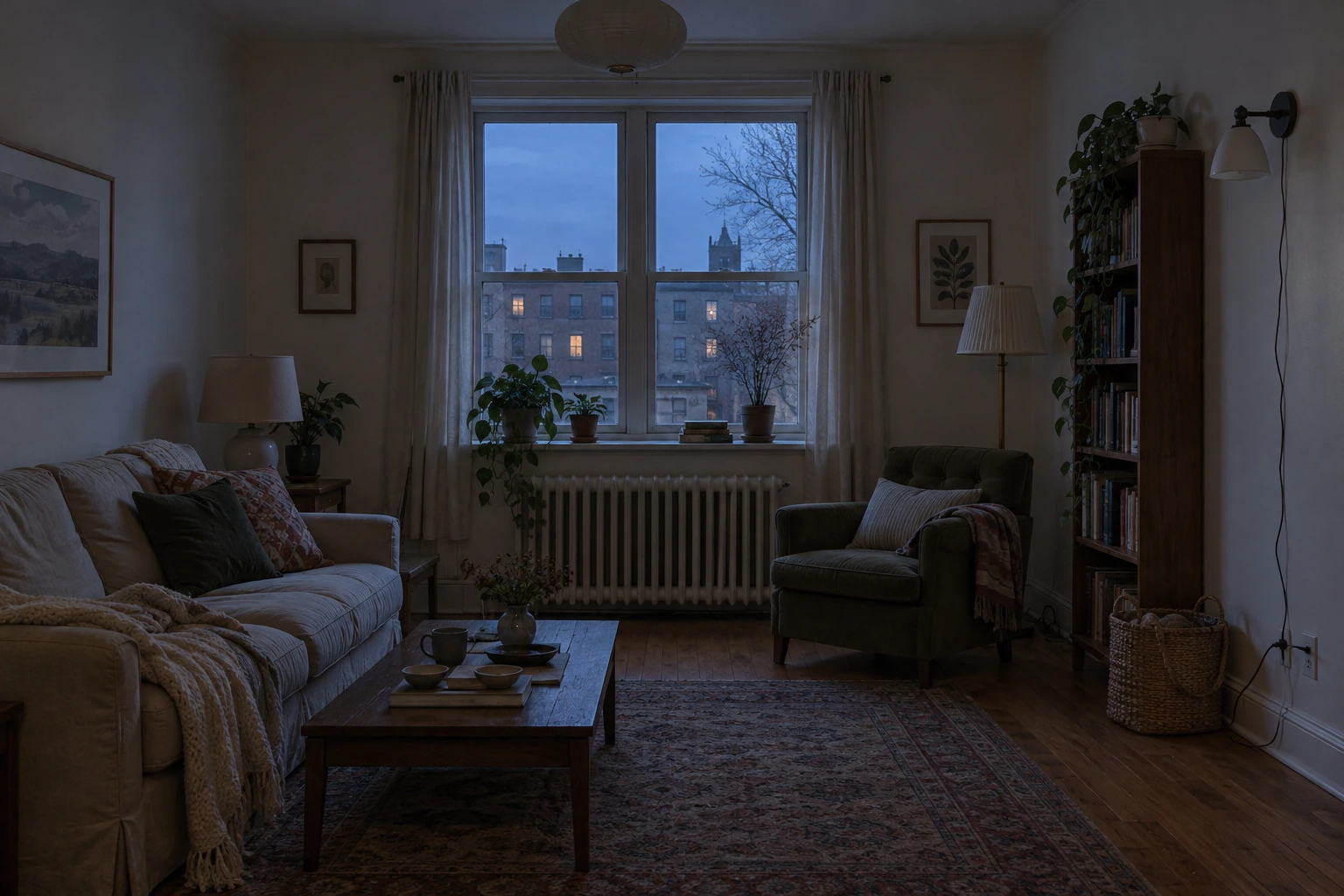
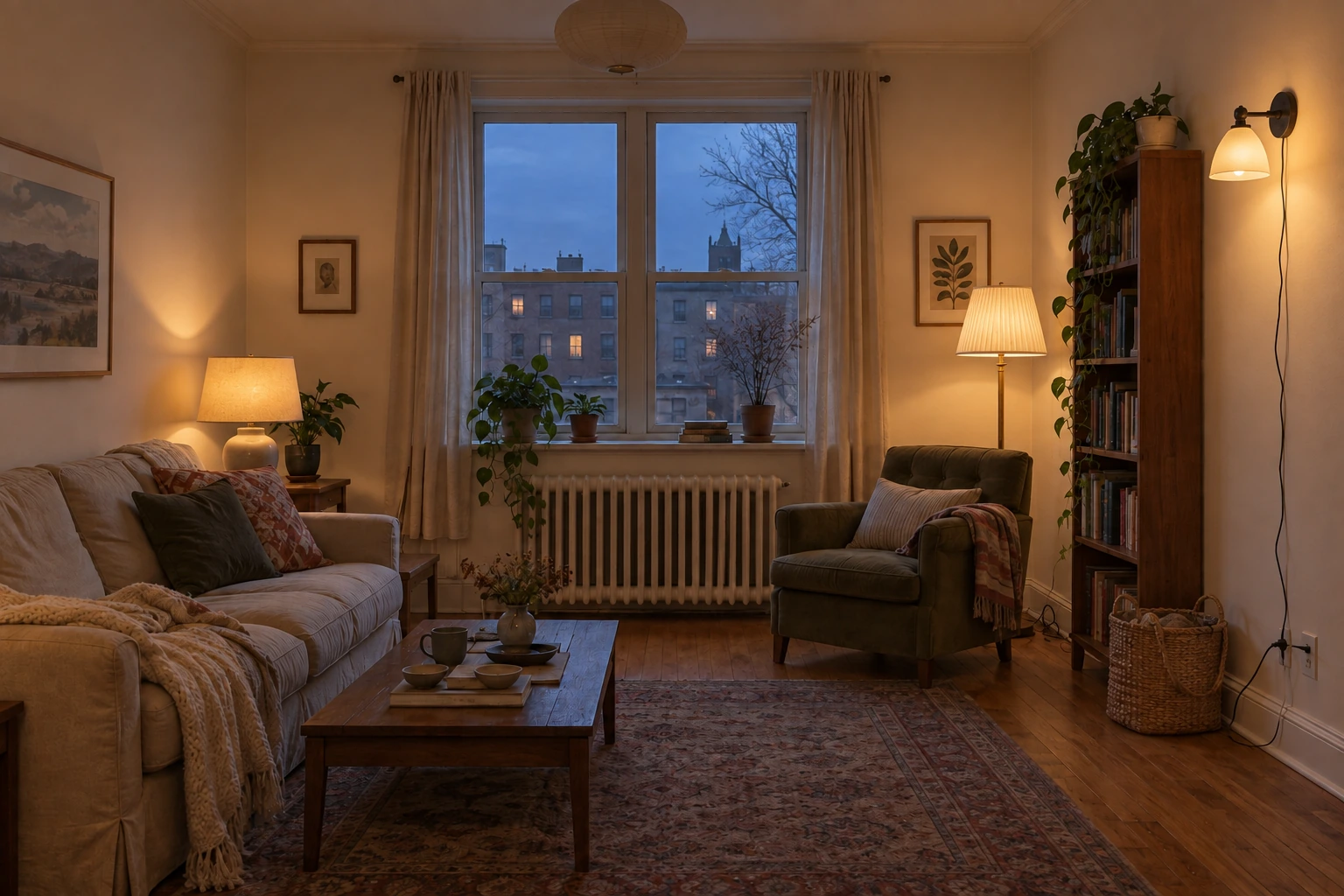
Above: the room with every lamp off, then the same room with the floor lamp, the table lamp and the plug-in sconce on. The ceiling fixture is off in both.
Three lamps on and she has already found the one warm spot. That is the test.
-
Ambient. The one you turn on walking in.
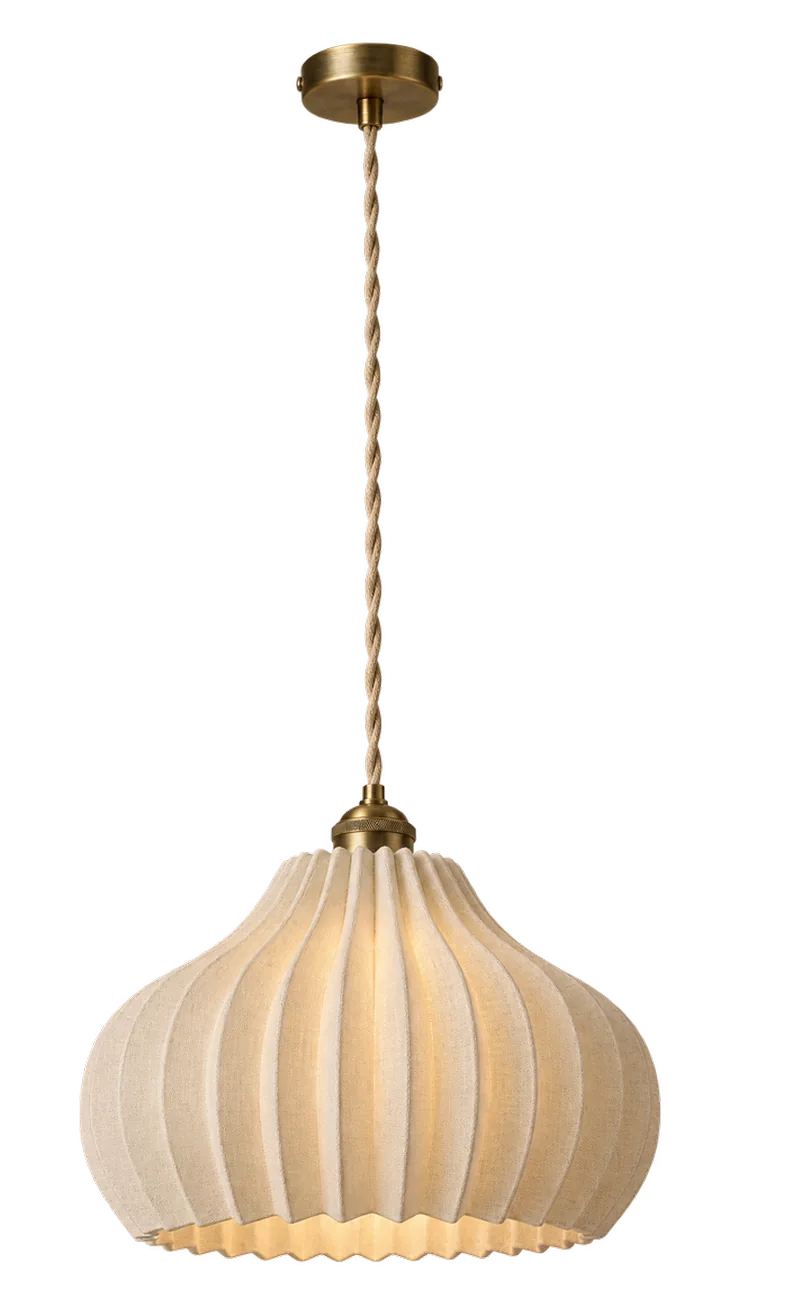
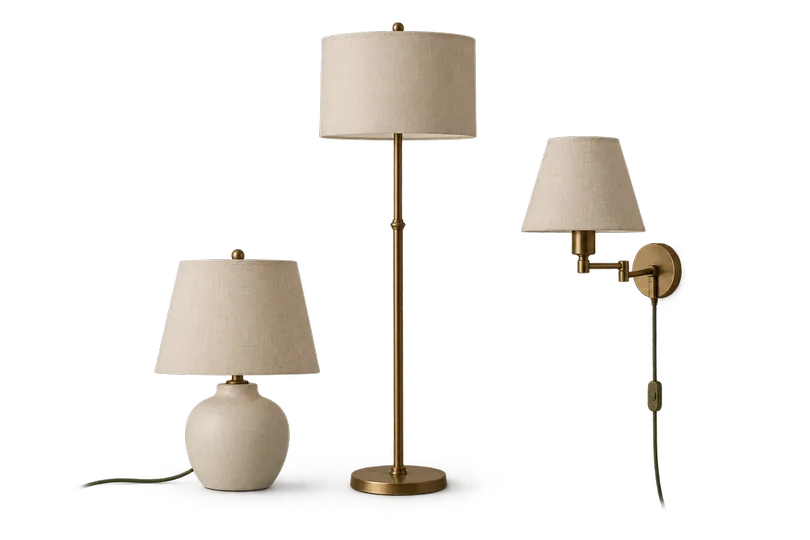
A floor lamp in a corner bounces light off the ceiling and fills the room without a single hole in the wall. If you want the look of a hanging fixture without an electrician, a plug-in pendant on a swag hook does it: the cord runs to a hook, along the ceiling line, down to an outlet. Buy one that comes with its shade, because a shade sized to a socket you already own is the one measurement on this page nobody gets right by eye.
-
Task. The one at your eye line.
This is the whole top half of this page: a table lamp beside the chair with its shade bottom near 40 in, or a gooseneck aimed at the book. Task light is the only kind you will miss when it is gone, and it is the one people skip because ambient light looks fine in a photograph.
-
Accent. The one that makes the room look finished.
Small and pointed at something: a plug-in sconce beside the bed, a little lamp on a shelf, anything under 450 lumens that throws a pool rather than a field. It is the cheapest of the three layers, and the one nobody buys.
Then deal with the cords, because that is what gives it away
Three lamps means three cords, and three cords crossing a rented floor is the fastest way to undo everything above. Adhesive clips run a cord along a baseboard in a straight line instead of a sag. A paintable raceway hides the one that has to cross open wall. Both come off without taking paint, which is the only reason they are on this site.
See the cord clips See the cord cover
Hang all three without drilling, step by step → · See the living room in order →
Quick answers
The questions I get most
58 to 64 inches, floor to the top of the shade. With a standard shade, that puts the bottom edge of the shade at or just below your eyes when you are sitting, so you never see the bulb. Arc lamps are the exception: the pole stands beside the chair and the shade hangs about 18 inches in front of your shoulder.
26 to 30 inches on a side table of 24 to 26 inches. What matters is the sum: table plus lamp should land between 52 and 58 inches, which puts the bottom of the shade around 40 inches off the floor, at or just below your eyes when you sit. Seats vary, so sit down and check that you cannot see the bulb.
About as tall as the nightstand, give or take two inches. A 24 to 26 inch nightstand takes a 24 to 27 inch lamp. Sitting up in bed, the bottom of the shade should be at chin height, which is lower than it is in a chair.
Shade height about a third of the total lamp height. Shade bottom wider than the widest part of the base, and narrower than the table it stands on. Then check the fitter: spider shades sit on a harp, uno shades slip over the socket, clip-ons clip to the bulb, and they do not swap.
No, but they should be the same height. Two different lamps at the same height read as a decision. Two matching lamps at different heights read as a mistake. If only one of you reads in bed, one lamp and a tray is a perfectly good answer.
2700K, around 800 lumens for a reading lamp. 3000K in kitchens and bathrooms, 4000K and up only where you work. And a dimmable bulb only dims if the lamp or the outlet can dim it, so add a cord dimmer or do not pay for the feature.
She has opinions about your eye level too.
One more thing
Sit down in the chair before you buy anything. The whole page is one line drawn at your eye level, and you are the only person who can measure where that is.
Last, the shape
The straight pole
The shapes come after the heights for the same reason the heights came first: a lamp at the wrong height is wrong in a way you cannot decorate around, and a lamp in the wrong shape is only not to your taste.
Nine straight poles, which is the plain case and the one every number above was written for: the pole stands beside the seat, the shade sits at the top, and the bottom of that shade is what has to land near a seated eye. One of these is a torchiere that aims at the ceiling instead, and one is 72 in. I have said which is which under each.
JONATHAN Y June, brass and marble
adjustable, up to 65 in · marble base, metal pole · cotton hardback drum shade, 10 in tall · about 10 lb
The straight pole worth paying more for. A marble base is what keeps a tall lamp from wobbling every time someone brushes past, and because the height adjusts you can set the shade bottom to your own eye line instead of the factory’s. The catch: at full height it is a little over the 58 to 64 in range, so plan to lower it, and a hardback shade glows a little less than soft linen.
-
01
If you buy one
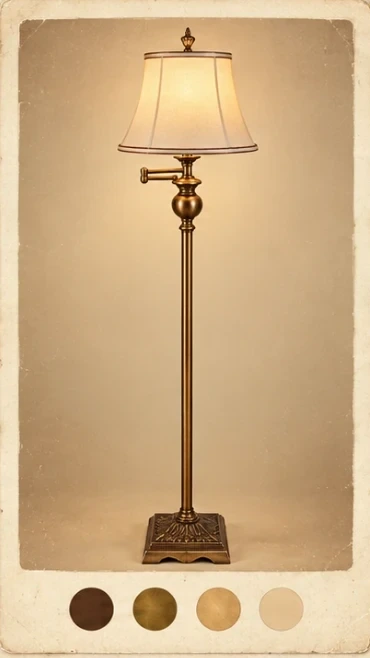
PARTPHONER Swing Arm
PARTPHONER, 61 in, beige fabric shade, 350 degree swing arm, bronze and gold
The one to buy if you buy one, and the lamp in the short answer. Sixty one inches sits inside the range, the fabric shade is pale enough to glow, and the arm reaches over the seat without the lamp being an arc. The catch: the shade moves after you have placed it.
-
02
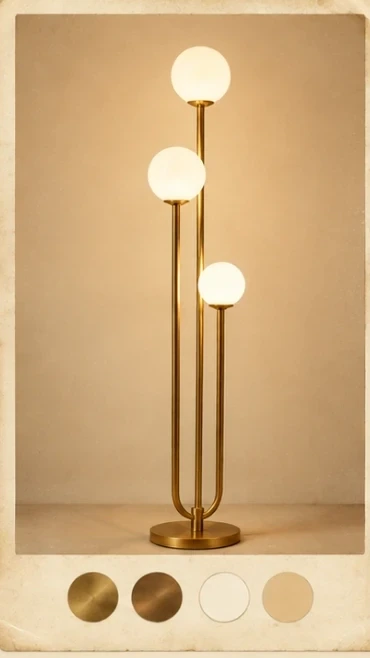
Lightdot
Lightdot, 63 in, gold, three globe lights, dimmable, five pound base
Sixty three inches, which lands inside the 58 to 64 in this page asks for. Three globes at that height means the light is spread up the pole instead of dumped in one pool.
-
03
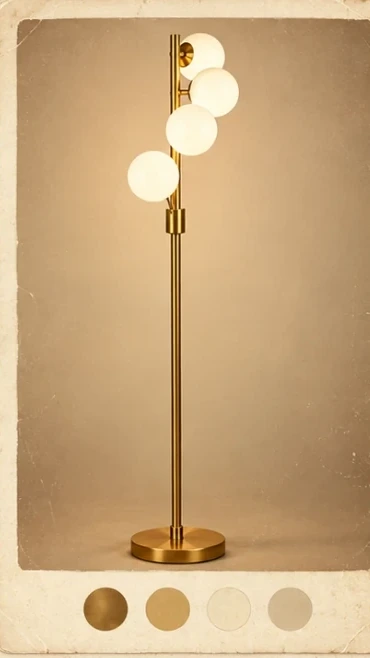
Lightdot Globes
Lightdot, 64 in, gold, four 3000 K globe bulbs, five pound base
Sixty four inches, the exact top of the window above, and the bulbs come at 3000 K. That is warm, but after sunset this guide argues for 2700K or lower, so swap them if this is an evening lamp. Most people never change a bulb, so the one in the box matters.
-
04
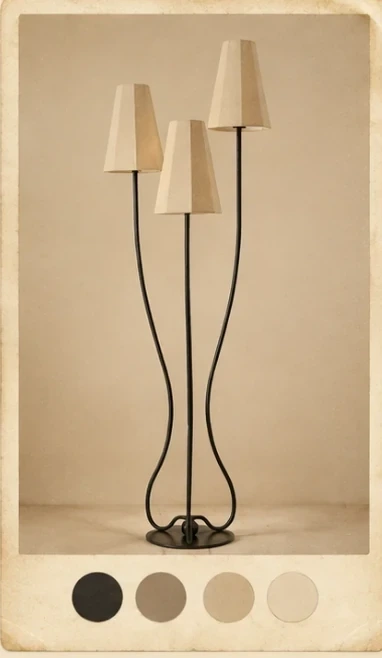
ZenGlimmer
ZenGlimmer, three lights, sculptural curved iron base, octagonal linen shades
Linen is the softest shade on this list, and the guide argues for fabric over glass a few sections up. The curved base is the cost: it takes more floor than a disc.
-
05
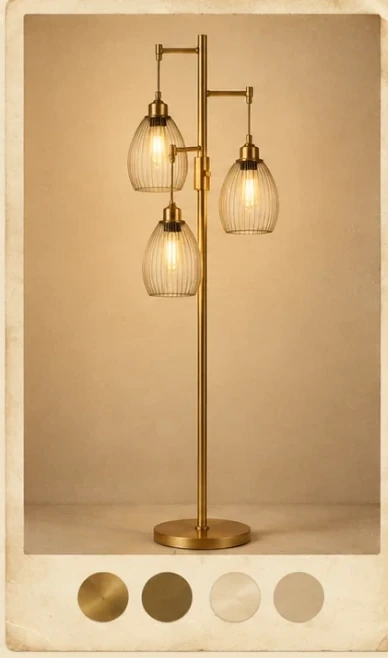
Teardrop Tree
Gold tree lamp, three teardrop cage heads, 800 lumen LED bulbs
Cage heads leave the bulb visible, so what you see from the sofa is the filament and not a shade. Worth knowing if the seat faces it.
-
06
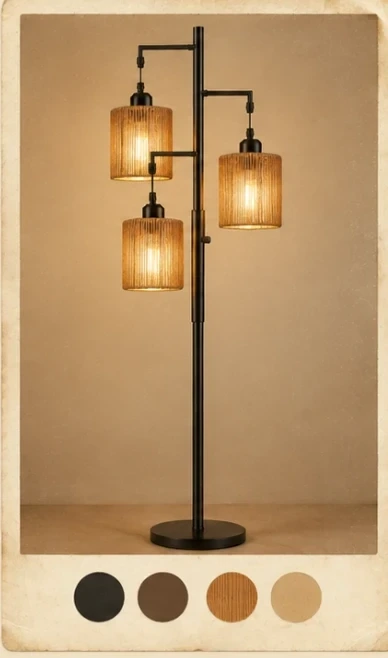
Hotsonic Rattan
Hotsonic, 72 in, boho rattan tree lamp, three 800 lumen bulbs, black
Seventy two inches, well over the window above, which is the trade for three heads on one pole. Rattan throws a patterned light instead of a plain one.
-
07
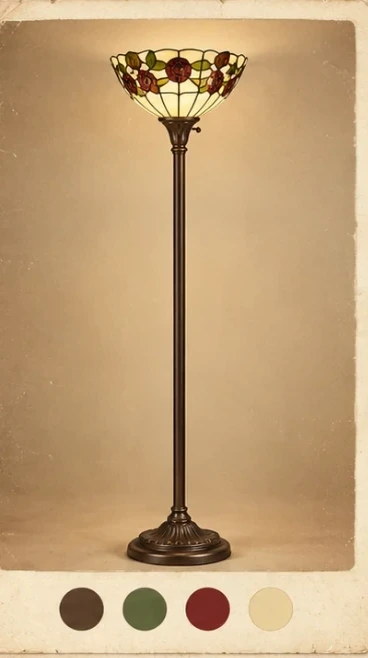
Rynxphera Tiffany
Rynxphera Tiffany, 70 in, stained glass shade, floral dragonfly, torchiere
A torchiere aims at the ceiling, so the eye level rule on this page does not govern it. The whole room gets bounced light and nothing gets a reading pool.
-
08
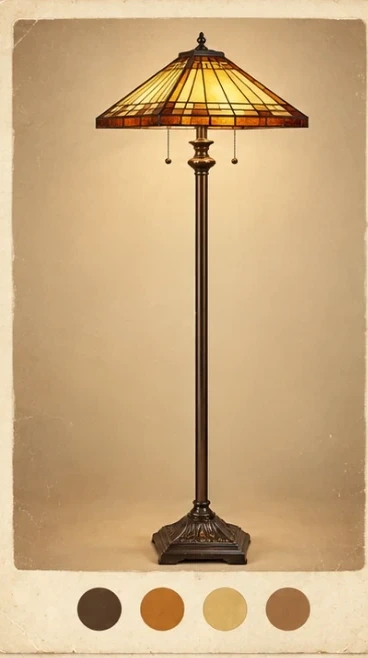
Capulina Tiffany
Capulina Tiffany, two lights, antique amber brown stained glass
Amber glass warms whatever bulb you put behind it, so a cool bulb still comes out warm. Two lights, which is the one thing the three lights section asks of a lamp.
-
09
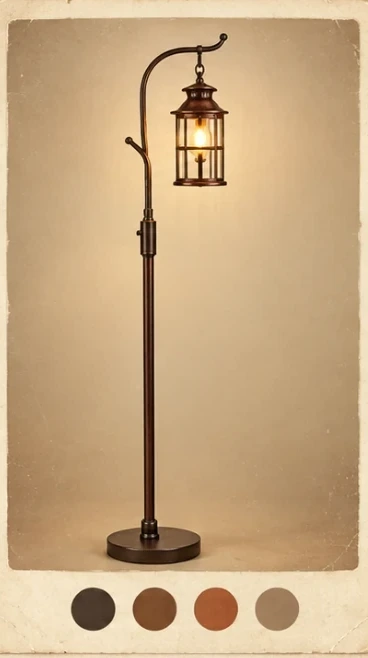
Asmymhd Lantern
Asmymhd vintage floor lamp, dimmable, lantern head
A lantern head is a small shade around a small bulb, so this is a lamp for a corner you want lit, not a corner you want to work in. The dimmer is the useful part.
What is under each one is its listing’s own words and how that lamp behaves against the numbers on this page. I have not lived with any of these lamps, and I am not going to write as though I had.
Every picture below is a drawing of the shape, made for this page. None of them is a photograph of the lamp it sits beside, so treat them as shapes and read the words for the facts.
The shape that reaches
Over the shoulder
Nine goosenecks, which is the shape for a chair that moves. The pole stands where there is room and the head goes where the book is, so this is the one lamp here that does not need you to have guessed right about the furniture.
It changes what the heights above mean. On a straight pole the shade has to land near a seated eye and stay there. On a gooseneck you aim the head instead, so the number to care about is whether the neck reaches over the arm of the chair at all. Two of these adjust their own height as well.
Every picture below is a drawing of the shape, made for this page. None of them is a photograph of the lamp it sits beside, so treat them as shapes and read the words for the facts.
Jenson pharmacy lamp, aged brass
adjustable 44 to 54 in · swing arm reaching 20 in · metal, about 13 lb · Regency Hill
The pharmacy lamp is the old answer to light over a chair, and this one is built heavy: thirteen pounds on a 9 in base, so the arm can reach out over the seat without the lamp tipping toward you. Height and arm both adjust, and it takes an ordinary bulb, so you choose the 2700K. The catch: the metal head is small and throws a pool rather than a glow, and the bulb is not included.
-
01
If you buy one
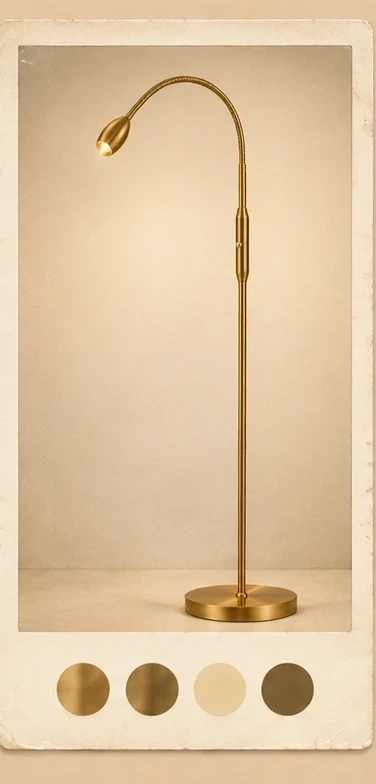
O’Bright Ray
O’Bright Ray, adjustable LED beam, dimmable and zoomable spotlight, flexible gooseneck, antique brass
The one to buy if you buy one. Zoomable, so the circle of light gets wider or tighter: it can light your page without lighting the person next to you, and the neck puts the head where the book is. 52 in tall on a 9 in base. The catch: its light is fixed at 4000K, cooler than the 2700K this page argues for at night. Aimed at a page and not at the room, that is a fair trade.
-
02
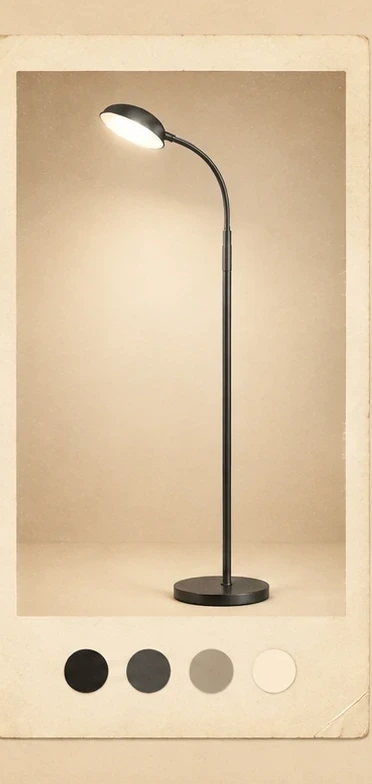
EDISHINE
EDISHINE, 1300 lumens, adjustable gooseneck, four color temperatures, dimmable, remote and touch, two timers, black
Four color temperatures and a remote. A gooseneck aims light at your hands, so the control that matters is the one you can reach without standing up.
-
03
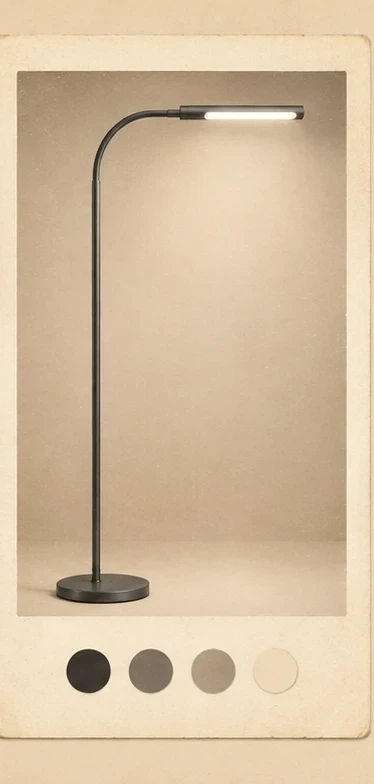
Honeywell
Honeywell, 77 in, dimmable gooseneck, three color temperatures from 3000 to 5000 K, CRI 97
Seventy seven inches, the tallest here by a long way, which is how the head clears a standing shoulder. CRI 97 is a claim about color, and color is what decides whether your yarn looks like your yarn.
-
04
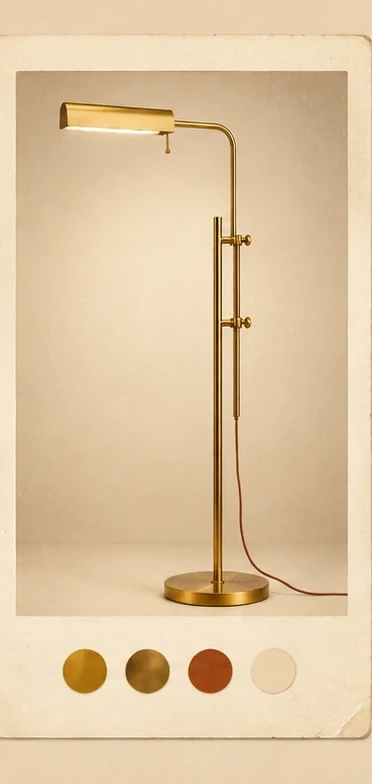
O’Bright Cedric
O’Bright Cedric adjustable pharmacy floor lamp, 45 to 61 in, 10 W LED, antique brass
It adjusts from 45 to 61 in, so one lamp covers both a low armchair and a dining chair. A pharmacy head points down and nowhere else, which is the entire idea.
-
05
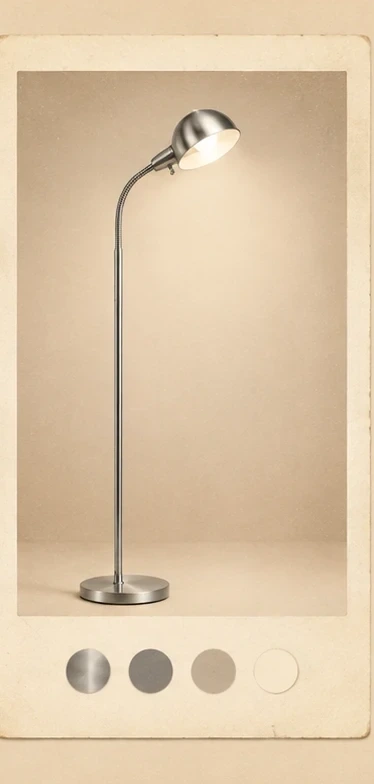
LALISU
LALISU, silver, 360 degree flexible gooseneck, rotatable shade, three level knob dimming, E26 socket, anti tip base
An E26 socket means you pick the bulb, so this is the one on the list where the color temperature is still your call. The dimming has three steps, not a slider.
-
06
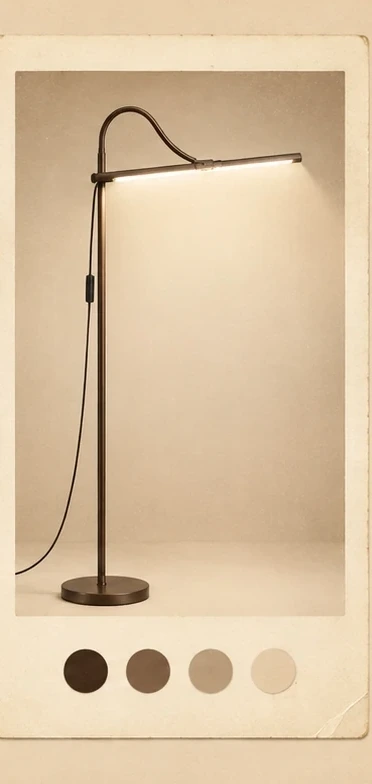
Double Head
Double head gooseneck, 18 W, 2000 lumens, dimmable, brown
Two heads on one pole. It is sold for sewing and tattooing, which tells you plainly that it was built to light a task and not a room.
-
07
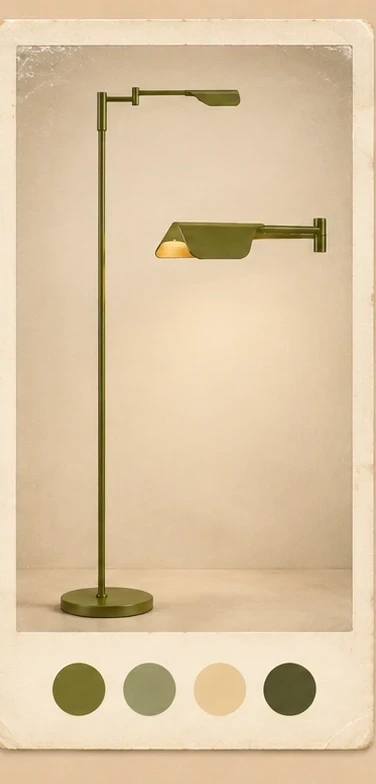
Brightech Leaf
Brightech Leaf pharmacy LED reading lamp, dimmable, rotates over a chair or a desk, antique brass
A head that swings out over the chair and back again. If your chair moves around, this is the shape that forgives you.
-
08
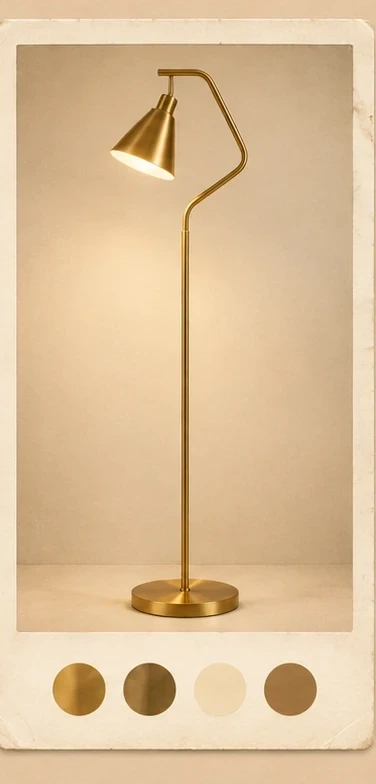
Copofed
Copofed, gold, rotatable iron shade, foot switch, 3000 K, 4000 K and 6500 K, bulb included
A foot switch, which is the detail that decides whether a lamp gets turned on at all. The 6500 K setting is at the cold end and this page argues against it, but the other two are there.
-
09
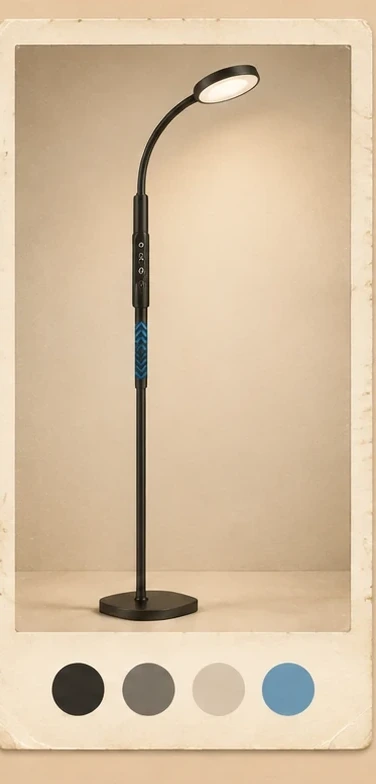
PACOVY
PACOVY, adjustable height, 120 LEDs, remote and touch, dimmable gooseneck, black
The height adjusts and the neck bends, so it is the most movable one here. The trade is a control panel partway up the pole, and you will see it from the sofa.
What is under each one is its listing’s own words and how that lamp behaves against the numbers on this page. I have not lived with any of these lamps, and I am not going to write as though I had.
The shape that argues with the numbers
The arc
Nine arc lamps. An arc is the one shape on this page that disagrees with the heights above it, so it gets a list of its own.
One thing the numbers above do not cover, and it matters here. An arc is taller than the 58 to 64 in this guide asks of a floor lamp, and it should be: the pole stands beside the seat and the shade hangs out over it, so the height you read on the box is the pole, not the shade. One of these is 80 in and one is 82. Measure the ceiling, then measure where the shade will land.
-
01
If you buy one
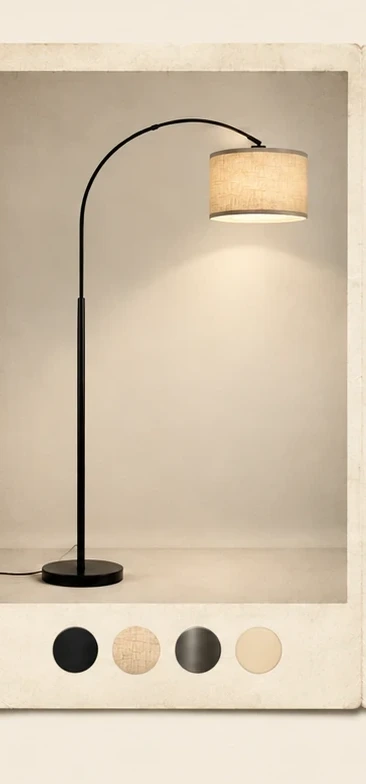
Seaside Village
Seaside village arc floor lamp, 71 in, black, beige fabric drum shade on an adjustable hanging cord, foot switch
The one to buy if you buy one. The shade hangs on a cord, so you can drop its bottom edge to your seated eye line instead of living with wherever the arc ends. Fabric drum, foot switch, an 11 in base. The catch: a shade on a cord can swing, so it wants a spot out of the walkway.
-
02
Buy it once
Brightech Olivia
Brightech Olivia, 75 in, rounded metal spotlight head, marble base
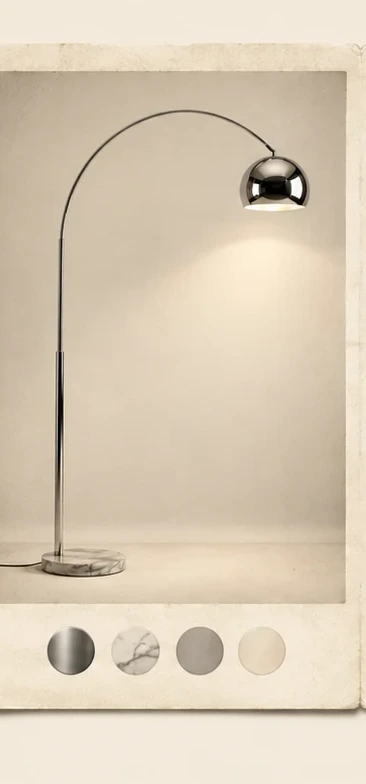
The worth it one. The marble has a job: an arc hangs its weight a long way from its foot, so the base is the whole reason it does not tip, and a heavy one is what still stands straight in five years. The catch: the head is metal, so it throws a pool of light on the page rather than a glow, and the arm reaches out about 57 in, so measure the clear floor first.
-
03
Brass Arc
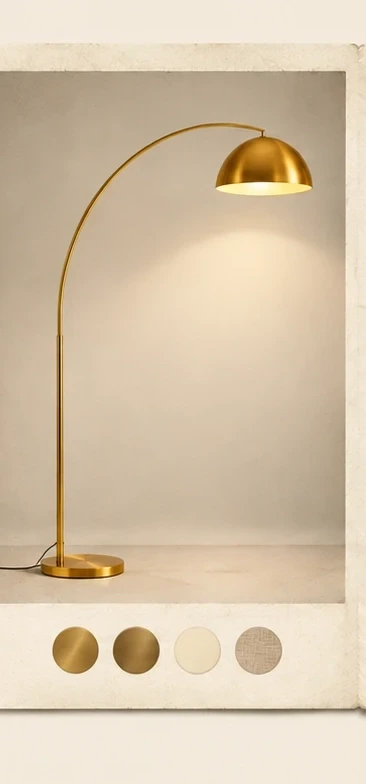
Gold brass large arc floor lamp, 20 W bulb with remote
The remote is the point. An arc puts the bulb out over the seat, where nobody can reach a pull chain, so the switch has to live somewhere else.
-
04
Brightech Trilage
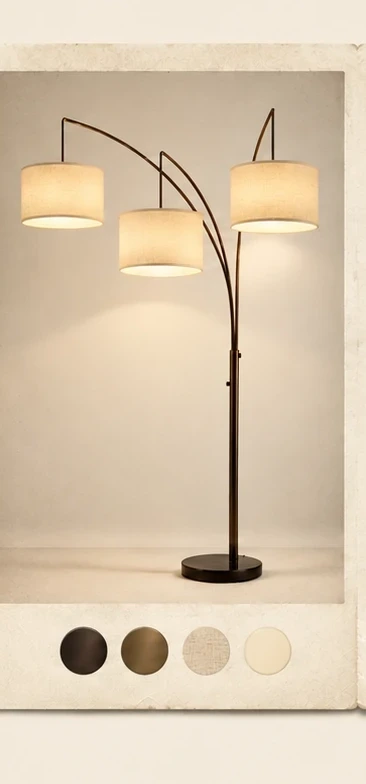
Brightech Trilage, three fabric shades, LED bulbs
Three shades means three pools of light from one plug, which is most of a lighting plan in one object. It also means a wider base and more floor gone.
-
05
Rattan Arc
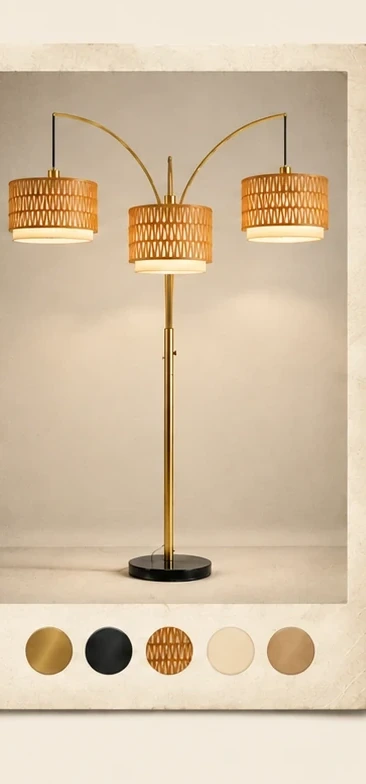
Brushed gold rattan arc, three lights, 80 in
Rattan throws a patterned light instead of a plain one, so it is a lamp you notice when it is off as well as on. Eighty inches: measure your ceiling before you fall for it.
-
06
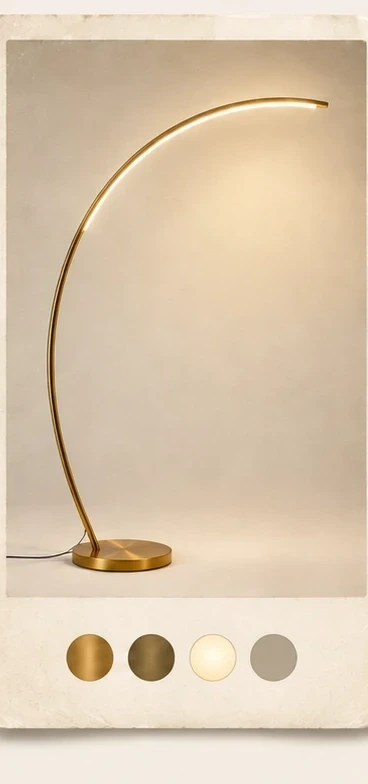
Gold LED Arc
Dimmable LED arc, three color temperatures, 2000 lumens, gold
Three color temperatures on one lamp. Keep it at the warm end in a living room: the guide argues that above the shade section, and it is the setting most people never change.
-
07
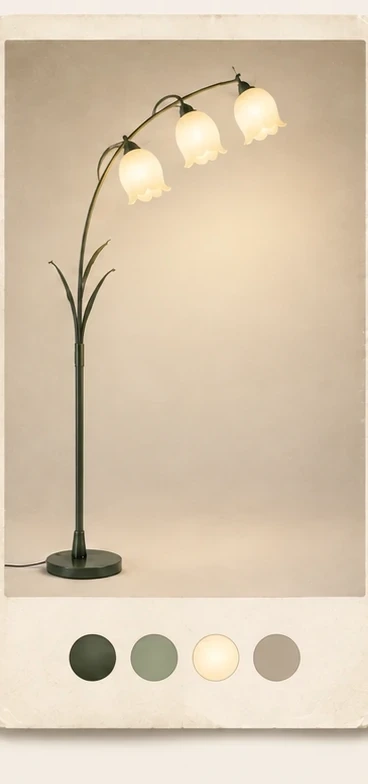
HMVPL Flower
HMVPL flower arc, five G9 bulbs, foot switch
Five small bulbs instead of one shade. It is the decorative end of the list, and the one hardest to make disappear into a room.
-
08
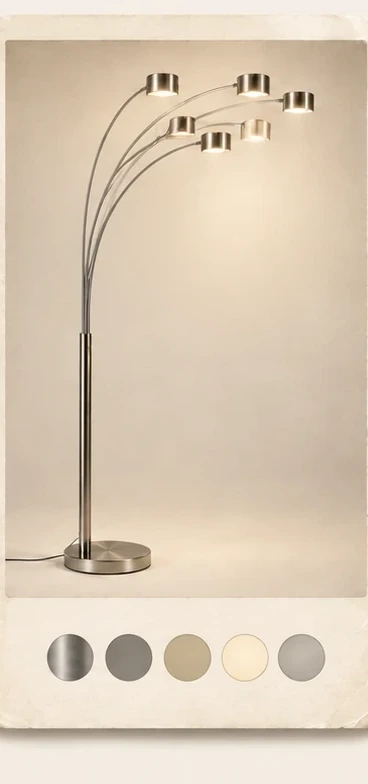
Artiva Micah
Artiva Micah, five arcs, dimmer, rotatable shades
Five arms that turn, so the light can be aimed after the furniture moves. The footprint is the trade: this one needs a corner of its own.
-
09
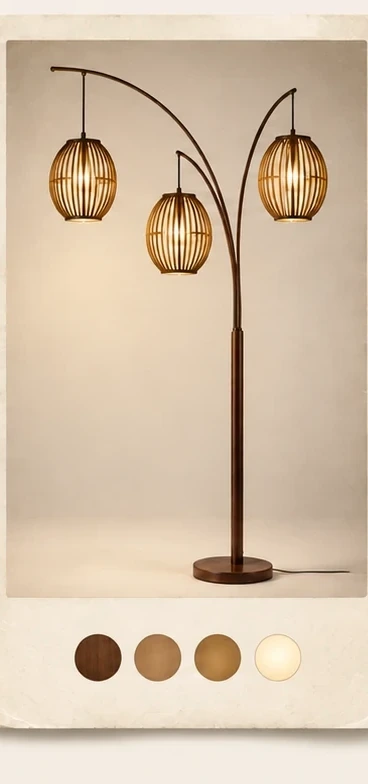
Adesso Bronze
Adesso three light arc, antique bronze, adjustable height, 82 in
The height adjusts, which on an arc matters more than on any other lamp: the shade has to clear a head that is sitting down, not standing up.
What is under each one is its listing’s own words and how that lamp behaves against the numbers on this page. I have not lived with any of these lamps, and I am not going to write as though I had.
Every picture below is a drawing of the shape, made for this page. None of them is a photograph of the lamp it sits beside, so treat them as shapes and read the words for the facts.
The shape with no floor
No floor at all
Sometimes the floor is full and the honest answer is to stop putting things on it. These go on the wall, and only one of them asks you to open it, which is why that one has no button.
Three things before you scroll, because they are not all the same animal. Numbers 07 and 08 are night lights, which keep a hallway safe and will not light a room. Numbers 05 and 06 run on a battery, so there is no cord and no socket, and instead there is charging. And a plug in sconce still has a cord that goes down the wall to a socket, which is the trade the whole shape is built on.
Every picture below is a drawing of the shape, made for this page. None of them is a photograph of the lamp it sits beside, so treat them as shapes and read the words for the facts.
-
01
If you buy one
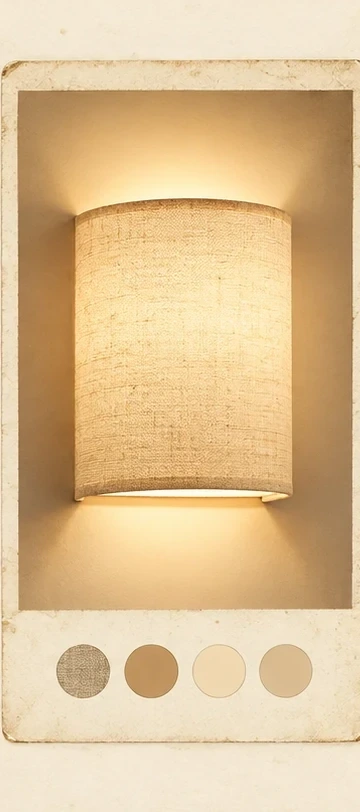
Yunaking
Yunaking plug in wall sconces, set of two, on and off switch on the cord, stepless color temperature, fabric linen shade
The one to buy if you buy one. Linen, so it glows like a pale lamp shade, a switch you can reach on the cord, and a color temperature you slide rather than step through. Of the plug in pairs here, this is the one that behaves most like a lamp. The catch: the cord still runs down the wall to the outlet.
-
02
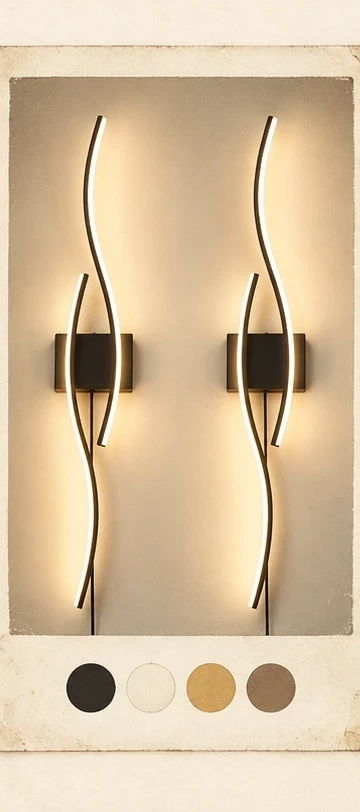
Daunton
Daunton modern plug in wall sconces, set of two, remote dimmable LED, black
A pair of real sconces that plug in and dim from a remote. This is the row that replaces a floor lamp, rather than the ones above that only keep you company at night.
-
03
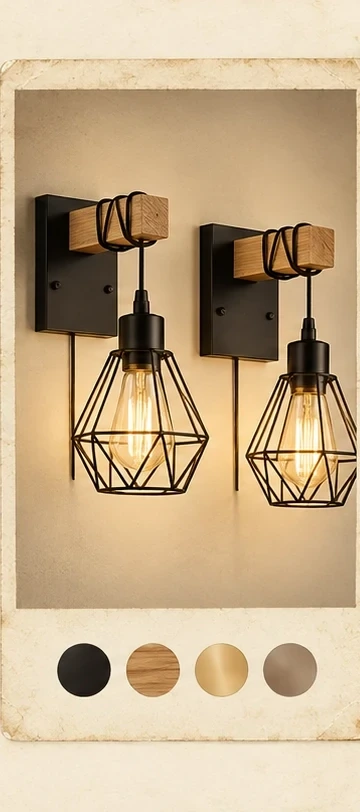
Lomoky
Lomoky plug in wall sconces, set of two, vintage wood, 5.25 ft cord with an on and off switch
The cord is 5.25 ft and they say so, which almost no listing does. Measure from where the sconce goes to where the socket is before you let yourself like them.
-
04
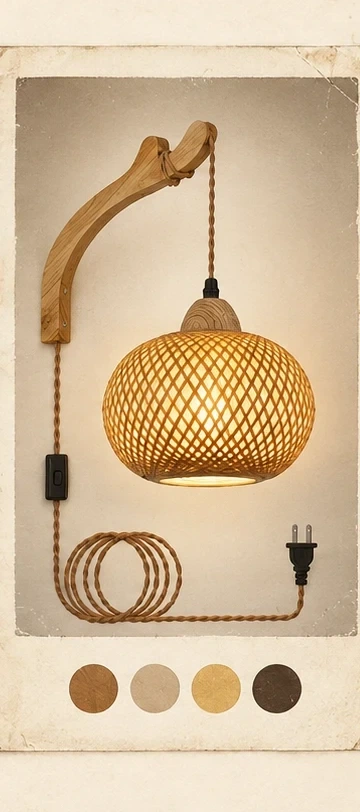
Frideko Rattan
Frideko bamboo lantern plug in wall sconce, hand woven rattan, with plug in cord
Woven rattan, so the light comes out patterned instead of plain, which is the same argument the rattan lamps make further up this page. A cord down the wall is the price.
-
05
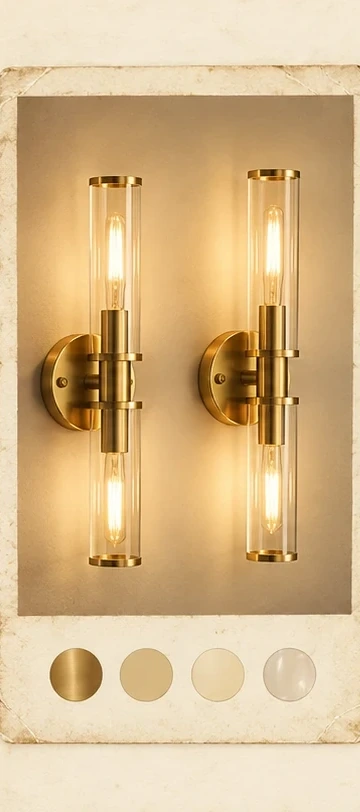
Gold Rechargeable
Gold battery operated wall sconces, set of two, rechargeable 8000 mAh, dimmable, timer, remote, 3000 K, 20.5 in, bulbs included
Battery, so there is no cord at all. It is the only version of a sconce that leaves nothing on the wall but its bracket. You charge it instead, which is a chore rather than a cost.
-
06
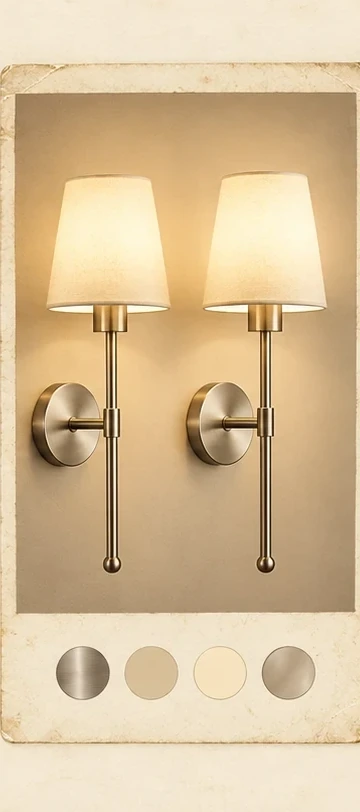
Depuley
Depuley battery operated wall sconce, set of two, wireless with remote, 24 in, nickel
Twenty four inches, the longest here, and battery as well. A sconce that length reads as architecture, which is a lot of presence for something you will unscrew when you move.
-
07
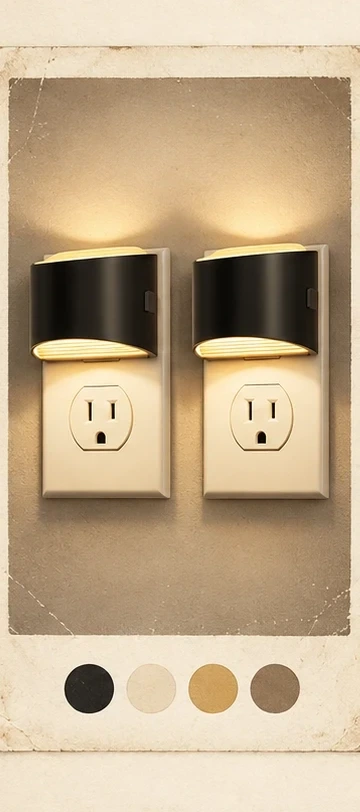
DORESshop
DORESshop night light, two pack, plugs into the wall, 3000 K, three brightness levels, dusk to dawn sensor
A night light, not a reading light, and that difference is the point: it stops you stubbing a toe at three in the morning. The sensor means you never have to touch it.
-
08
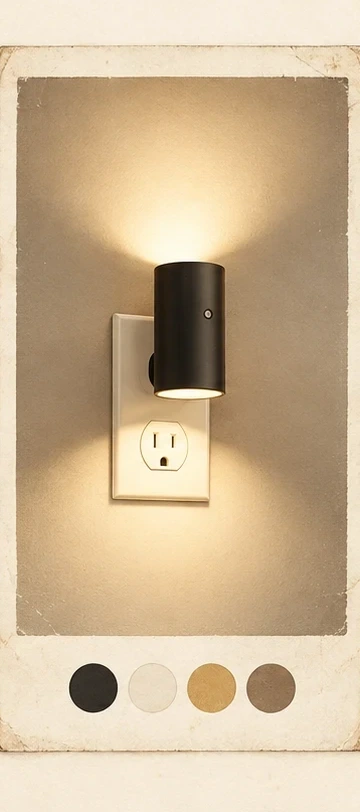
NIORSUN
NIORSUN night lights, four pack, black, dimmable, three color modes, automatic on and off sensor, ultra slim
Four of them, which is the honest number for an apartment with a hallway, a bathroom and a set of stairs. Three color modes, and the warm one is the setting to leave it on.
-
09
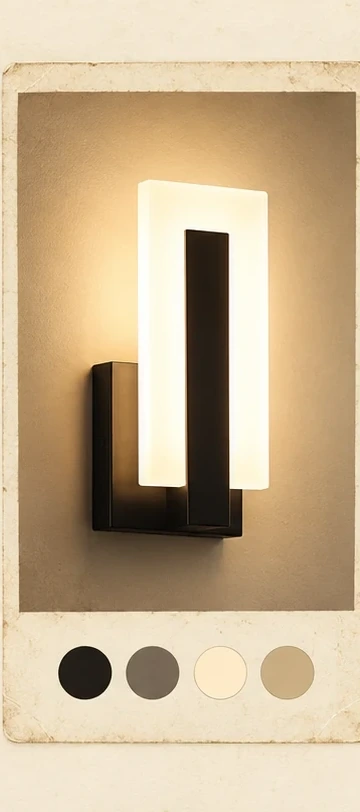
Joosenhouse
Joosenhouse modern LED wall sconces, up and down, black, 3000 K, set of two
This one is hardwired, and its own listing says so twice: the size reads Hard-Wired, and the install note says it connects to the reserved wire directly. That means an electrician and a wall you are allowed to open. In a section about not touching the wiring, I am not putting a buy button under it.
Not linked, see why
What is under each one is its listing’s own words and how that light behaves in an apartment you do not own. I have not lived with any of these, and I am not going to write as though I had.
Chenille’s Box · One email a month from Nora, for when the sofa, rug or bed is next on your list. See what is inside →