How many patterns can one room take?
Three, if the three are different sizes · Checked Sep 15, 2026

By NoraLease and Layer · Checked Sep 15, 2026
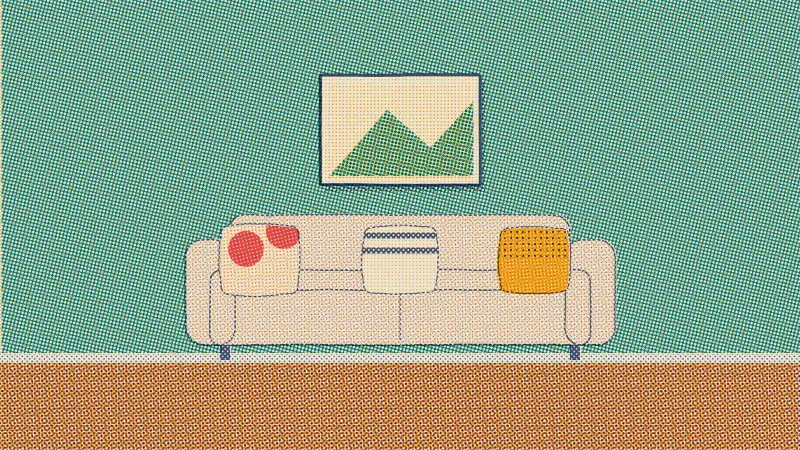
The whole answer, in three lines
- Three patterns. That is the number. Two looks like you stopped early. Four is where a room starts arguing with itself.
- All three at different sizes One big, one middling, one so small it reads as texture from the other side of the room. This is the part everybody skips.
- The motifs do not have to match Stripes with flowers with dots is fine. Two flowers the same size is not. Size is what your eye sorts first.
In this guide
Take me straight to the builder
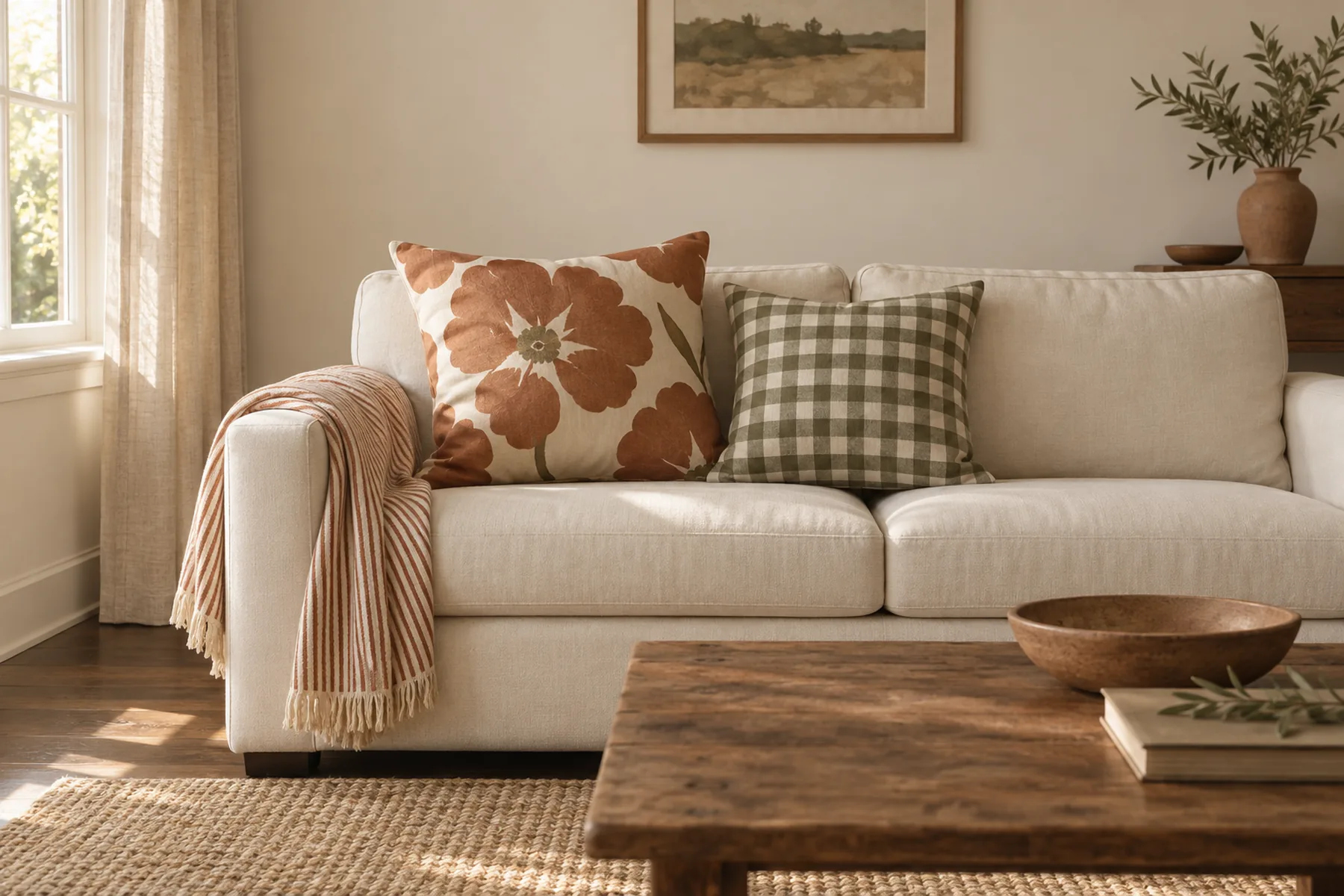
Three patterns in one room is not a lot. Three patterns at the same size is a headache.
Every time somebody tells me their room looks busy, I go and count, and it is almost never the number. It is four things all printed at roughly the same size, sitting within six feet of each other, none of them louder than the rest. Your eye has no instruction. It checks one, checks the next, finds them equal, goes back, and that flicker is what you feel as noise.
Swap one of those four for the same motif printed twice as big and the room settles down immediately. Nothing was removed. Nothing was matched. One thing got bigger, so one thing became the main event and the others became its background.
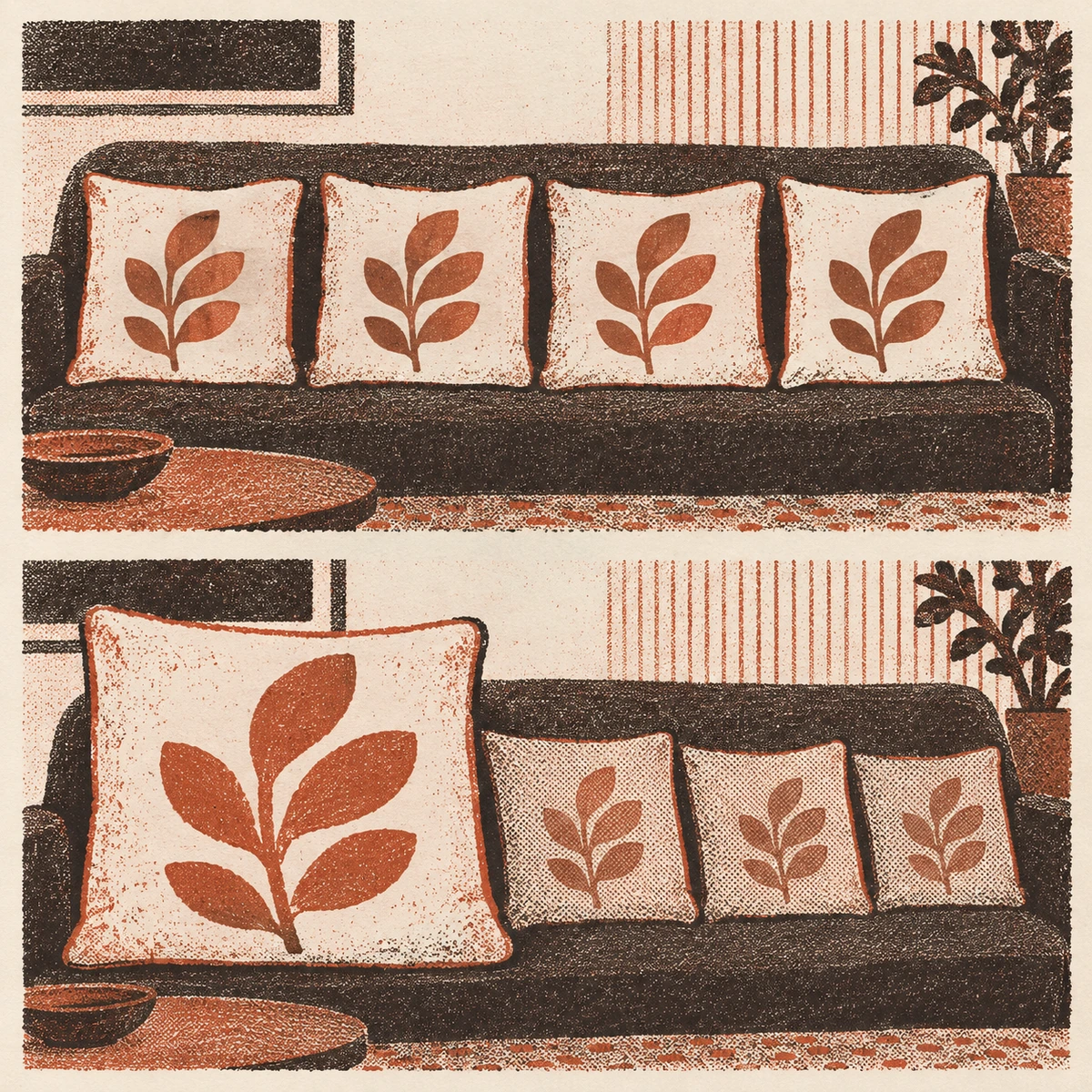
That is the whole page. What follows is how to tell one size from another with a cushion you already own, what to do when the sofa came with the apartment and you did not pick its pattern, and a builder below where you can put two large patterns next to each other on purpose and watch it fall apart.
Start here if you want the short version: how to measure a pattern scale in ten seconds.
The rule of three sizes
Three patterns, three sizes, and the sizes are the rule
Most advice on this subject gives you a number and stops. Three patterns. Fine, but I have seen three patterns look like a yard sale and I have seen five look calm, so the number on its own is useless. Here is what is underneath it.
One pattern is the loud one, and it has to be the biggest
Pick the pattern you like most and buy it in the biggest version you can find: a flower that nearly fills an 18 in cushion, a check with squares over 3 in across. This is the one people look at when they walk in, and it is doing a job no other pattern in the room can do.
A big pattern reads as one object from across the room. That is why it calms things down instead of stirring them up: your eye lands on it, resolves it, and moves on. A small pattern never resolves at that distance, it just shimmers.
What goes wrongBuying the big pattern as a rug and the two small ones as cushions. Now the loud thing is on the floor under a coffee table and nobody sees it. Put the biggest pattern at seat height or above.
The second one goes down a size, not a shade
Here is where it goes wrong for almost everybody. You find a big floral you love, then you look for a second fabric and you pick another floral in a softer color, roughly the same size, because it feels safer. It is not safer. Two patterns at the same size cancel each other out, and no amount of color agreement fixes it.
Cut the second one to somewhere between a third and half the size of the first. If the flower on cushion one is 9 in across, the check on cushion two wants to be 3 in to 4 in. You will see the difference from the doorway, which is the only test that counts.
What goes wrongMatching sets sold as a pair. Cushion covers sold two to a pack are usually printed at the same scale on purpose, because they photograph well side by side and nobody sees them in a room.
The third one is so small it stops being a pattern
The last one should read as a plain color from six feet away and only turn into stripes or dots when you sit down next to it. A 0.25 in stripe, a pin dot, a tight herringbone. Most people leave this one out, and the room ends up feeling flat in the exact way they were trying to avoid.
This is the cheapest of the three to get right, because at that size the motif barely matters. Ticking stripe, tiny grid, woven texture. Anything that behaves like a solid at a distance is doing the job.
What goes wrongCounting a plain woven texture as the small pattern and then adding a fourth print because you think you only have two. A texture counts. Look at your sofa before you buy anything.
behind you does not count as matching
The three scale builder
Dress the sofa, then put two patterns at the same size and watch it go wrong
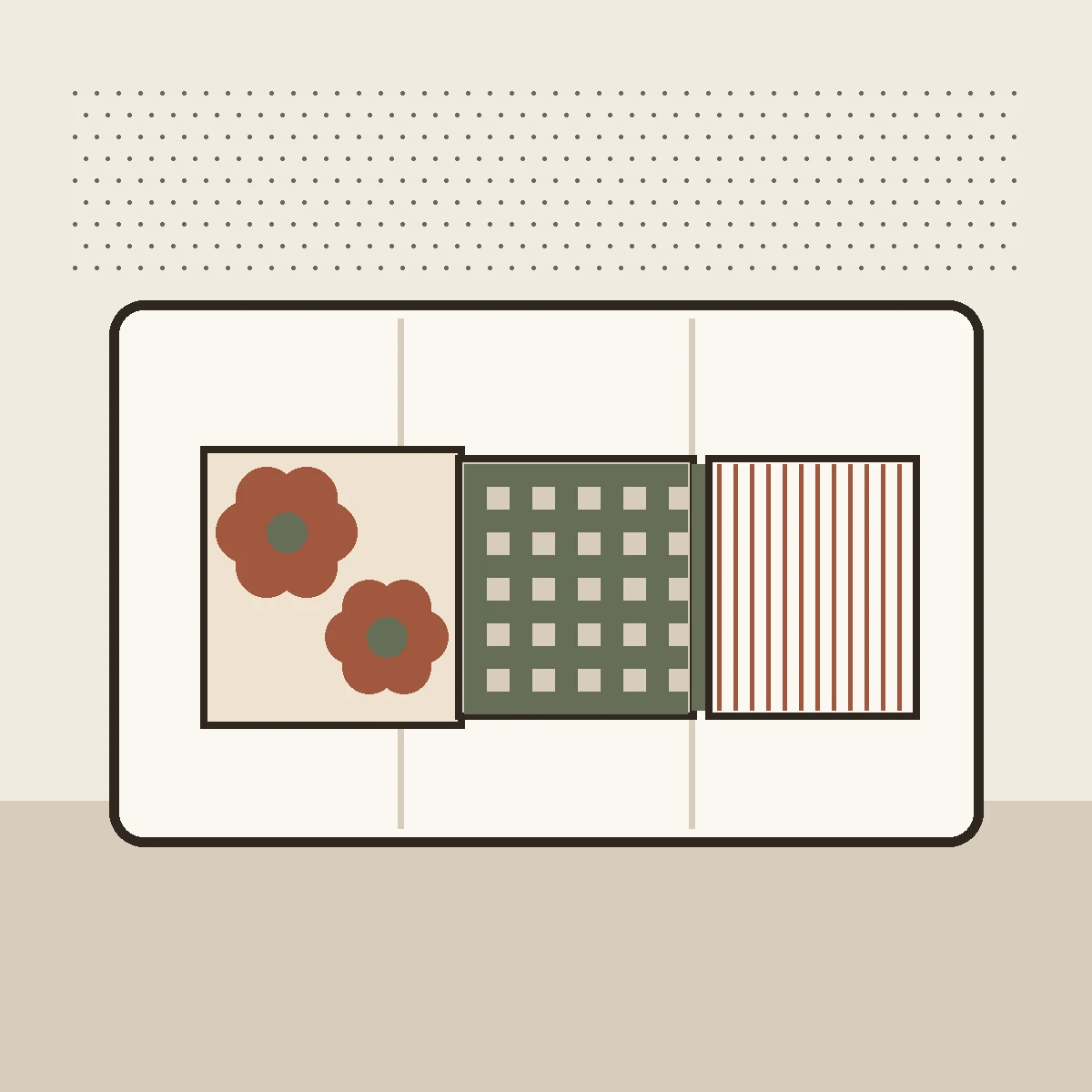
Three slots, six patterns, three sizes each. Every pattern here is drawn in the same olive on the same ivory, on purpose: color is doing none of the work, so anything you see is coming from size alone. Pick whatever motifs you like. Then set two of them to the same size and read what happens.
Three sizes. It holds.
Your eye goes to the large geometric floral first, then the medium check, then the small stripe, which has already stopped being a pattern.
Nothing here matches. A geometric floral, a check and a stripe have nothing in common, and it does not matter, because size sorted them out before you noticed.
Sofa reads: 01 large, 02 medium, 03 small / 3 of 3 sizes used
cushion 01The large one
cushion 02The middle one
cushion 03The small one
Press two size buttons in the same row of a different slot to force the clash. The two cushions that fight get outlined in clay.
Without JavaScript the sofa stays in its correct state: a large flower, a medium check and a small stripe. The six patterns are drawn out at all three sizes in the next section, which is the same information without the buttons.
The six patterns, three sizes each
The same six motifs, printed large, medium and small
This is the builder above with the buttons taken off. Read across each row and the point makes itself: the motif stays the same and the character changes completely. The left square is a pattern. The right square is a color with a bit of grain in it.
One ink, one paper, eighteen squares. If you can pick one from the left column, one from the middle and one from the right, you have a room that works, and you did it without matching anything.
Stripe
The one that works at every size. Wide bands read as a large pattern; a pin stripe behaves like a solid from across the room.
Check
Gingham and tartan live here, and almost all of it is sold in the medium band. Two checks in one room is the most common version of the mistake this page is about.
Geometric floral
The natural candidate for the large slot. A flower that nearly fills a cushion reads as one object, and one object is easy to look at.
Dot
Hard to make large without it turning silly. Small dots are the most useful third pattern in the house, because they fill the gap without asking for attention.
Herringbone
Reads as a weave rather than a print. At the small size it counts as your solid, which means a herringbone sofa is already using one of your three slots.
Zigzag
Loud at any size, so give it the largest slot or the smallest and never the middle. In between it is neither the event nor the background.
How to measure a scale
Hold it against a cushion and count how many fit
Scale is not a feeling and you do not need a word for it. You need one number: how wide is one whole motif, corner to corner, before it starts again. Then you compare that number to something you own. An 18 in cushion cover is the easiest ruler in the house, because it is the size most pattern gets sold on and it is already sitting on your sofa. Elsewhere on this site the sofa pillow number is 20 to 22 in, and the two numbers agree: that one is the insert you buy for the seat depth, this one is the printed cover you are counting repeats against.
Hold the fabric flat against the cushion and count whole repeats across the width. That count is the whole classification.
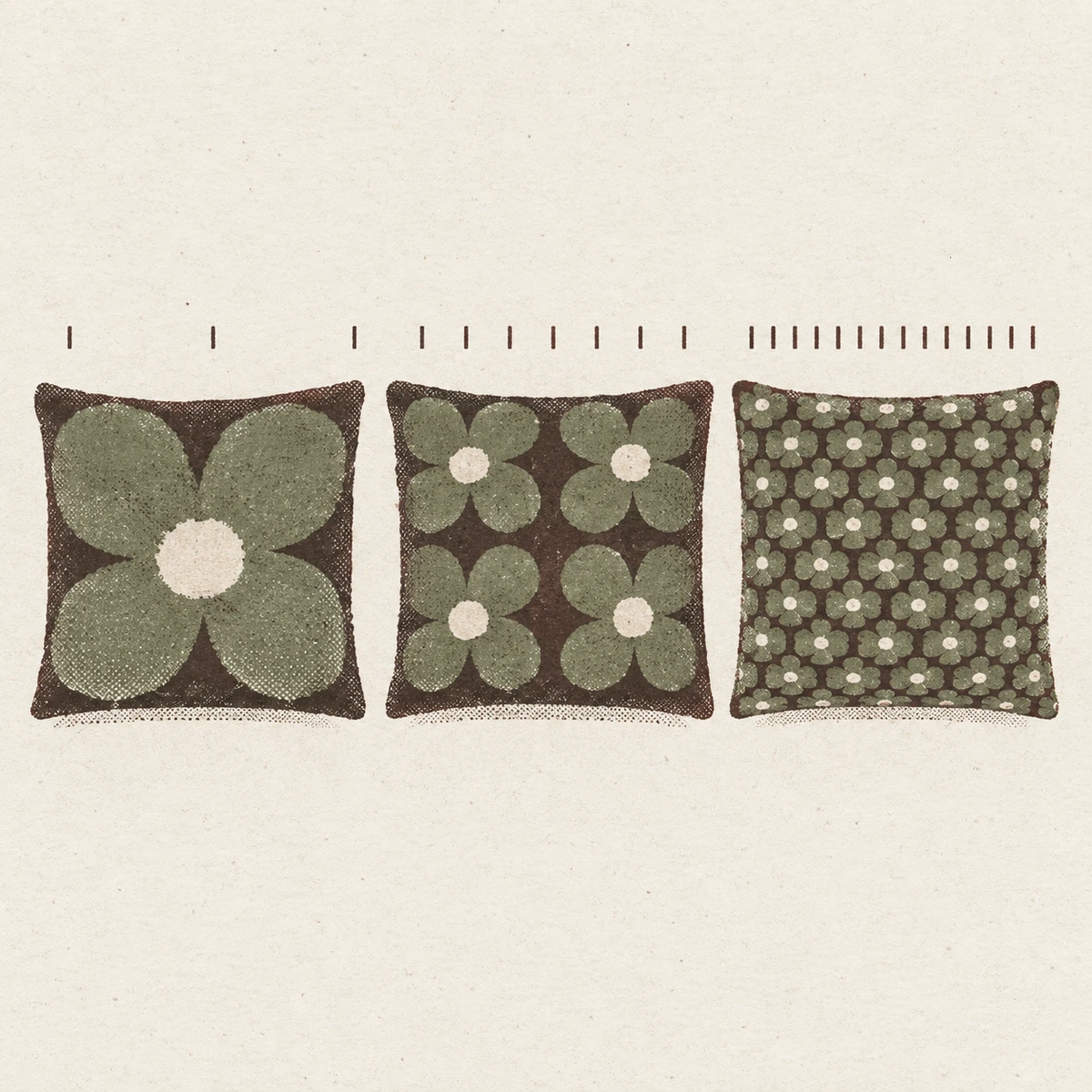
| Size | Drawn | One motif measures | Across an 18 in cushion |
|---|---|---|---|
| LargeThe one you look at | 8 in or widerA motif this size cannot repeat inside a cushion, so you see part of one shape and your eye reads it as a single object. That is why a big print calms a sofa down instead of speeding it up. | Fewer than 2.5 | |
| MediumThe hardest one to buy | 3 in to 7 inMost fabric sold for cushions lands here, which is exactly why rooms go wrong: buy three cushions without thinking and all three are medium. If two of your patterns are already in this band, one of them has to move. | 3 to 6 | |
| SmallReads as a color | Under 2 inAt 6 ft, roughly the distance from a sofa to the chair opposite, a motif under two inches stops being a shape and turns into texture. That is the job. It fills the gap between your two real patterns without adding a third thing to look at. | More than 9 |
Color is the thread
One color in all three, and the motifs can be strangers
Sizes stop the patterns fighting. Color is what makes them look like they arrived together instead of separately, and it is one color, not a palette.
Pick a color that shows up in all three fabrics. It does not have to be the main color in any of them. A terracotta flower on cream, an olive check with a terracotta line running through it, a cream stripe with a terracotta edge: the terracotta is present in all three and absent as the lead in two. That is enough. Your eye finds the repeat without being told.
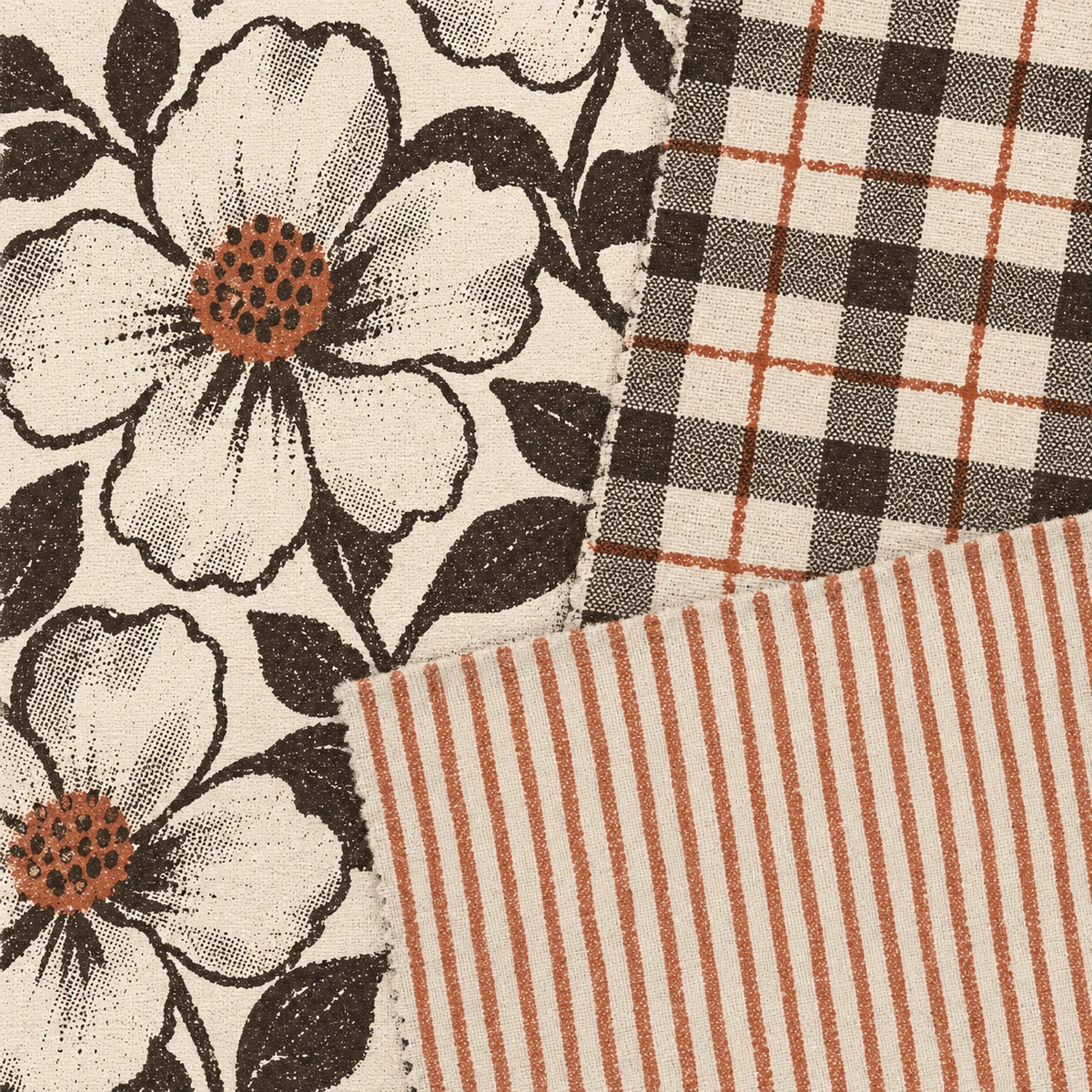
The version that fails is picking three fabrics in three colors you like and hoping. Liking all three is not a relationship. One shared color is.
If you want a number for how much of each color goes where, that is a different rule and it already has its own page: the 60 / 30 / 10 split. Your patterns almost always end up on the smallest share of the room, the 10.
What goes wrongMatching the thread color exactly across all three. Fabric dye lots never agree and a near miss looks like a mistake, where a deliberate difference looks like a choice.
When the room is small, and when the sofa is not yours
Two patterns beat three in a room under 10 by 12 ft
In a big room you see the patterns in sequence, one wall at a time, and three is comfortable. In a rented box where the sofa, the window and the bed are all inside one glance, three patterns arrive at once and the middle one is the first casualty. Drop it. Keep the large and the small, because those two are the furthest apart and the gap between them is what you were buying.
-
Free
Drop the medium, keep the extremes
One big print and one that reads as texture. Two patterns that far apart never compete, and in a small room the empty middle is doing the same job that empty shelf space does on a bookcase: it gives your eye somewhere to land.
-
One decision
Put the big pattern on the thing you cannot move
In a small room the largest pattern belongs on the fixed surface: the curtain, the bed, the sofa if it is yours. Small rooms have one wall you always face, and a large print on a fixed surface gives that wall a center. Put the big print on a floating cushion instead and it wanders around the room every time somebody sits down.
small room, and she has already taken the good half of it
-
Work around it
If the landlord’s sofa is already patterned, it is slot one
Furnished rentals hand you a pattern you did not pick, and it is almost always medium, which is the hardest band to work around. Measure the motif. If it lands between 3 in and 7 in, your job is now one large print and one that behaves like a solid, and nothing else in that band. A throw over the back changes how much of it you see, which is the only lever you have without buying a sofa.
-
Count first
Windows count, and so does the rug
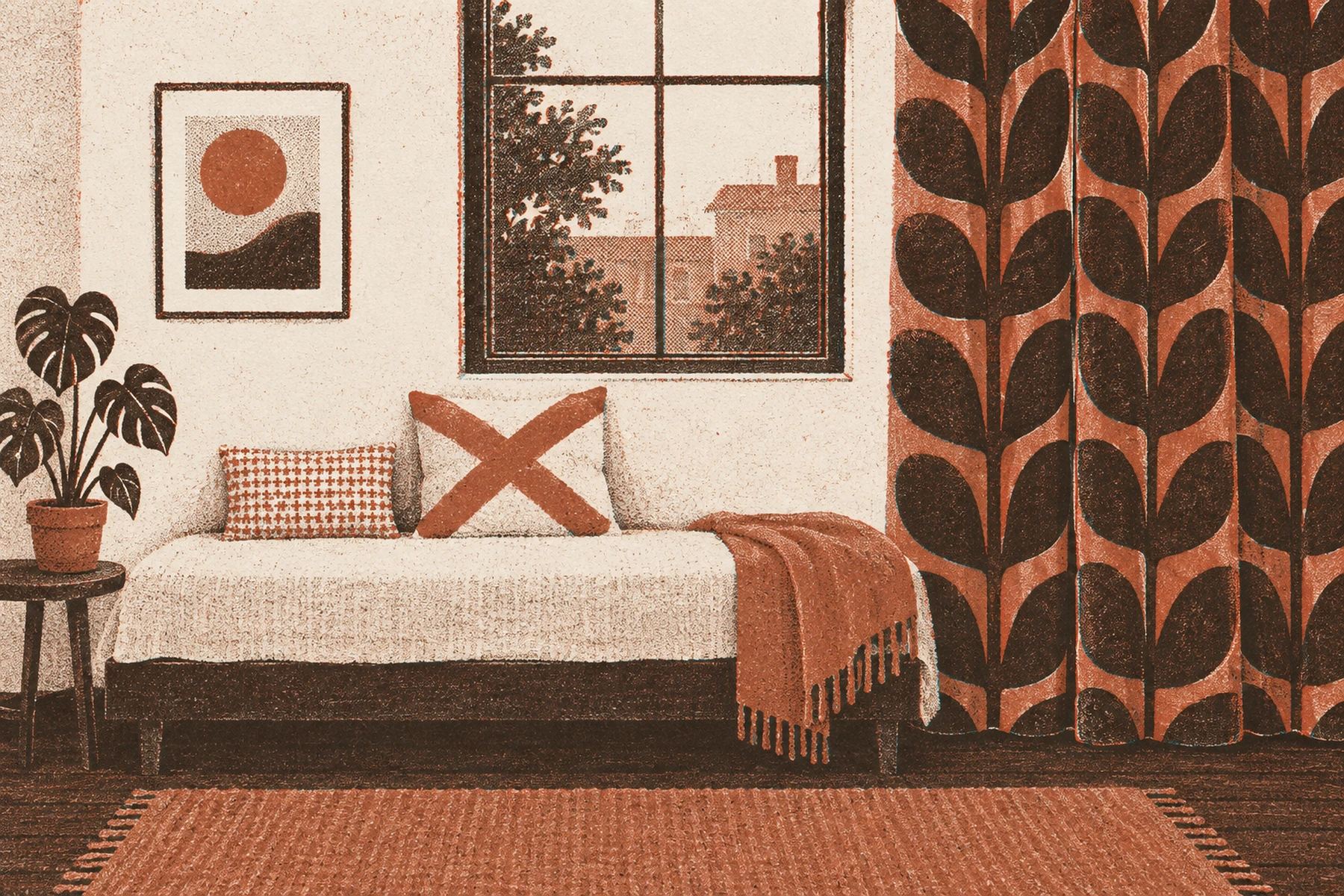
People count cushions and forget the two biggest patterned surfaces in the apartment. A patterned curtain is a large pattern whether you meant it or not, and a patterned rug is usually a medium one. Count them before you buy anything, or you will get home with a fourth pattern and no idea why the room got worse.
Quick answers
The questions people type
Three, as long as all three are different sizes: one large, one medium and one small enough to read as a plain color from six feet away. The number on its own means nothing. Five patterns at five different sizes will look calmer than two patterns at the same size, because size is what your eye sorts by before it looks at anything else.
Yes, if one flower is roughly three times the size of the other. Same motif at two clearly different sizes is the safest mix there is, which is the opposite of what most people assume. What does not work is two florals at the same size in different colors, because then nothing tells your eye which one to look at first and it keeps checking both.
Scale is the width of one whole motif before it repeats. Measure it with a tape or hold the fabric against an 18 inch cushion and count how many whole repeats fit across. Fewer than about 2.5 is large, 3 to 6 is medium, more than 9 is small. That count is the only measurement you need to mix patterns.
One shared color across all three is what makes a mix look deliberate, but it comes second. Sizes stop patterns fighting. Color makes them look related. The shared color does not have to be the main color in any of the three, and it should not be an exact match, because a near miss between two dye lots reads as an error where an obvious difference reads as a choice.
Use two instead of three, and drop the medium one. In a room under about 10 by 12 feet you see every pattern in a single glance, so keep the two that are furthest apart: one large print and one small enough to behave like a solid. Put the large print on something fixed, like the curtain or the bed, so the room has a center that does not move.
Measure its motif first, because that pattern is now slot one whether you like it or not. Most furnished sofas land in the medium band, 3 to 7 inches, so everything you add has to sit clearly above or clearly below that. A large print cushion and a fine stripe throw will do it. A throw folded over the back also cuts down how much of the sofa pattern you see, which is the only real lever you get without replacing furniture you do not own.
Where next
Three things worth your next five minutes
 Read next
Same argument, different surface: sizes, not quantity.
How to style a shelf in five moves
Get the five moves →
Read next
Same argument, different surface: sizes, not quantity.
How to style a shelf in five moves
Get the five moves →
Measured in a rental · Checked Sep 15, 2026