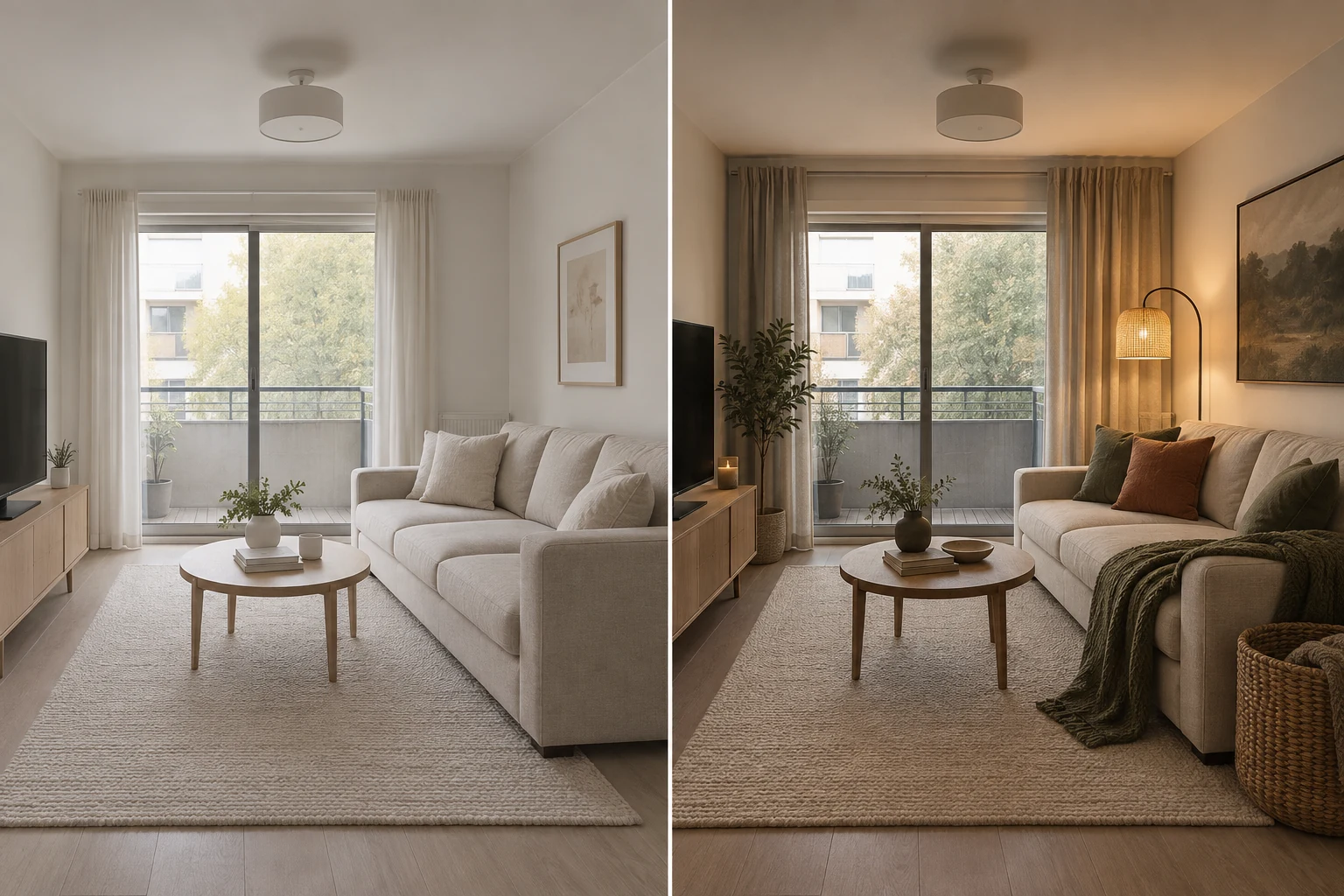
What is the 60-30-10 rule, and how does it work when you cannot paint?
No. 27 · Color · Checked Sep 15, 2026

By NoraLease and Layer · Checked Sep 15, 2026
Some links go to Amazon. As an Amazon Associate I earn from qualifying purchases. How this works
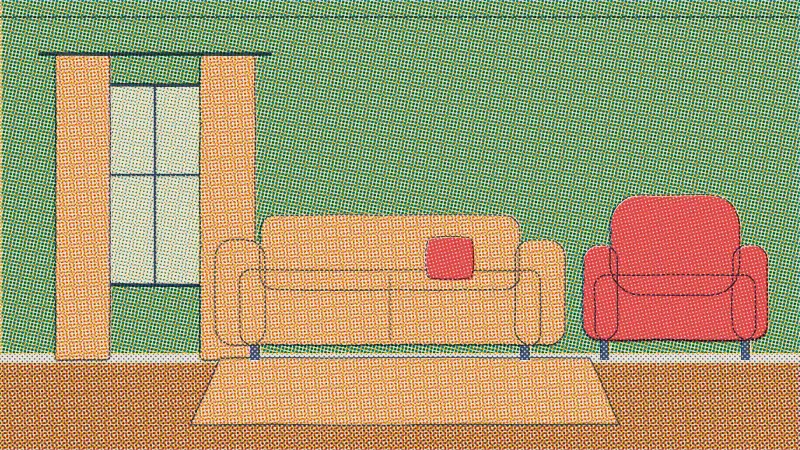
Sage walls, camel sofa, rug and curtains, one coral armchair.
In this guide
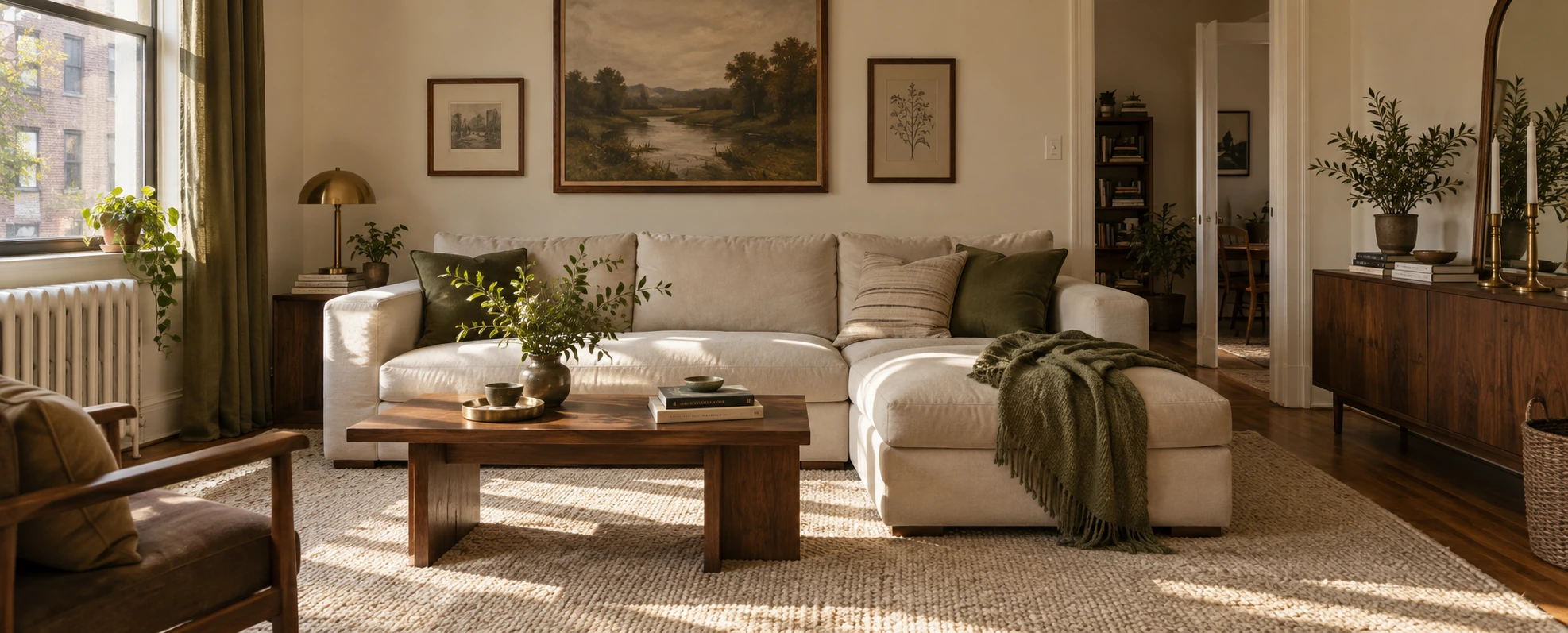
Six pages here tell you to use 60-30-10. None of them stop to say what the numbers are.
The rule says one color covers about sixty percent of what you see, a second thirty, a third ten. Every color article repeats it, calls it a designer secret and then starts on paint, where it stops being useful to a renter.
In a rental the sixty was settled before you got the keys: the walls and the ceiling, rolled beige by somebody in 2019, and in a normal living room walls and ceiling are about sixty percent of everything you see.
Bad news for four seconds, then the freeing part: two decisions, not three. Find out what your sixty already is, then spend on the forty you control.

No. 27 · Color
Sixty, thirty, ten, and what each one is doing
Three jobs rather than three colors.
Sixty is the ground. The color your eye rests on and stops noticing: the walls and the ceiling. A loud sixty never lets you sit down.
Thirty is the direction. Sage, clay, dusty blue, charcoal: loud enough to read from the doorway, not to shout. The sofa you are keeping, the rug and the curtains do almost all of it.
Ten is the spark. The most saturated color in the room on the smallest area, and small still means an armchair, not a coaster. I come back to that.
Bend the proportions if you need to and keep the order: ground, direction, spark. Skip it and you end up with a room full of sparks.
The paper trail
Why it works is “anybody’s guess,” says the man who wrote it down
The earliest place I can find all three numbers is a 1997 Better Homes and Gardens decorating book, where they split three fabrics. The earliest color version is a paperback from 2000, Color Therapy at Home, by the Chicago designer Mark McCauley, who also wrote the rule up for HGTV’s website. His evidence was magazines: the rooms you like most, he wrote, come out at sixty, thirty and ten. Then, in his own words: “Why this works is anybody’s guess.”
It is not ancient, and it is not the golden ratio, which splits a thing in two, about 62 and 38; split the smaller part again and you get 62, 24 and 14, a different rule. The suit, jacket sixty, shirt thirty, tie ten, is McCauley’s own way of explaining the room, not where the room came from. The idea underneath is older: in 1905 the painter Albert Munsell balanced a strong color with more of a weak one, twice as many violets as buttercups, and in 1961 Johannes Itten gave ratios that change with every pair of colors. None of them is sixty, thirty, ten.
- A room with one color that leads, one that backs it up and one that gets looked at is easy to read, and three colors decided in advance is how you do not come home with five.
- How much of each color you use changes how good a room looks a little, mostly with loud colors. In tests, people keep drifting toward half and half.
- I could not find a study that compared sixty, thirty, ten with seventy, twenty, ten or fifty, forty, ten.
- People rate colors from one family, and lighter colors, as more harmonious. That measures what people like, not what a color does to them.
- Paint that promises calm or energy. In booths painted Cool Down Pink, Energy Red and Relaxing Blue, moods did not change, and test scores did not do what the labels promised.
So pick colors because you like them, and use the rule for what it is good at: sizes.
Drawn to scale
Three equal squares is why the rule never sticks
Most drawings of this give each color the same box and change only the label. Here the areas are real, and the ten is an armchair and a print, with two pillows repeating them, instead of a scatter of small things.
- 60The walls, and the ceiling you cannot see here. Inherited.
- 30The sofa you are keeping, two curtain panels and the rug.
- 10An armchair and a big print. The two pillows only repeat them.
Repaint the same room
Parchment, olive, clay.
Nothing moves when the palette does. The ratio is sizes; colors swap once the sizes are right.

You have been standing in front of that wall for a while now.
The part you inherited
Your sixty is the walls and the ceiling, and it came with the lease
Every color article starts at the paint can. You cannot, so count surfaces instead of objects: stand in the doorway and look at the two you did not choose.

Last step, not the first.
-
The walls, whatever they are
Beige, greige, builder white, that yellow-white that only exists in rentals. Write the color it is, not the one you wish it was. Cannot name it? Hold printer paper against it in daylight: the lean is pink, yellow or gray, and it agrees or fights with everything you buy.
-
The ceiling, which counts too
Look up. In a living room 12 by 15 ft with an 8 ft ceiling, the walls come to about 370 sq ft once two windows and a door are out, and the ceiling adds 180. Floor, rug, furniture and curtains are about 330, and every small thing together about 25. Walls plus ceiling: 61 percent. The sixty is not a choice. It is drywall.
-
Name the average
One word for walls and ceiling together: warm neutral, cool neutral or warm gray. That is your sixty, and the only fact you need from this step. Everything below has to go with it.

Every answer after this is a size.
No. 27 · The thirty
The thirty starts with the thing you cannot return
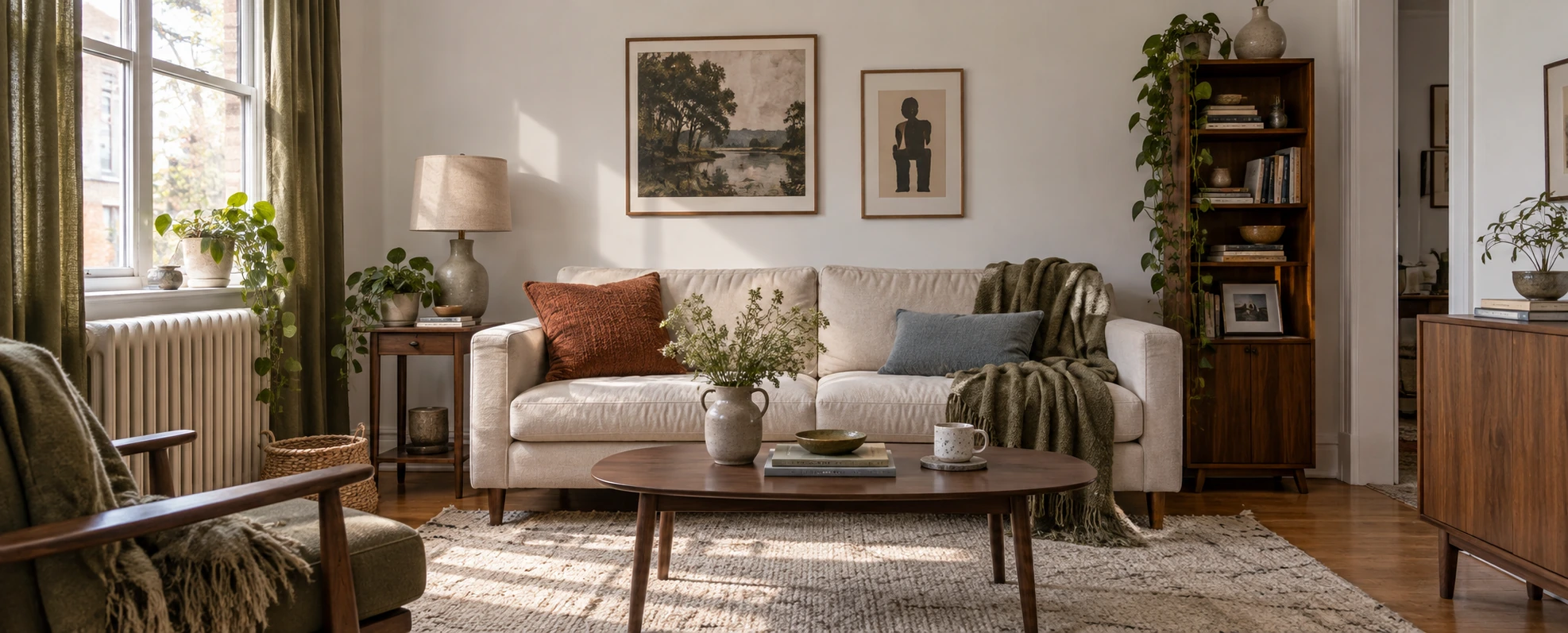
The sofa you are keeping is already in it, whatever color it is, and the floor you cannot change is what it stands on. Decide around those two first, then make the rug and the curtains agree with them. Paint, if you ever get to use it, goes last: it comes in thousands of colors and your sofa comes in the one you bought.
Look down before you buy. Orange laminate, gray vinyl plank, beige carpet that has seen four tenants: a warm orange floor under a cool gray rug is the commonest reason a room feels wrong for no nameable reason. Then look at the sofa. If it is gray and the rest is warm, the rug and the curtains have to bridge it, not fight it.
Curtains do most, being the only thing in a rental that runs ceiling to floor. A pair of 96 in panels puts a band of color down each side of the window, the closest to painting a wall you are allowed.
Then buy curtains, rug and bedding in that order. Stop after two and the room still works, which is not true the other way round.
The pieces you buy, and what each one does
Sage, because sage is the thirty above. Swap the color, keep the sizes.
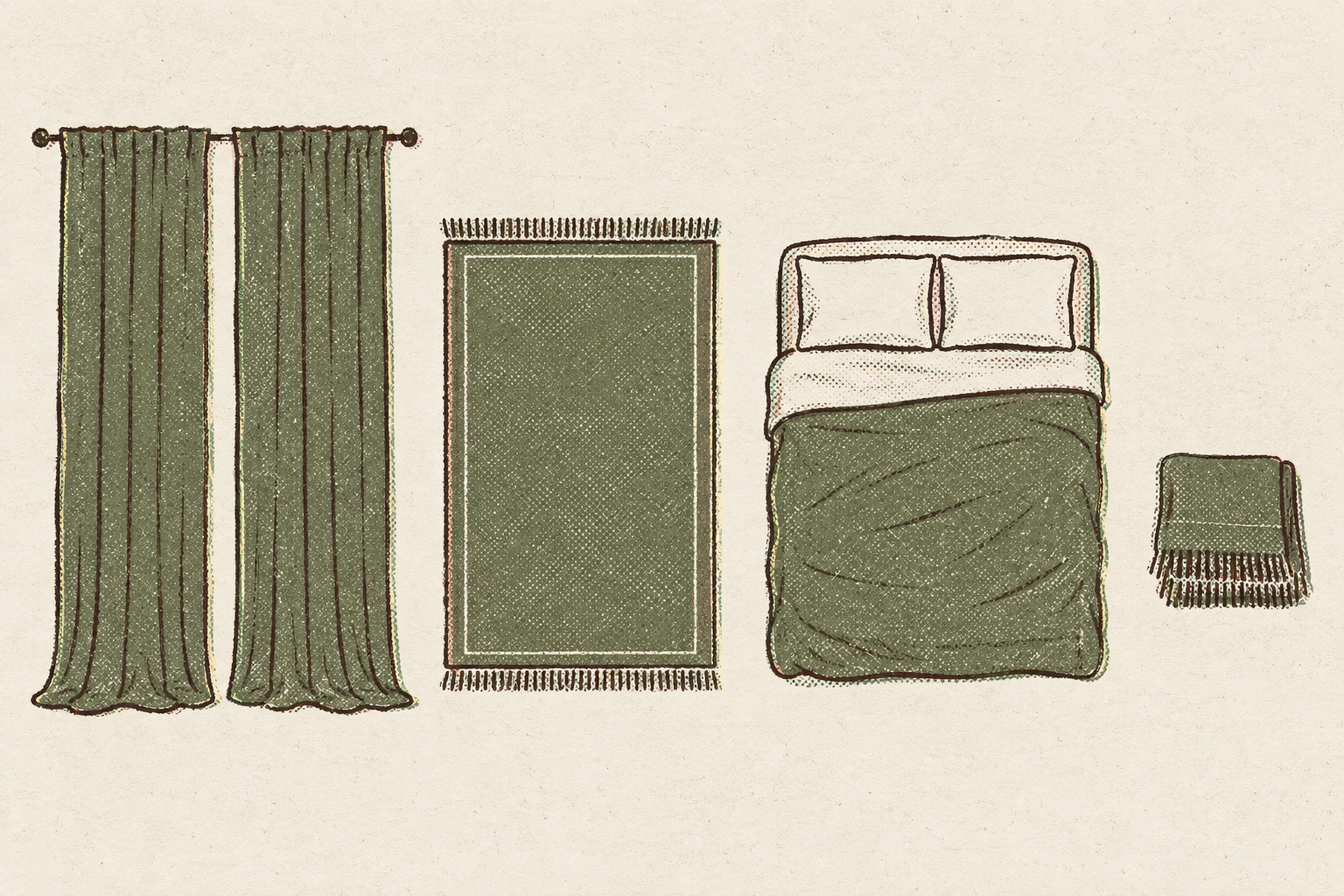
| Piece | What it does for the thirty | See it |
|---|---|---|
| Curtains Two panels |
96 in back tab semi sheer in sage.The largest area of chosen color a rental allows, down again in ten minutes. Semi sheer, or the room goes green by four. | See them in the short answer |
| Rug Living room |
8 × 10 ft washable, low pile, sage.The horizontal half: it covers the floor you did not choose, and low pile lets a door open over it. | See the 8 × 10 sage |
| Bedding Duvet cover |
Queen, washed cotton, solid sage.A bed is a third of a bedroom, so the duvet is the thirty on its own. Solid, not floral: a pattern here kills the accent step. | See the queen duvet cover |
| Throw The test, not the thirty |
50 × 60 in chunky knit in sage.The piece that moves: sofa in January, bed in June. At about 20 sq ft it is too small to be the thirty, and it is the cheapest way to test a color against the sofa you are keeping. | See the 50 × 60 throw |

The half a landlord never sees.
Solid first, always. Once the thirty is settled and you are ready to trade one of those solids for a print, three patterns at three different sizes is what keeps the mix from fighting instead of just adding noise to the color you already picked.
No. 27 · The ten
The ten is bigger than you think: an armchair, not a coaster
The number nobody gives you. In that 12 by 15 ft living room, cushions, a throw, a lamp, art and a vase come to about 25 sq ft: three percent. A real ten is about 90 sq ft (8 m²). Three cushions will not get you there. An armchair and a pair of curtains will.
So give the ten one piece with size, in the most saturated color in the room, then repeat it small in two more places. If your accent fits in a tote bag, it is a garnish.
An armchair, a pair of curtains or a large print in the accent color. This is the ten; the other two only repeat it.
Across the room, not beside the first. Diagonal is the trick.
Low and small: candles, books spine out, a tray. This one makes the other two deliberate.
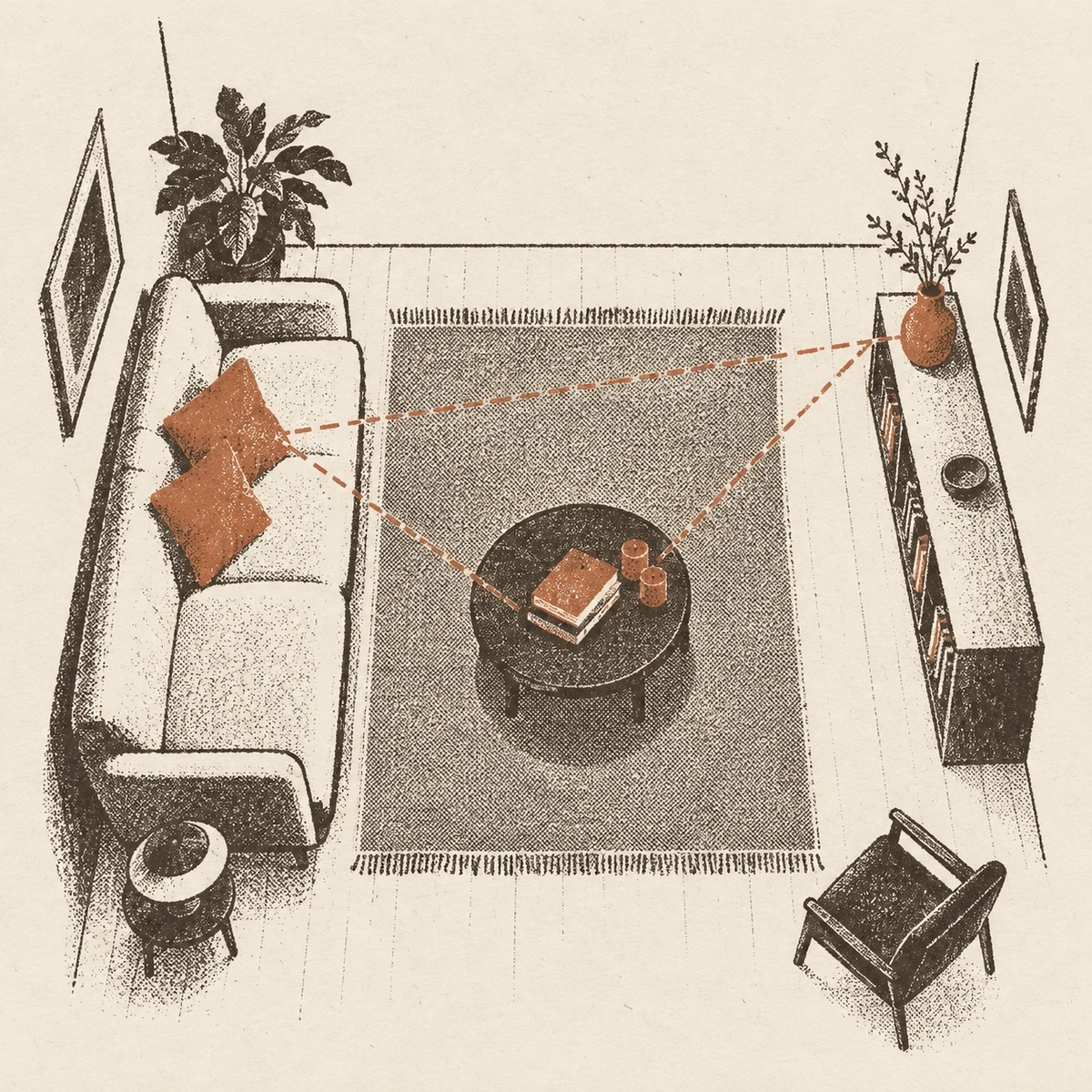
Three is a stylist’s habit, and nobody has tested it. One small thing in the accent reads as an accident, the big one and two echoes read as a plan. Spread them: three on one shelf is one appearance in disguise. See the chair and the print in the drawing.
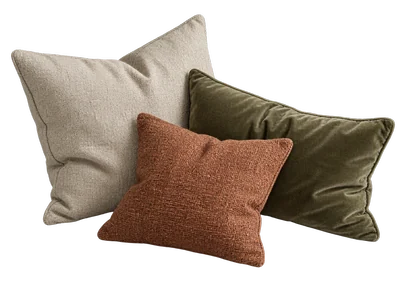
An echo, not the ten.
| Where it goes | What it is, and why that one | See it |
|---|---|---|
| Sofa or bed Echo on the sofa |
20 × 20 in velvet covers, burgundy, pair.Covers only: keep your inserts, change the accent next year for the price of two covers. Velvet holds a dark color flat-free. | See the 20 × 20 pair |
| Shelf or console Echo across the room |
Rust red ceramic vases, three heights.A set is the diagonal on its own: one high, one across, one low. Matte, so it reads as an object. | See the rust red vases |
| Far wall or shelf Echo across the room, if the vase is out |
8 × 10 in framed abstract with burgundy in it.Small on purpose. Leaned on a shelf it puts the accent across the room without a nail. | See the 8 × 10 print |
| Table height Echo, low |
10 in burgundy tapers, unscented, five.Unscented matters: a candle chosen for color and one chosen for smell are different purchases, and mixing them gets a vanilla living room. | See the 10 in tapers |
| Anywhere Free |
Books you already own, turned spine out.Pull every red spine off your shelf: a low echo that costs nothing. Not a joke, it is what I do first. | No link, on purpose |

A low echo, already owned.
Three that work
Steal a split instead of inventing one
Three palettes the site already uses, written as sixty, thirty and ten. Each starts from a neutral you probably have, which is why they work in a rental.
If none of the three below is you, do not invent one from scratch. Pull the sixty, thirty and ten straight out of a painting you already love, the same way these three were built.
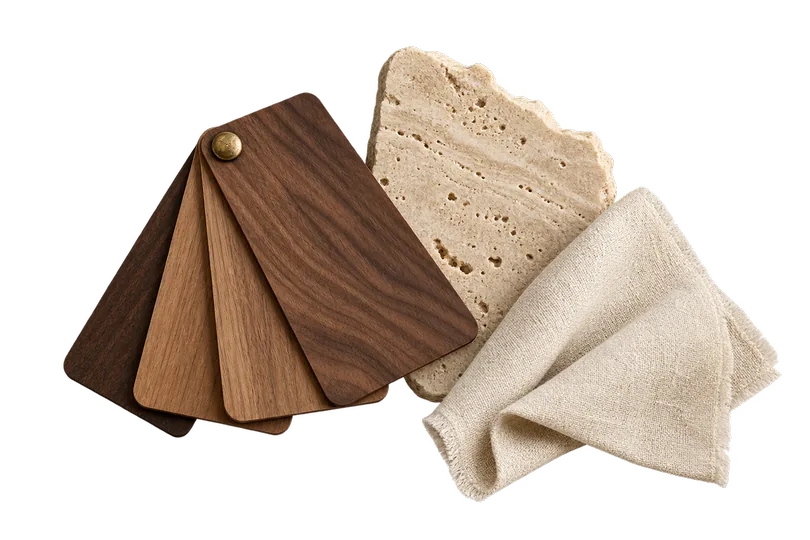
Sample the thirty first.
Cream, walnut, olive
The easiest on a beige wall, because cream and beige are relatives. Walnut carries the thirty through the furniture you keep; olive is the ten, on a tree or a chair before it goes on a pillow.
- Cream
- Walnut
- Olive
Oatmeal, dark oak, rust
For a floor already orange, because rust agrees with it instead of arguing. Dark oak carries the thirty through furniture, so pick this if you inherited brown furniture.
- Oatmeal
- Dark oak
- Rust
Cream, dusty blue, oxblood
The only one with a real accent, and what people mean by how much color is too much. Dusty blue is calm enough for a whole rug; oxblood beside it is the ten, and ten percent is more than it sounds.
- Cream
- Dusty blue
- Oxblood

Garnish. The ten is a chair.
Copy my palette
Tick what you want and take it with you. Out comes the hex and the material, because a paint code is no use to somebody buying a cushion. The link below rebuilds the selection.
Nothing ticked yet
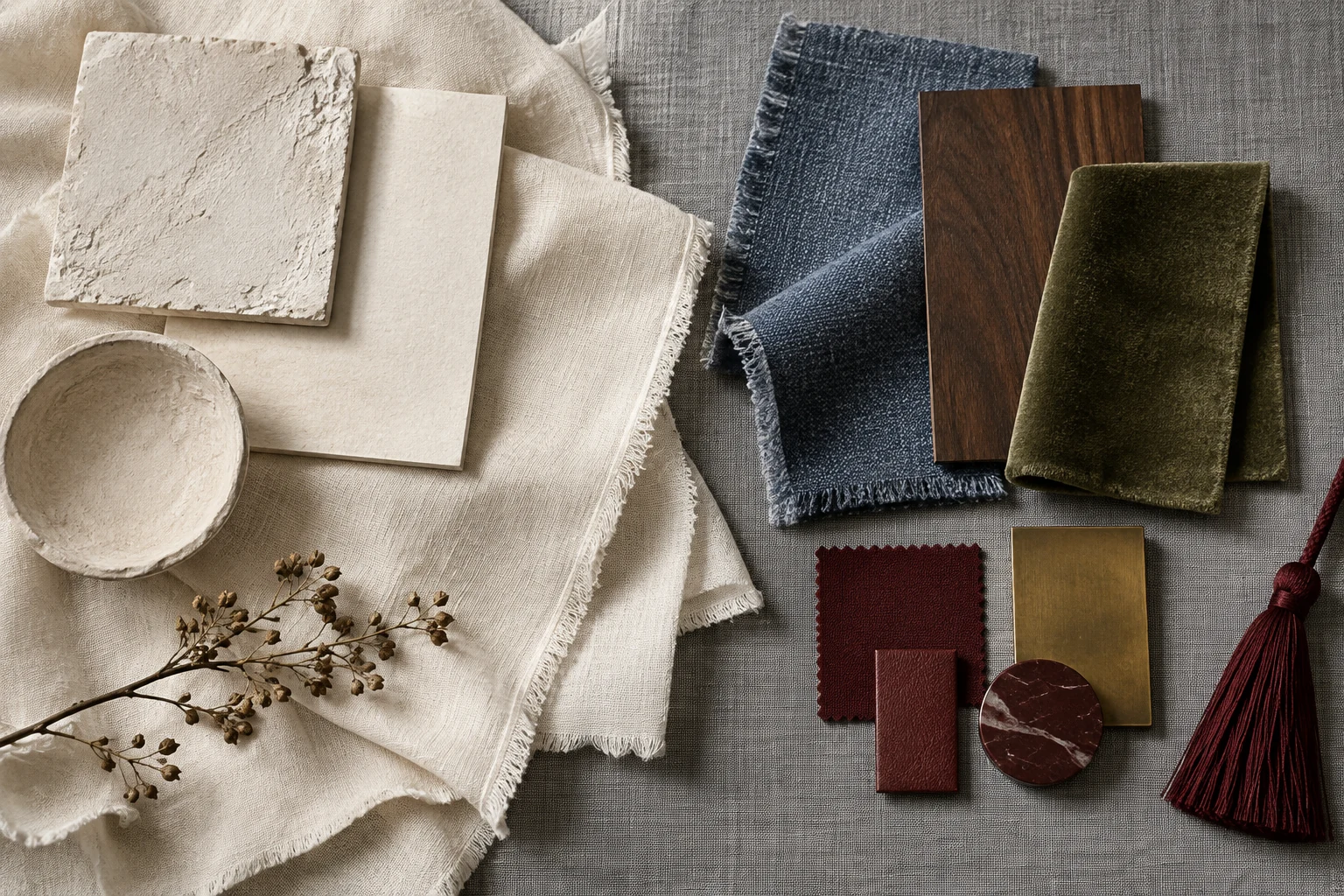
Four years on. Pick a thirty you like worn: that is the state you see longest. See the six materials new and four years worn →
The honest part
Three rooms need the rule bent
The ratio was written down by somebody looking at rooms that already worked, and nobody has tested it against fifty, forty, ten or seventy, twenty, ten. Treat it as a description, and read these three as my calls, as untested as the rule.
-
A small room
Push the thirty toward forty. In a room under about 120 sq ft the walls are even more of what you see, and a big field of one pale neutral can read as a box. More of the second color, across curtains, rug and bedding, gives the eye somewhere to go. The ten stays a ten, and in a room this size the chair carries it.
50 / 40 / 10 -
A dark room
Same move, other reason. A north facing room drains any pale sixty, so cream walls go the color of dishwater by three. Raise the thirty to real saturation and let it carry. The trap is brightening with more white: white in poor light looks gray, and now the room is gray on purpose.
50 / 40 / 10, saturated -
An open plan
Count the whole floor as one room. Give each end its own sixty, thirty and ten and you have six colors in one line of sight, restless in a way nobody can name. One sixty and one thirty across the floor; only the ten changes, oxblood by the sofa, ochre in the kitchen.
60 / 30 / 10, twice over
Quick answers
The questions people type

She has opinions on all of these and will not be sharing them.
One color on about 60 percent of what you see, a second on 30, a third on 10. The 60 is the walls and the ceiling, the 30 is the sofa, the rug and the curtains, and the 10 is the loudest color on the smallest area: an armchair, not a coaster. The earliest print I can find is a 1997 Better Homes and Gardens book, for fabrics; the color version is Mark McCauley’s, from 2000, and nobody has tested the numbers against any others.
The landlord’s walls and ceiling are your 60, so you are sixty percent done. Start the 30 from the thing you cannot return, usually the sofa you already own, and make the rug and the curtains agree with it. Then give the 10 real size: an armchair or a pair of curtains in the accent color, repeated small in two more places.
When the accent stops being the smallest share. If the brightest color is in the curtains, the rug, the chair and the art, it is competing to be the 30 and the room reads loud. Loudest color on the smallest area, but small means a chair, not a coaster.

A leaned frame moves with the accent.
The color of your 10, and they are its echo, not the 10 itself. Three cushions are about one percent of a living room. Put the accent on something the size of a chair first, then repeat it in the pillows and one more small place.
Yes. Beige, cream, greige and taupe all count. Three close neutrals is one color at 100 percent: on purpose, that is a tonal room and it can look very good; by accident, it is why a room feels flat. Commit to it, or make one of the three different.
Yes. The rule is a brake: three colors decided in advance is how you do not come home with five. Extra colors are easiest inside the 10, oxblood and ochre sharing it, and hardest on a big surface, where two colors end up fighting for the 30.
Where next
Three things worth five minutes
Measured in a rental · Checked Sep 15, 2026