Your room is clean, it is finished, and it is dead. That is a real problem with a real name, and the name is not "bad taste."
A flat room is rarely missing anything. Usually five or six things in it are all doing the same job. Same lightness, same texture, same height, one light, nothing touching anything. Each of those on its own is fine. Stacked up, they make a room that photographs like a catalog page and feels like a waiting area.
The reason it is hard to fix is that you cannot fix what you cannot name. You walk in, you feel the flatness, and the only word you have is "boring," so you buy a cushion and it does nothing. Below are the five names. Read the one that matches, do the small thing, and come back for the next one.
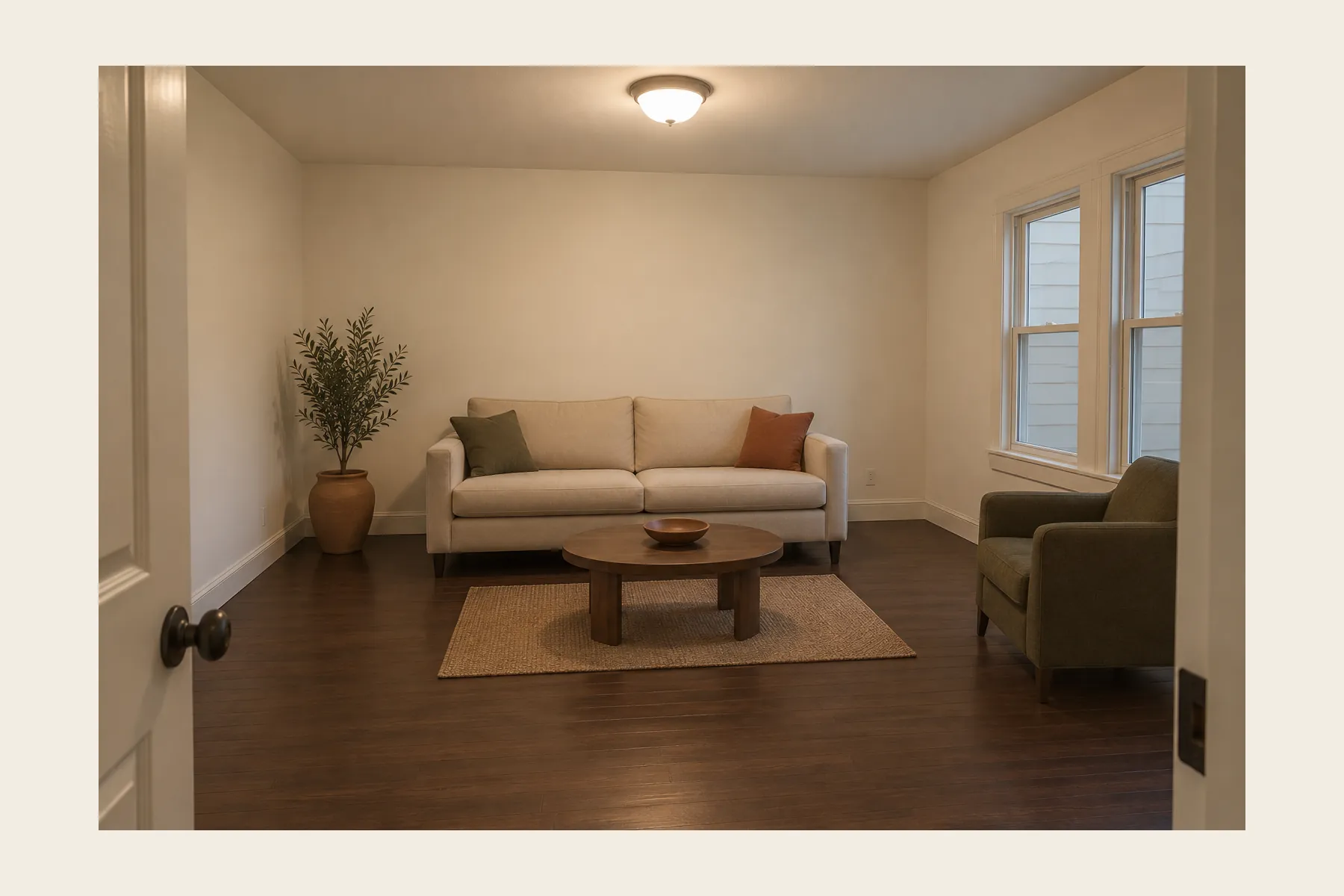
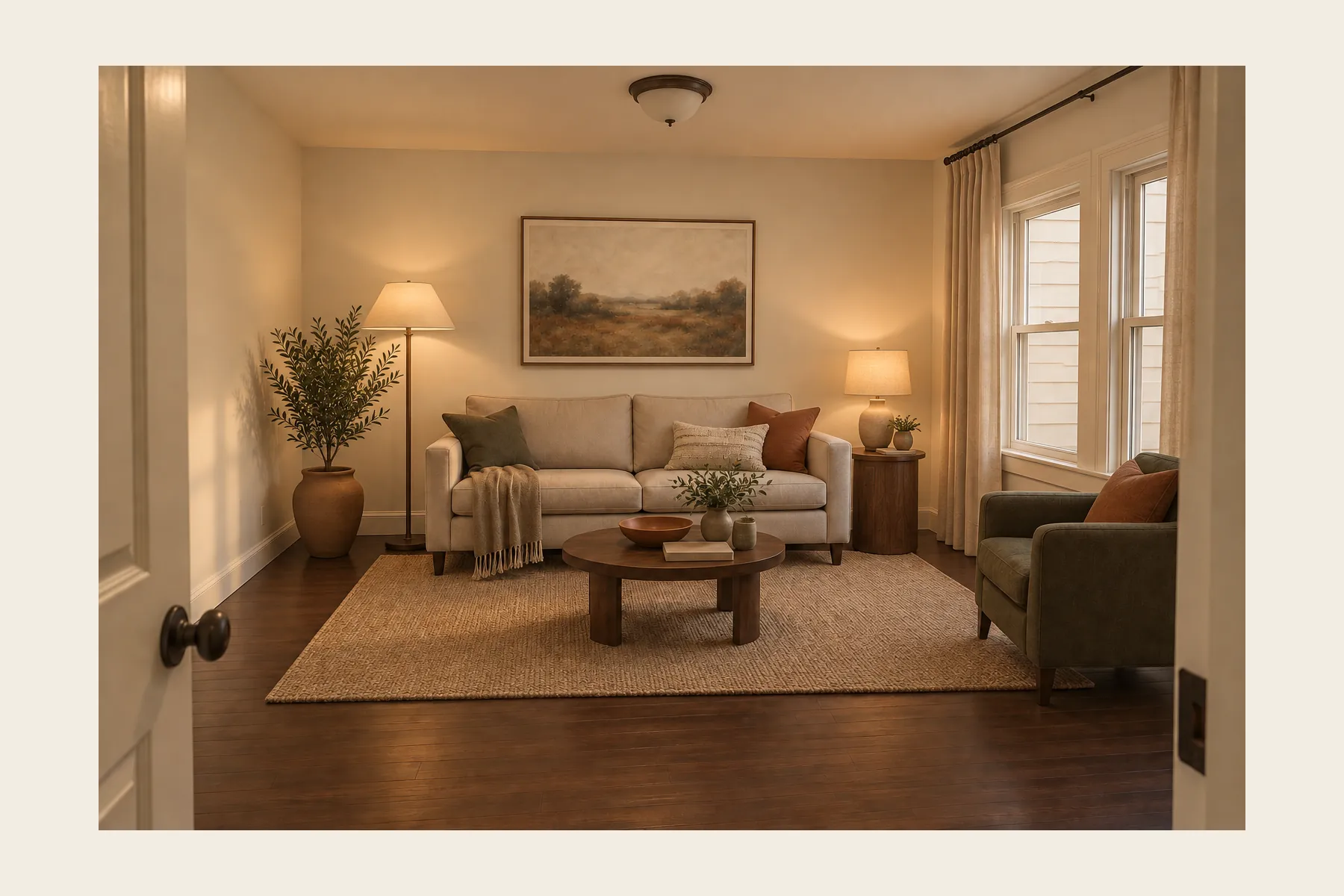
None of this gets fixed by buying another sofa.
The flat room and the good room are usually the same furniture. What separates them is four or five small pieces and about two hours. A new sofa moves nothing on this list except your bank balance, and it arrives in eight weeks.

The other thing worth saying once: a rental starts behind. Flat white matte walls, a floor somebody else picked, a ceiling that is probably 8 ft, and a single light fixture in the middle of it. That is four of the five problems handed to you on day one, along with the keys.
Diagnosis 01
Everything in the room is the same lightness
How you recognize it. Photograph the room and turn the photo black and white on your phone. If the whole picture goes to one mid gray, that is the diagnosis. A flat room is usually not short of color. It is short of range. Beige, cream, greige, oat and bone are five names for the same value, and the eye reads them as one surface with furniture drawn on it.
Why it happens. Every safe purchase is a light neutral, and safe purchases stack. Nobody buys one beige thing and panics. You buy eleven of them over two years, and each one was reasonable.
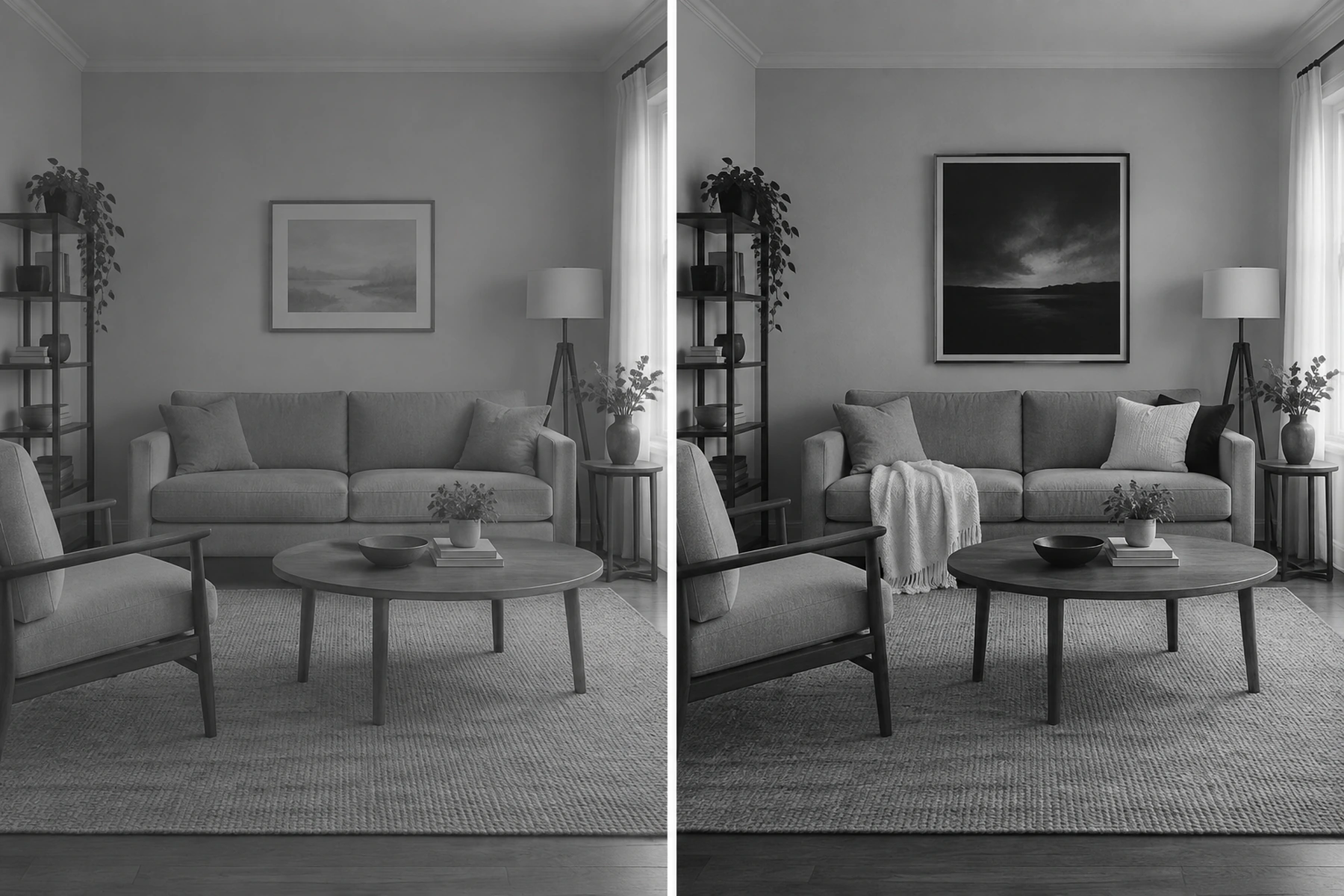
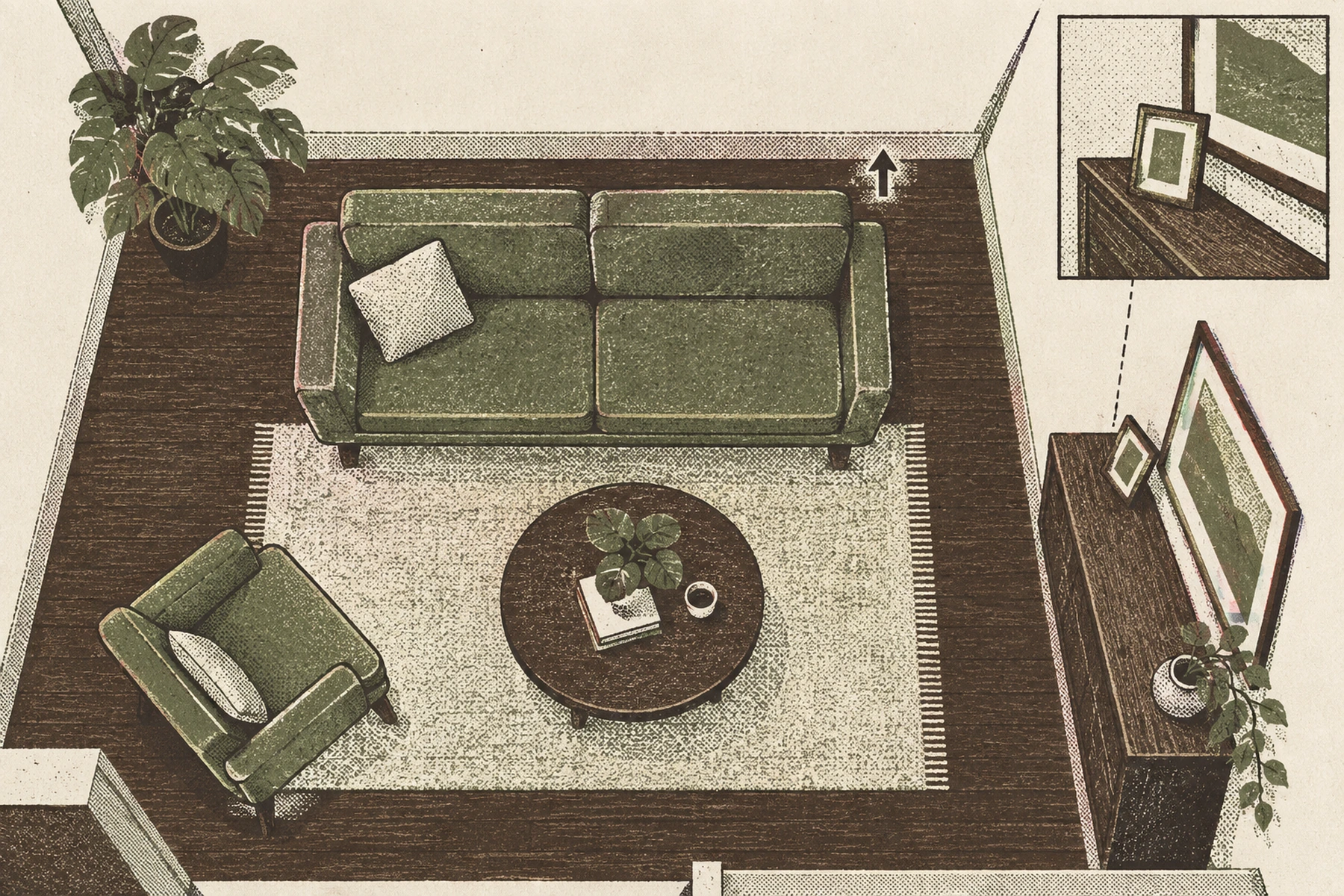
The fix, and it is one piece. Put something properly dark in the room, at eye level, on the wall the sofa faces or above the sofa itself. Not "darker beige." Dark. One object doing the job of the far end of that strip up there. The room reads three dimensional the second it has a floor and a ceiling to its own scale, and a single black frame gives it one.
The proportion question that comes next, which shade goes where and how much of it, is its own page: see how the 60 30 10 ratio works →

She is the only thing in here with any contrast, and she knows it.
-
A 24 × 36 in black frame, hung alone
See the 24 × 36 black frame
One large dark rectangle beats four small ones here. Put anything in it, even a plain print: the frame does the work. Opens Amazon in a new tab
-
Two 18 × 18 in burgundy velvet covers
See the 18 × 18 covers
Covers, not new pillows. Your existing inserts go inside, the beige ones go in a drawer, and you can undo the whole thing in four minutes. Opens Amazon in a new tab
You might not need either. If there is already a dark bookcase, a black TV or a cast iron radiator in the room, you have your dark value and it is in the wrong place. Move a chair so that thing sits in the sightline from the door and check again before you spend anything.

Diagnosis 02
Everything in the room is the same texture
How you recognize it. Walk around and touch six things without looking. If your hand reports the same answer six times, soft, or smooth, or cold, there it is. Most flat rentals are all matte and all soft: painted wall, cotton sofa, cotton cushion, cotton curtain, low pile rug.
Why it happens. Texture is the one thing a photograph cannot sell you. You shop online, everything arrives looking like its thumbnail, and the surfaces were never part of the decision.

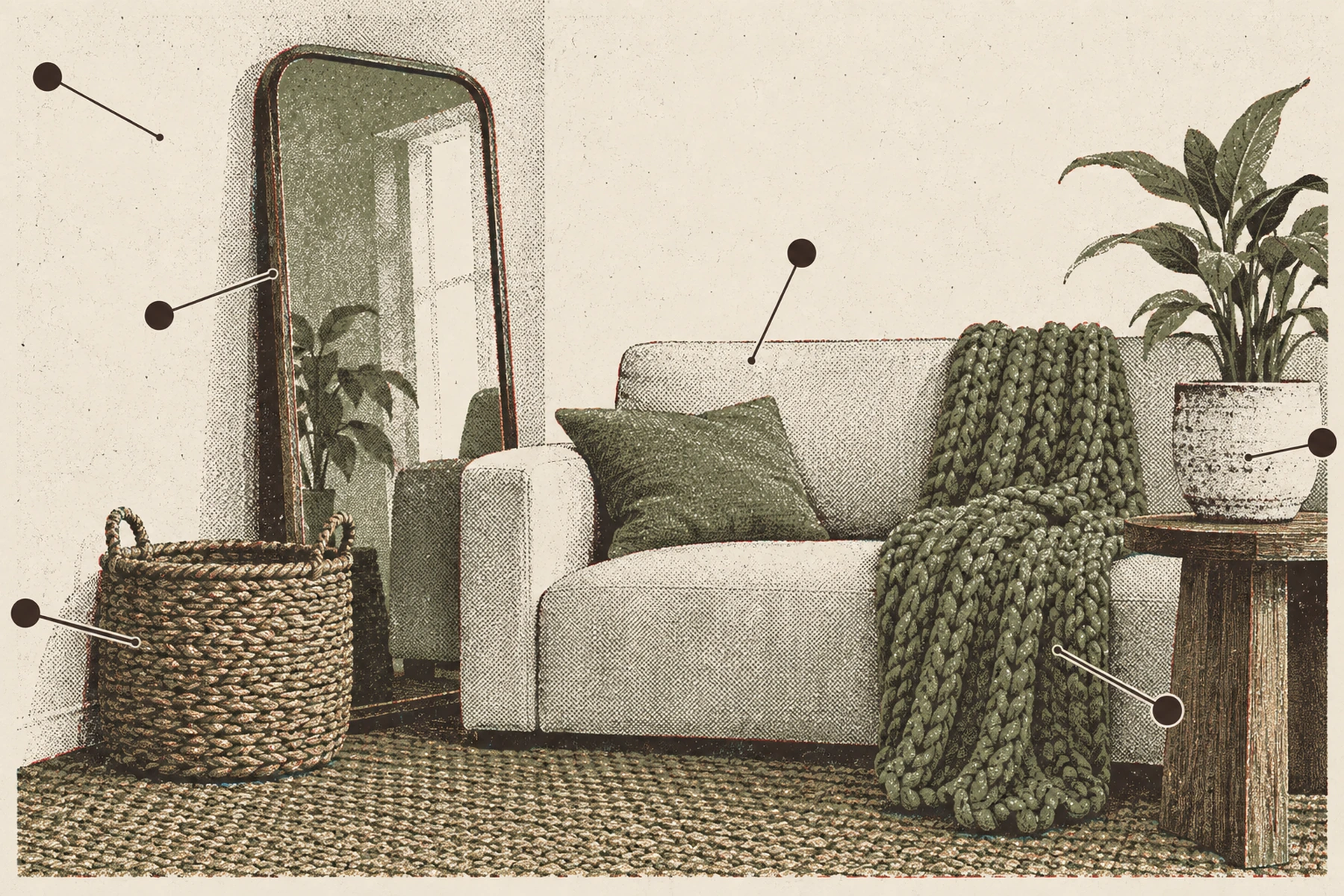
The fix. Three pairs, and you want both halves of each pair inside one sightline. Matte and shine. Smooth and rough. Soft and hard. That is six surfaces, which sounds like a lot until you count what you already own.
Matte and shine
Matte you have: the walls. Shine is what a rental never gives you. A mirror, a glazed pot, a glass of water on a metal tray.
Smooth and rough
Smooth you have: the sofa, the table top. Rough is jute, raw clay, a basket weave you can see from across the room.
Soft and hard
Soft you have: everything. Hard is wood, stone, ceramic, metal. Hard is what stops a room feeling like a bed.
-
A 60 × 80 in chunky knit throw
See the 60 × 80 throw
Buy the one with a stitch big enough to read from the doorway. A thin flat throw adds a color and no texture, which is half a purchase. Opens Amazon in a new tab
-
Two 22 × 22 in boucle covers
See the 22 × 22 covers
22 in is the size that reads as furniture rather than as decoration. Boucle is the cheapest rough surface you can put at seat height. Opens Amazon in a new tab
-
Four 6 in terracotta pots, unglazed
See the four 6 in pots
Raw clay is matte, rough and hard all at once, which is three of the six boxes for the price of a lunch. Put plants in two and let two hold nothing. Opens Amazon in a new tab
-
Three seagrass baskets
See the set of three
Rough at floor level, where a flat room has nothing going on at all. They also swallow the cables and the shoes, which is why I would buy six before I bought one more pillow. Opens Amazon in a new tab
If you already picked up the velvet covers in diagnosis 01, skip the boucle ones. Two sets of cushion covers on one sofa make a cushion collection, and the room will look busier without looking any deeper. One pair of covers, one throw, one rough thing. That is the whole prescription.
The shine half of pair one is the hardest to buy well, so it gets handled in diagnosis 04, where it is doing two jobs at once: go to the light problem →
Diagnosis 03
Everything in the room stops at hip height
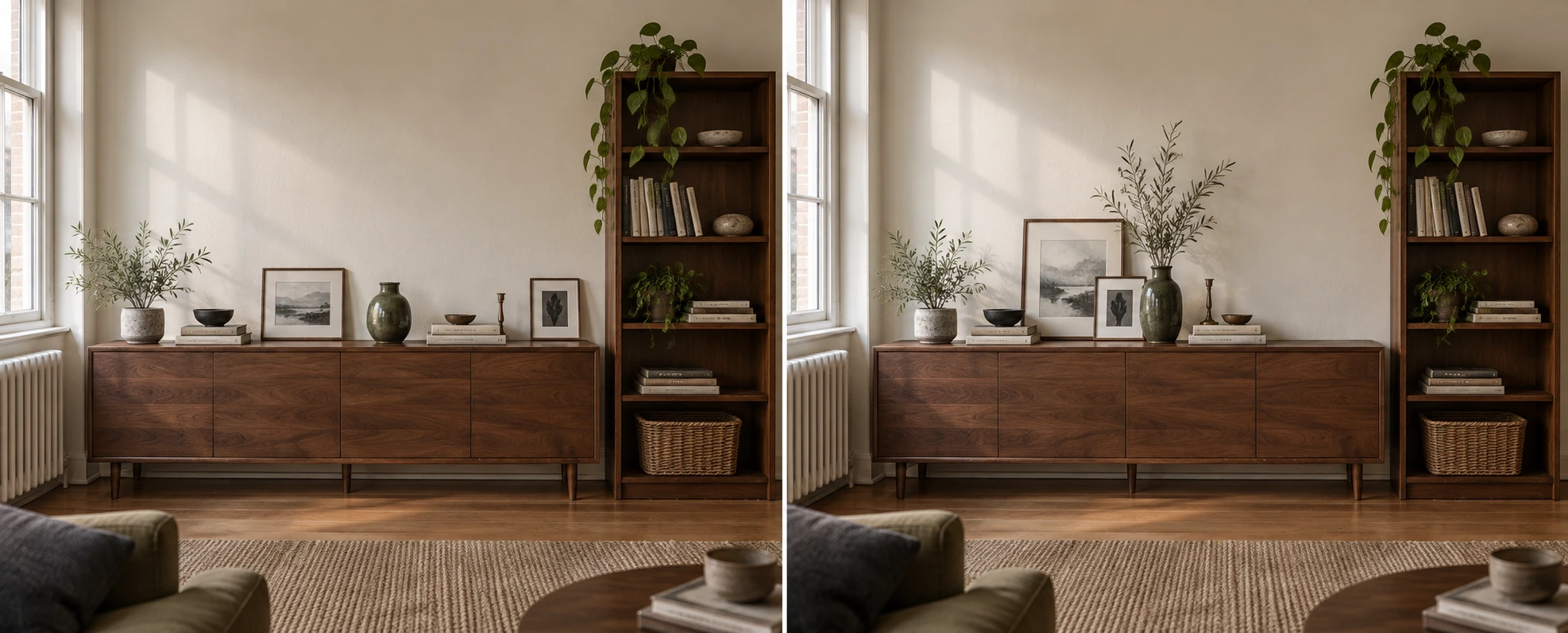
How you recognize it. Stand in the doorway and let your eye run round the walls. If it travels in a straight horizontal line and never has to climb, that is it. Sofa backs land near 32 in. Consoles land near 30. Sideboards land near 32. Coffee tables sit lower but still in the same band. Buy four pieces of furniture from four different shops and they will agree on this without asking you.
Why it happens. Furniture is built to a body. Walls are not furniture, so nobody sells you anything for them, so the top two thirds of a rental stays empty and the bottom third does all the talking.
The fix. Three heights inside one sightline, not four pieces at the same one.
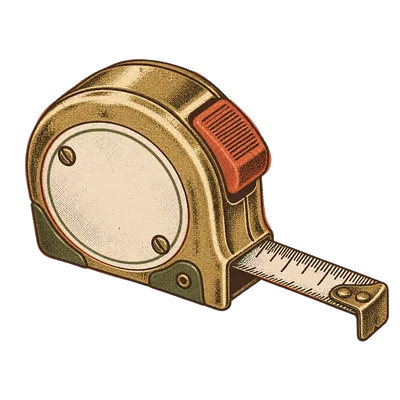
-
01
Floor level, below the furniture line
A basket, a stack of books, a low pot. Something that makes the eye drop before it climbs. Most rooms skip this one entirely and then wonder why the furniture looks like it is hovering.
-
02
The middle, which you already have
This is the band your whole room already lives in. Nothing to buy. The job here is subtraction: if three things sit at 30 to 32 in along the same wall, move one.
-
03
Above 57 in, on the wall or standing
Art centered at 57 to 60 in from the floor, a tall plant, a shelf, a leaning ladder. 57 in sits between standing and seated eye level, and a taller ceiling does not move your eyes, which is why it works in a room with an 8 ft ceiling and why it still works in one with a 9 ft ceiling. See 57 in drawn →

Everything in here ends at the same height. So do you, technically.
If the answer for you is frames on a wall, the spacing and the centering are fussier than they look and they are the difference between one composition and scattered rectangles: lay out the gallery wall →
-
A 5 tier bamboo ladder shelf
See the 5 tier ladder shelf
The renter answer to the high band: it leans, it takes no screws, and it carries the eye from the floor past 60 in in one move. Fill the top two shelves and leave the bottom ones honest. Opens Amazon in a new tab

-
A 6 ft faux olive tree
See the 6 ft tree
6 ft, not 4. A 4 ft tree lands back in the furniture band and disappears. Put it in a corner the light reaches, so the wall behind it gets a shadow to do. Opens Amazon in a new tab
-
Ten black gallery frames
See the set of ten frames
Ten is more than most walls need, and the set is still the cheaper way to get seven matching ones. Center the group at 57 to 60 in, not each frame. Opens Amazon in a new tab
Before you buy any of it: try moving what you own. A tall plant you already have, put on top of the sideboard, solves this for nothing. So does hanging the one picture you own 8 in higher than it is now. Do that first, look again from the doorway, and buy only if the line is still flat.

Diagnosis 04
There is one light in the room and it is on the ceiling
How you recognize it. Turn the big light on at night and look at the corners. If the walls and corners sit dim while the middle of the room glares, and every shadow falls straight down, under the shelf, under the plant, under your eyes, the room is being lit like a corridor. One source directly overhead flattens faces, flattens texture, and kills every surface you went to the trouble of buying in diagnosis 02.
Why it happens. The landlord put it there. It came with the unit. It is the only switch on the wall, so it is the only light you use, and after six months you stop seeing it.
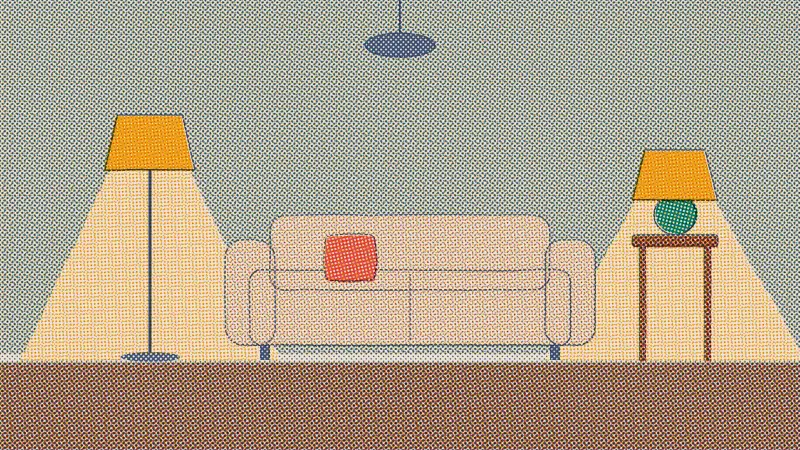
The fix, and this is the one to do tonight. Three lights at three heights, none of them in the ceiling, all of them warm. Then turn the big light off after sunset and leave it off. In the daytime, for cleaning or hunting for an earring under the sofa, it earns its keep. This is the cheapest thing here and it changes the room more than anything else here, an annoying pair of facts.
Height and shade width per lamp are a whole guide of their own, and getting the shade wrong is how a good lamp still looks wrong: see the three lamp layout →. If there is no outlet where the light needs to be, that is a solved problem too: wire it without wiring it →
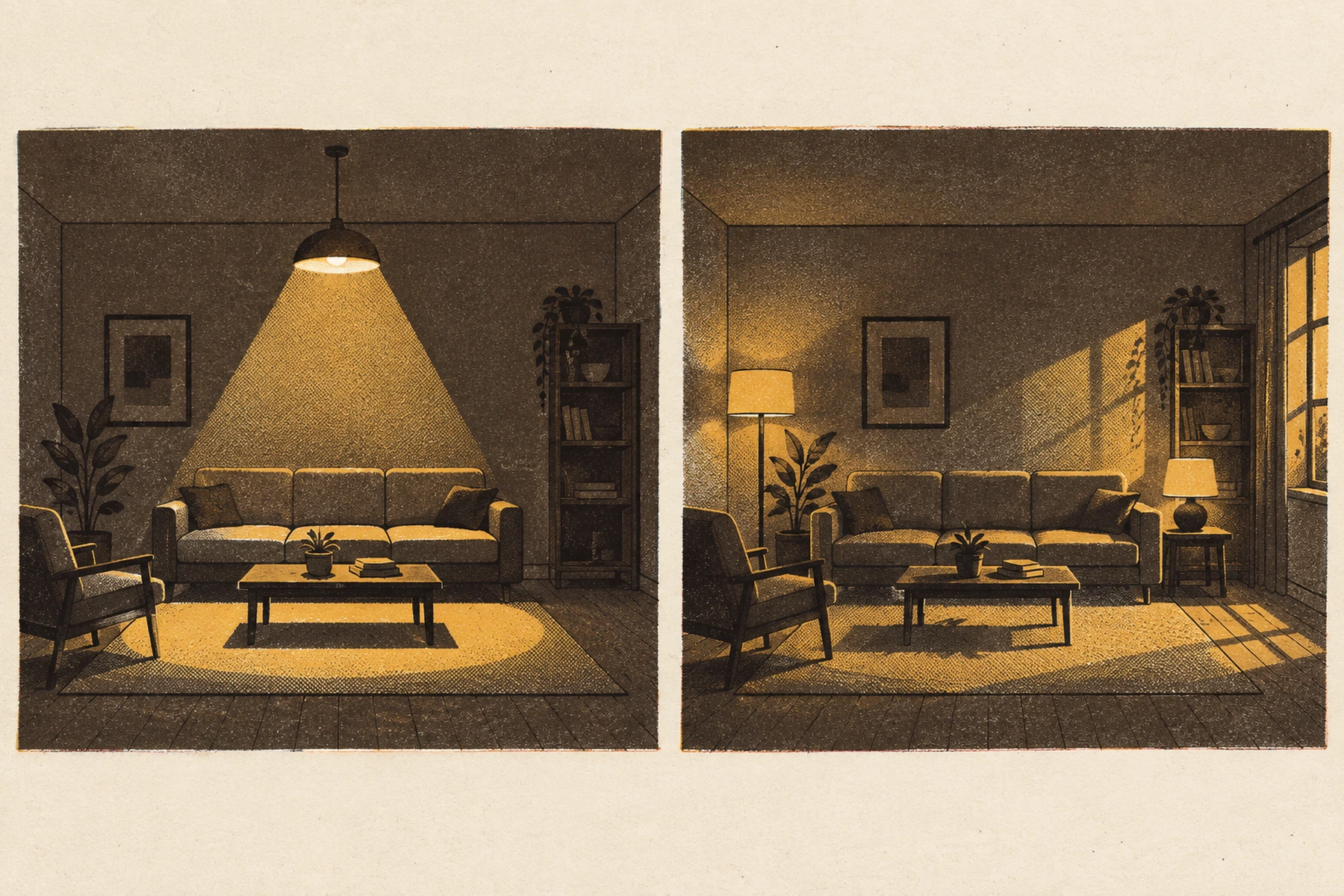
- LowFloor level, one corner
A lamp on the floor behind a chair, or a small one on the bottom shelf. Light from below eye level is kinder to faces than light from the ceiling.
- MidTable height, across the room
Diagonally opposite the low one. Two pools of light at different heights is already a lit room. One is a lamp.
- HighOn a wall or a shelf, above 57 in
A clip light, a picture light, or a bulb bounced off the ceiling from a corner. This is the one that stops the top of the room going black at night.
- All2700K, and dimmable
Warm white, every bulb the same. Mixed color temperature is why a room with four lamps can still look wrong.
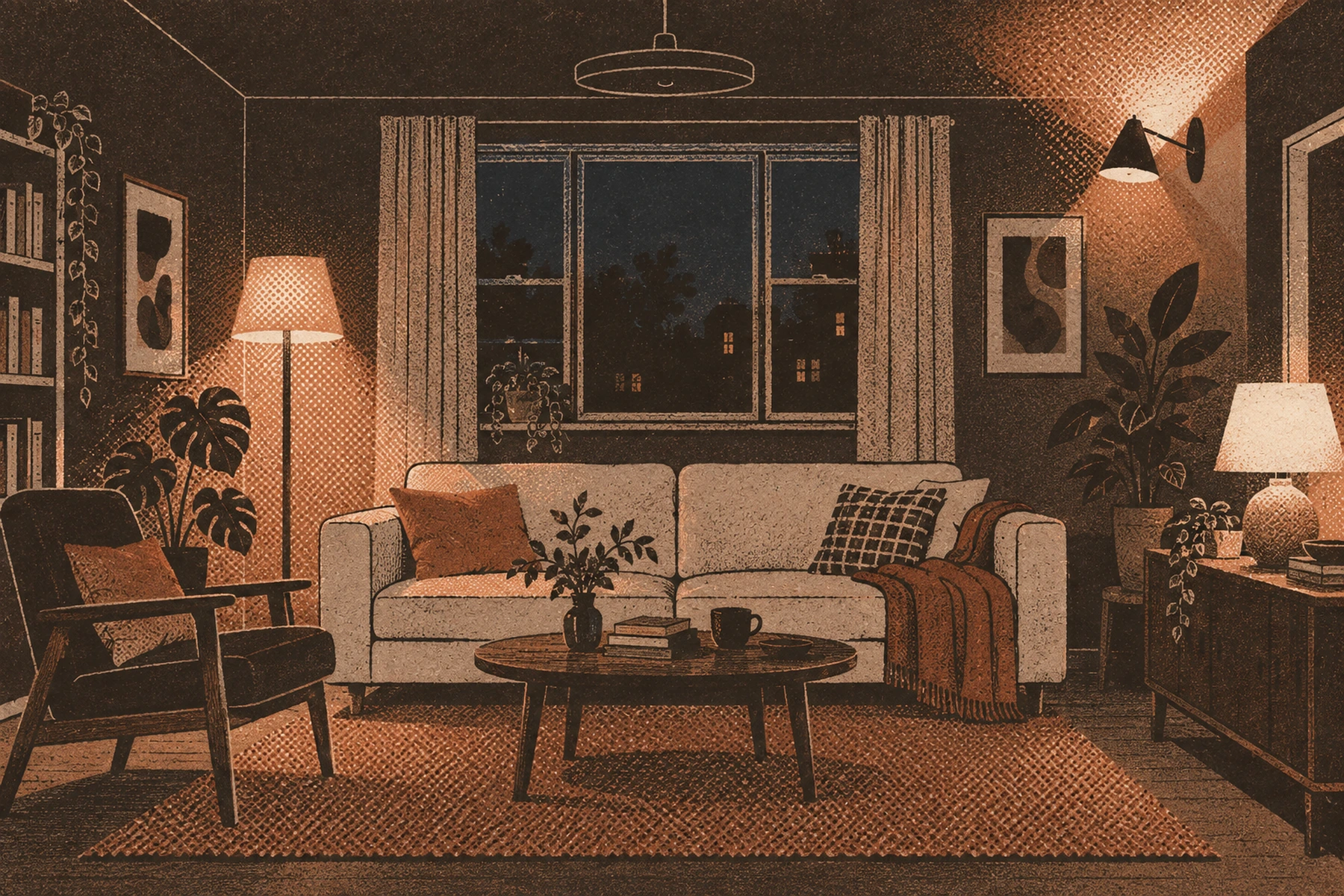
-
A textured ceramic table lamp
See the ceramic lamp
Doing two jobs: the mid light, and the glazed shine from diagnosis 02. A lamp base is the easiest place in a rental to smuggle in a hard, shiny surface. Opens Amazon in a new tab
-
A 27 in brass table lamp
See the 27 in lamp
27 in is tall enough to sit on a console and still put the shade near seated eye level. Metal, so it is your second shine and your second hard surface. Opens Amazon in a new tab

-
A four pack of 2700K, 800 lm bulbs
See the 2700K bulb
Put the same bulb in all four lamps on the same day. Half of what people call bad lighting is three different whites arguing in one room. Opens Amazon in a new tab
-
A plug-in dimmer
See the plug-in dimmer
Goes between the lamp and the wall, no wiring, comes with you when the lease ends. A lamp at 60 percent reads as evening. The same lamp at full reads as an office. Opens Amazon in a new tab
-
A 65 × 22 in full length mirror
See the 65 × 22 mirror
Leaned, not hung, opposite or beside the window. It is a second window, a shine, and a piece that finally goes above 60 in, all in one object. Opens Amazon in a new tab
Buy the bulbs and nothing else this week. Move two lamps you already own to the two corners that have none, put the same warm bulb in both, and switch the ceiling light off for four nights. If the room still feels flat after that, come back and buy a lamp. I would rather you skipped a purchase than bought a third lamp you put in the same corner as the first two.
Diagnosis 05
Nothing in the room overlaps anything else
How you recognize it. Every piece is flat against a wall with a clear border of floor around it. You can see all four legs of everything. There is a polite gap between the sofa and the rug, and another between the picture and the sideboard. The room looks like the shop it came from, because a shop has to let you walk round the stock.
Why it happens. It feels tidy, and it feels safe, and on move in day it is the only arrangement that does not require a decision. Then it never gets revisited.

The fix. Make things touch. Depth is what your eye does when one object partly hides another, and a room where nothing overlaps gives it nothing to do. This costs nothing to test and about ten minutes to undo.
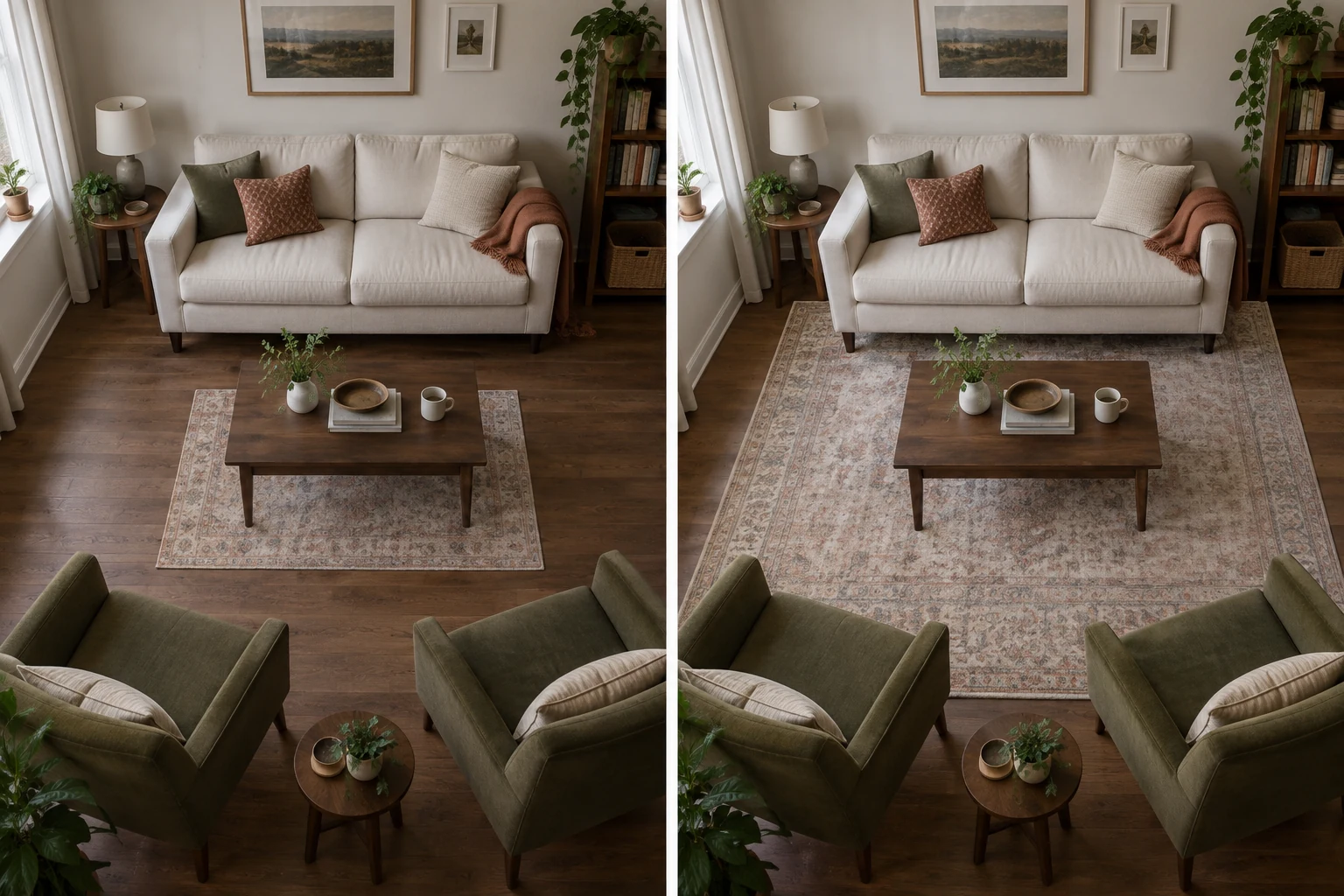
The rug goes under the legs
At minimum the two front legs of every seat sit on it. A rug that floats in the middle with a moat of floor around it splits the room into two rooms.
The art comes down to meet the furniture
6 to 8 in above the sideboard, not floating a foot above it. Lean one small frame against the wall on the surface so it overlaps the bottom edge of the big one.
Something stands in front of a corner
A plant, a lamp, a basket, placed so it covers about a third of the vertical line where two walls meet. Hiding the corner is what makes the room read as deep.
Pull the sofa off the wall
4 in is enough. Four inches of shadow behind a sofa reads as a room with a back to it. Zero inches reads as a waiting area.

Two of these have exact numbers behind them and both are worth getting right before you move anything: get my rug size → and check the table against the sofa →
-
A 20 × 20 in acacia wood tray
See the 20 × 20 tray
A tray is a small overlap machine. It sits on the table, the books sit on it, the candle sits on the books, and suddenly three things are stacked instead of scattered. Opens Amazon in a new tab
-
Command picture hanging strips
See the hanging strips
Check the weight rating per pair before you trust them with glass. They are what makes rehanging a picture 8 in lower a five minute job instead of a wall full of holes you will pay for in March. Opens Amazon in a new tab

-
A pair of 52 × 96 in linen panels
See the 52 × 96 panels
96 in so they touch the floor and the rod goes near the ceiling. Curtains that stop above the sill are the largest non overlap in most rentals. Opens Amazon in a new tab
Do the free version first, all of it, before you buy one thing here. Slide the rug under the front legs. Pull the sofa out 4 in. Move a plant into a corner. Rehang one picture lower. That is four moves, no money, and it fixes this diagnosis outright in most rooms. The tray is a nice object, and optional.
The five, stacked
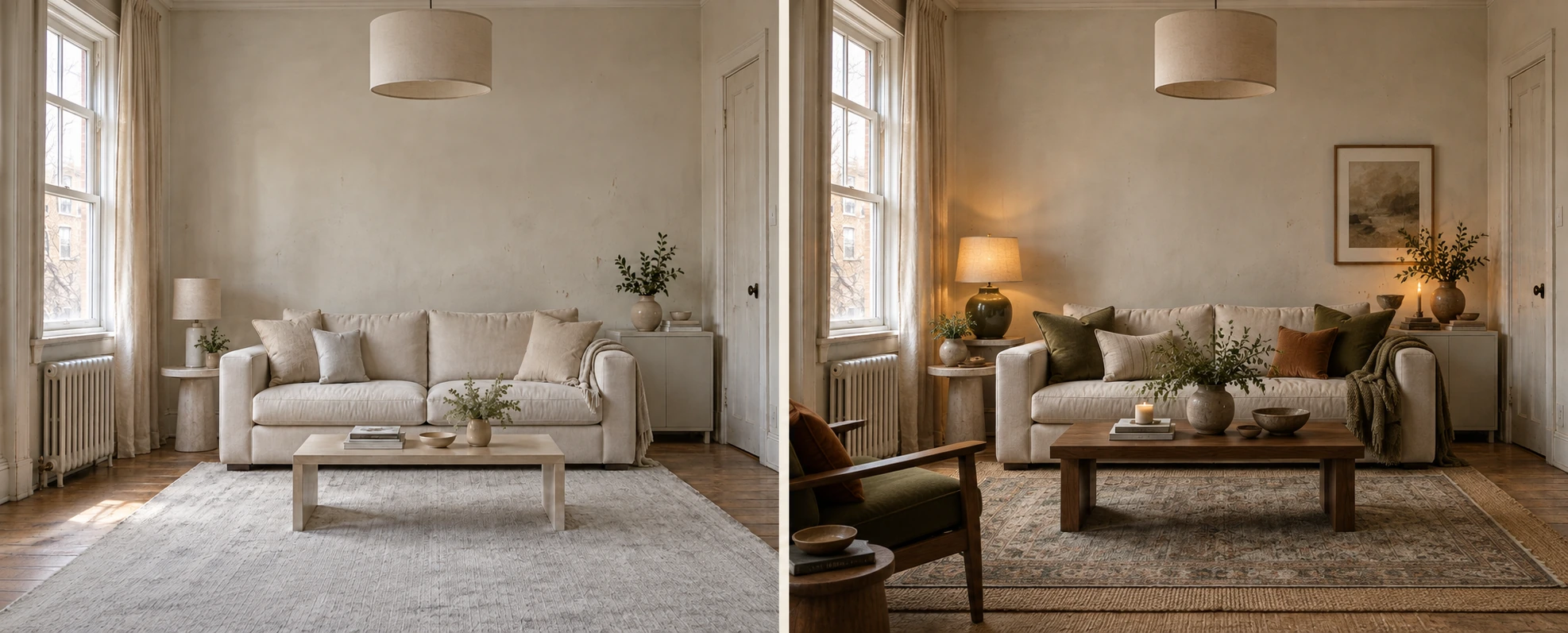
The same room, the same spot, five changes
Two frames of one rented living room, taken from the same spot so nothing moves but the fixes. Nothing in the second frame arrived that you have not already read about above. Drag the slider, or press the button, and watch which parts of the frame change.
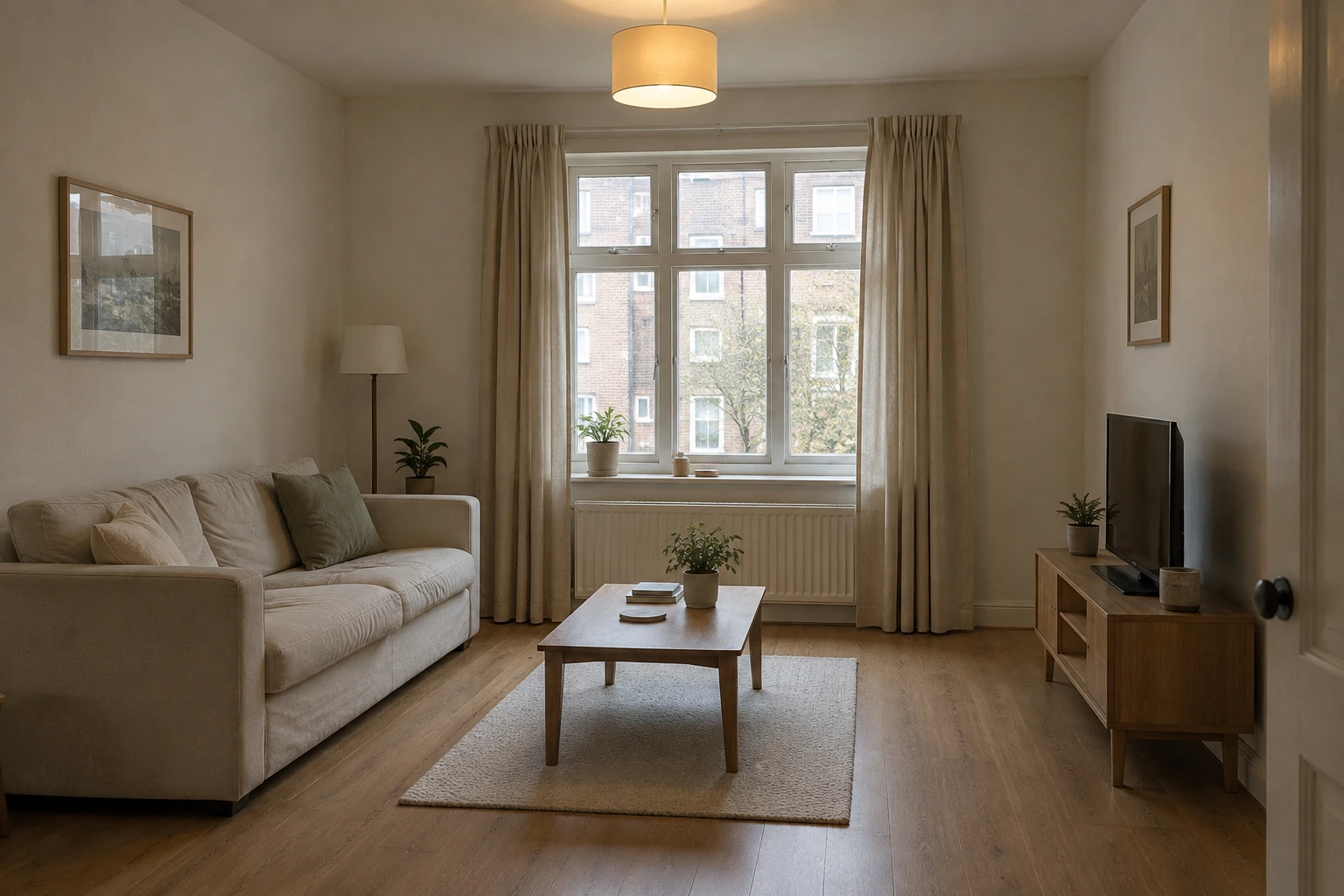
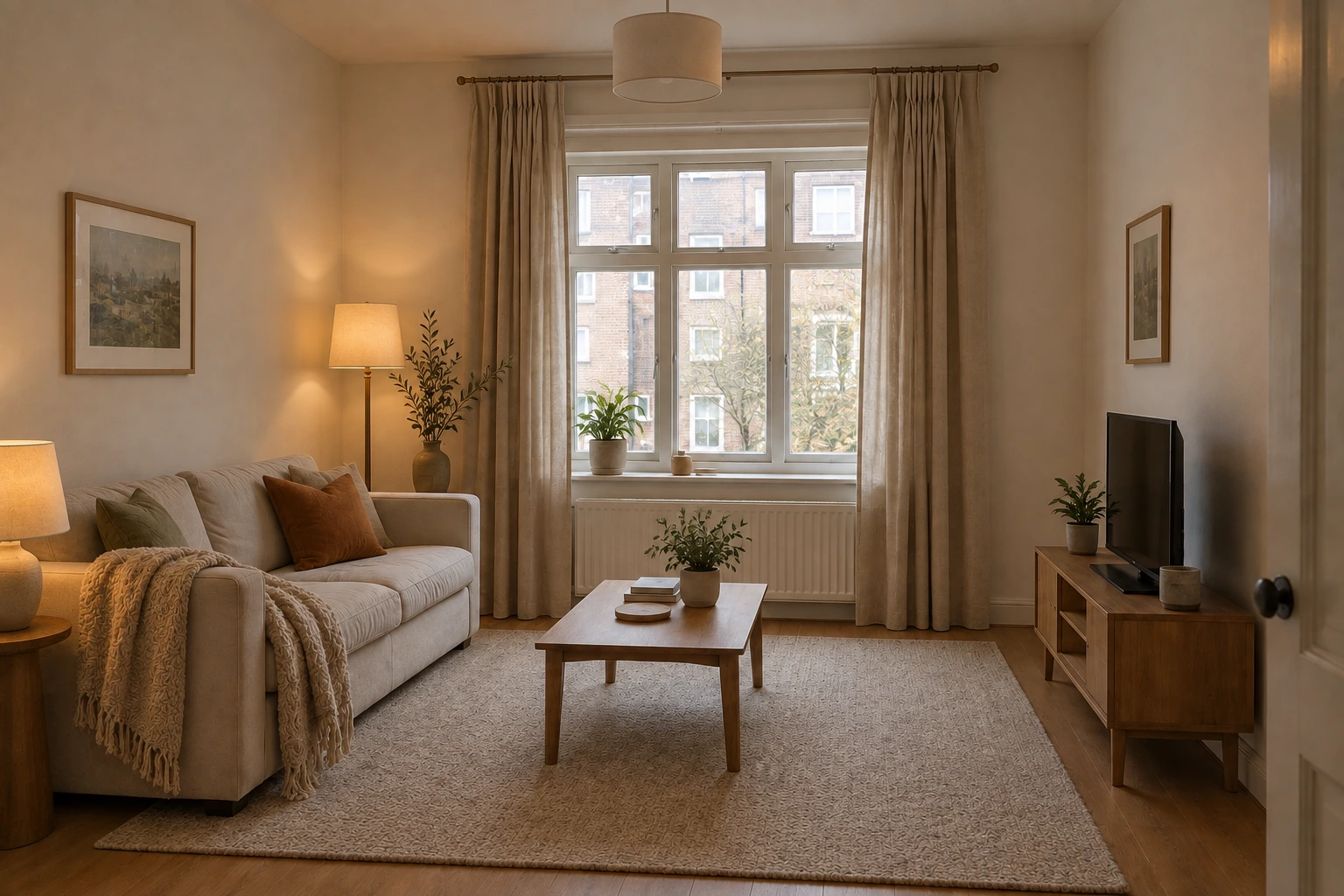
Above: the same rented living room twice. The first frame has the ceiling light on, a small rug floating in the middle of the floor and the curtains hung low against the window frame. The second has a larger textured rug under the front legs, the rod up near the ceiling, a table lamp and a floor lamp lit, a throw and a cushion on the sofa, and a plant.
0 of 5 ticked · the picture moves when the fifth one does
-
Diagnosis 05. Both front legs of every seat land on it, not near it. The rug in the first frame floats with a moat of floor around it, and a rug with a moat splits one room into two. The size is the whole decision here, and it is the one people get wrong by a foot: get my rug size →

-
Diagnosis 04. Three lights at three heights, none of them in the ceiling, all of them 2700K so the whites stop arguing. The first frame has one source directly overhead, which is why every shadow in it falls straight down. The second has two of the three lit, which is already two more than none: read the light problem →
-
Diagnosis 05 again, the half nobody counts. 96 in of panel, because that is what it takes to reach the floor once the rod is up near the ceiling. Curtains that stop above the sill, hung narrow against the frame, are the largest non overlap in most rentals: hang them higher →
-
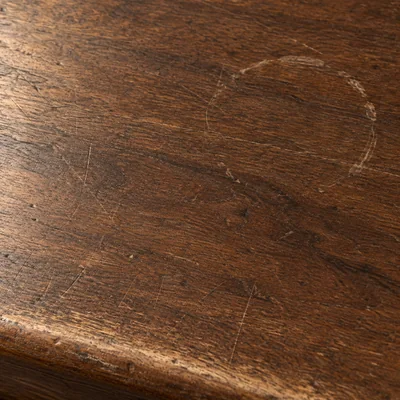
Diagnosis 02. Three pairs inside one sightline, which is six surfaces: matte and shine, smooth and rough, soft and hard. The first frame reads soft and matte all the way across, because that is what a rental hands you. The throw and the cushion in the second are two of the six: read the texture problem →
-
Diagnosis 03. Three heights in one sightline, not four pieces at the same one: floor level, the furniture band you already own, and something above 57 in. 57 in sits between standing and seated eye level, and a taller ceiling does not move your eyes, which is why it holds under an 8 ft ceiling and still holds under a 9 ft one: read the height problem →
There is no photograph of this room with only the rug fixed, because I never took one. Four of these done is a better room and it is still a flat room, which is the whole reason the picture waits for the fifth. Diagnosis 01 is not on the list at all: the same picture hangs on the same wall in both frames, so the dark value is the one you have to take from the page rather than from the photograph.
If you only do one thing
The order I would fix it in, this weekend

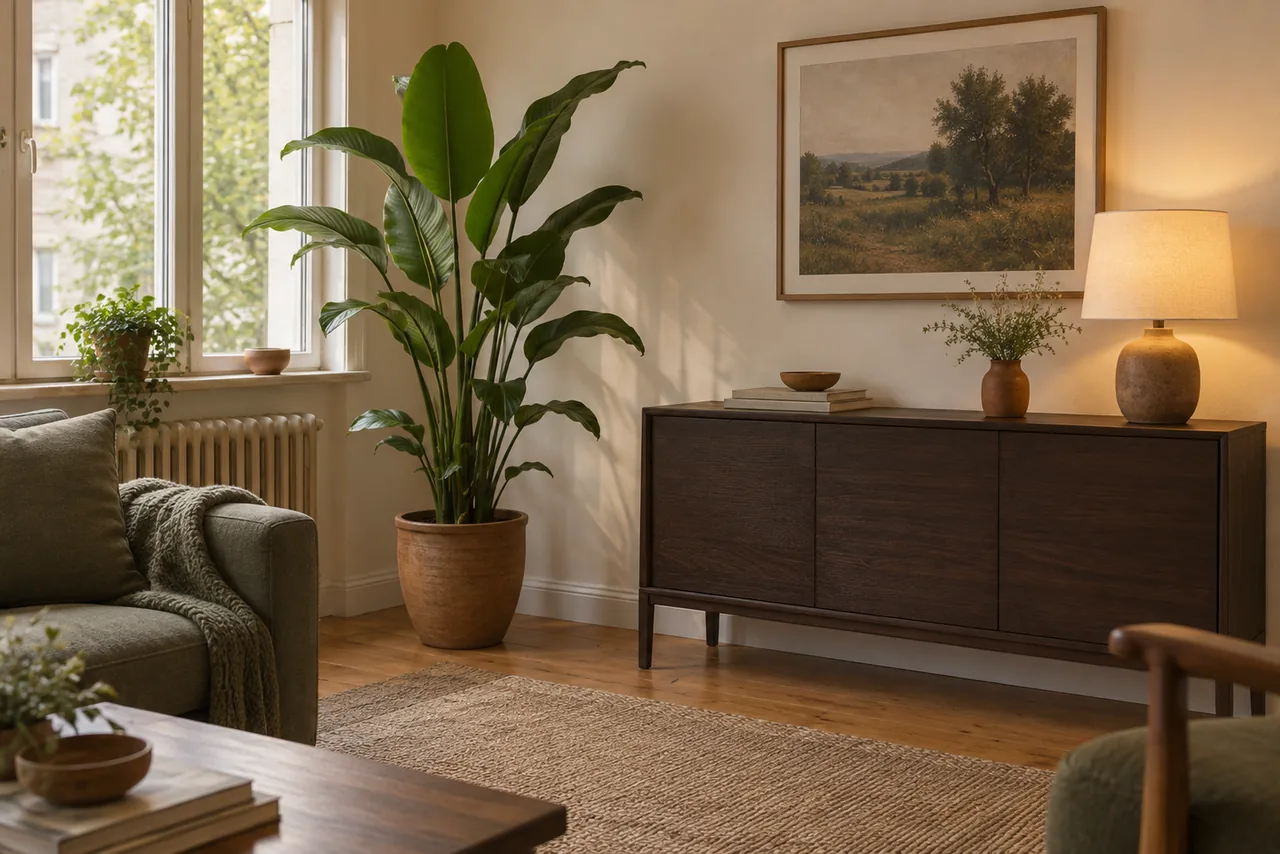
She would start with the dark thing, then sit on it.

Five diagnoses is a lot to hold. This is the order that gives you the most visible change per hour, and the first three cost nothing.
- Turn the ceiling light off for four nights0 minUse whatever lamps you own instead, even badly placed ones. You need to see the room lit from the side before any of the rest makes sense.
- Slide the rug under the front legs and pull the sofa out 4 in10 minThe whole of diagnosis 05, free, and it is the one most people can see immediately.
- Rehang your one picture at 57 to 60 in, or 6 to 8 in above the furniture15 minDiagnosis 03, free, one nail. Measure to the center of the picture, not to the hook.
- Buy four identical 2700K bulbs and put them in every lamp1 dayThe cheapest purchase on this page and the one with the largest effect. Do not buy lamps yet.
- Buy one dark thing, at eye level1 weekDiagnosis 01. A black frame, a dark cover, a near black pot. One. Live with it a week before you buy a second.
- Buy one rough thing and one hard thing2 weeksDiagnosis 02. A basket and a clay pot will do it. By now you will know which corner of the room is still asking for something.

Six moves. Three of them free. Total spend, four bulbs and three small objects, and the sofa you have stays exactly where it is.
Quick answers
The questions people type
Usually five things at once: everything is the same lightness, everything is the same texture, everything stops at hip height, there is one light and it is on the ceiling, and nothing overlaps anything else. Each one alone is survivable. Together they make a room that is clean, finished and dead. Fix the light first, because it is free and it changes the most.

Because new usually means bought together. A set arrives at one lightness, one texture and one height, from one catalog, in one week. Nothing in it argues with anything else, so there is no contrast for your eye to work on. The repair is four or five small pieces that clearly came from somewhere else, and no new furniture.
Nine times out of ten the top two thirds of the walls are empty and everything is pushed flat against them. A room reads as finished when the eye has something to climb to above 57 in and something partly hiding something else at floor level. Hang one picture at eye level and put one tall thing in a corner, and the same furniture stops looking like it just arrived.
Three lamps at three different heights, all with 2700K warm bulbs, and the ceiling light switched off. Then one chunky texture at seat height, a knit throw or a rough cushion cover. That is the whole trick, and it costs less than a single side table. Furniture is almost never the reason a room feels cold.
Because nothing overlaps. A shop has to leave a clear border of floor around every piece so you can walk round it, and rooms arranged that way inherit the feeling. Slide the rug under the front legs of the seating, pull the sofa 4 in off the wall, and stand something in front of a corner so one wall partly hides another.
A four pack of matching 2700K bulbs, put in every lamp on the same day, with the ceiling light left off. Mixed color temperature is why a room with four lamps can still look wrong, and matching them costs about the same as lunch. Second cheapest is moving the rug, which is free.

Where next
Three guides that finish what this page started
Measured in a rental · Checked Sep 15, 2026