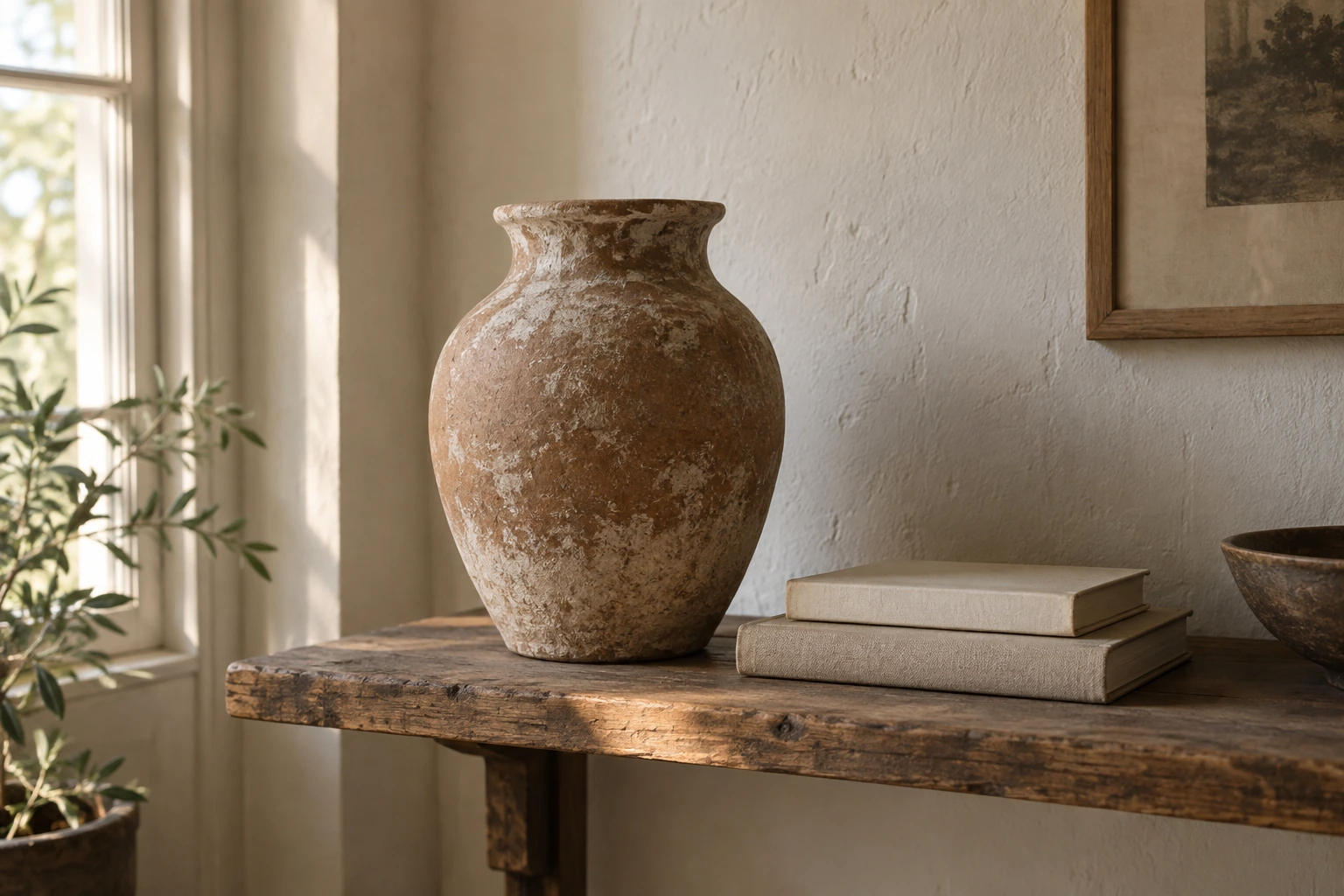
Make a new pot look like it has been somewhere.
Paint, baking soda, a sponge. Four steps, and the fourth one is the one everybody skips.

By NoraRenter DIY · Checked Sep 15, 2026
Some links on this page go to Amazon. As an Amazon Associate I earn from qualifying purchases, which is how the site pays for itself. How this works
Quick change 1 of 3 rolls
This is a vase, not a wall. The entire project happens on a sheet of newspaper, and it fits in a shoebox when the lease ends.
Renter DIY · deposit risk: none · drill: no
Materials
What you need, and what you can skip
I opened every link on this page on Sep 15, 2026. Amazon will not hand over prices or product photographs without their API, so what you get is the name, the variant, why it is that one, and the thing that is wrong with it. One of the seven below is already in your kitchen.
-
vensovo Terracotta & Clay Pots with Saucer
6 in · 4 pack · unglazed, with drainageUnglazed is the whole requirement. Glaze is a sheet of glass and nothing you brush on will bite into it. Four pots is not overkill either: you need one to get wrong, and the placement rule further down wants an odd number on the shelf, which means three good ones and one that stays in the closet.
The catchThese are plant pots, so they have a hole in the bottom. Fine for dried stems and for a pot that just sits there. If you want water in it, put a jar inside, or buy a taller unglazed vessel with a closed base instead.
See it above Opens Amazon in a new tab
Odd numbers, later -
New and aged, same scale -
FolkArt Acrylic Paint, Country Twill
2 oz · 602 Country Twill · matteThe chalky cream. Country Twill is a warm off white with gray in it, which is what old lime scale looks like; a bright white reads as primer and gives the whole thing away. Two ounces covers four pots twice over, because you are dabbing, not coating.
The catchAcrylic craft paint is the cheap answer, not the only one. A leftover tester pot of matte wall paint in your own off white does the job and ties the pot to the room, which is better than tying it to a color chart.
See Country Twill on Amazon Opens Amazon in a new tab -
FolkArt Acrylic Paint, Nutmeg
2 oz · 944 Nutmeg · matteThe earth brown that goes on in step three and mostly comes back off. Nutmeg is a soft mid brown with red under it, so it settles into the texture as shadow rather than sitting on top as mud. Anything too dark reads as soot, and soot is a different story about a pot.
The catchYou can get to the same place with a drop of instant coffee in a spoonful of water. It is less controllable and it is free, and on one small pot that trade is often the right one.
See Nutmeg on Amazon Opens Amazon in a new tab -
Arm & Hammer Pure Baking Soda
5 lb · resealable bagThis is the ingredient that does the work. Stirred into paint it turns a smooth coat into a gritty, absorbent crust that catches the brown in step three and holds it. Without it you have a painted pot; with it you have a surface with a texture that reads as mineral.
The catchYou almost certainly have some. The orange box at the back of a kitchen cabinet is the same sodium bicarbonate. Do not buy five pounds of it for one vase, and do not let the size of this bag tell you the recipe needs a lot.
See the 5 lb bag on Amazon Opens Amazon in a new tab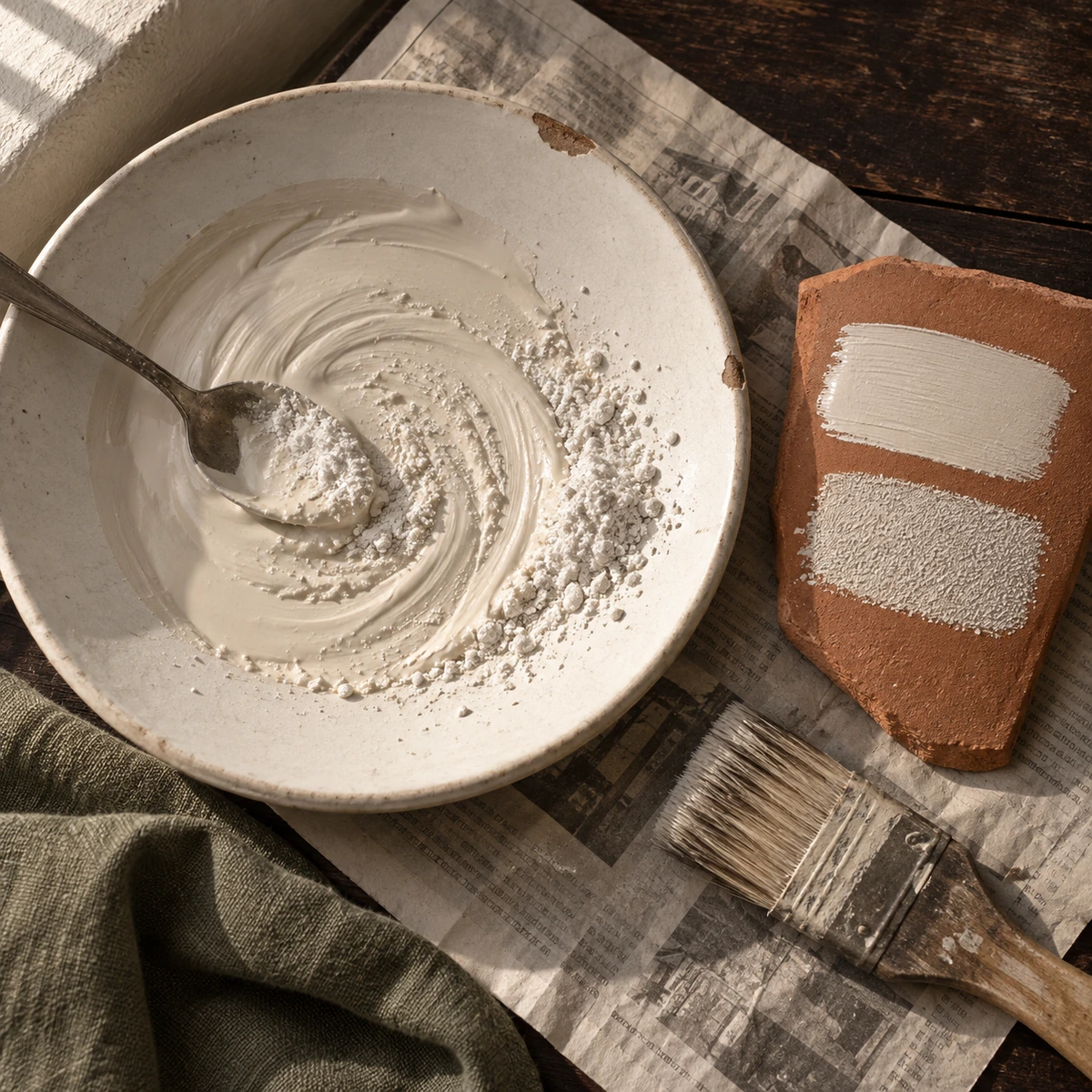
Same paint, same pot, one spoon apart. The upper swatch is what you get without it. -
Bates Chip Paint Brushes
2 in · 9 pack · natural bristleCheap natural bristle is what you want here, not a good brush. Chip brushes shed and splay, and both of those are features when you are dragging a nearly dry brown across a rough surface. Nine of them means you never stop to wash one out mid job.
The catchAn old toothbrush and a stiff dish brush cover both jobs on this page, the scrub in step one and the dry brush in step three. Nine brushes is a purchase for the next five projects, not for this one.
See the 2 in brushes on Amazon Opens Amazon in a new tab
2 in, dry -
Lullingworth Unbleached Natural Sea Sponges
2 pack · 5 to 5.5 in · unbleachedA natural sponge has holes of every size, so it leaves a mark that never repeats. That irregularity is the entire reason the finish looks like weather and not like a technique. Tear a piece off the big one rather than using it whole: a fist sized sponge on a 6 in pot gives you one dull pattern.
The catchA crumpled plastic bag, a wad of paper towels or a scrunched paper bag all leave a random enough mark to pass. They tear up faster, and on one pot they will outlast the job.
See the sea sponges on Amazon Opens Amazon in a new tab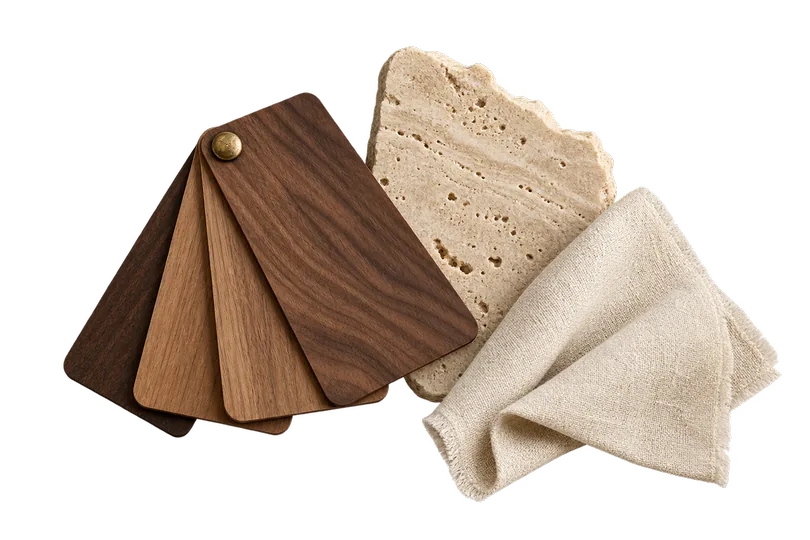
A mark that never repeats -
Krylon Crystal Clear Matte Spray
11 oz · matte · clearThe step people skip, and the reason their pot is bald in a month. Matte clear locks the chalky layer down without putting a shine on it. Spray, not brush: a brush drags the brown you carefully rubbed back into the cream you carefully left alone.
The catchIt is a solvent aerosol, so it wants an open window or a balcony and ten minutes of patience, which in a small apartment is a real cost. A water based matte sealer brushed on very lightly is the compromise if you have no outdoor space at all.
See the matte sealer on Amazon Opens Amazon in a new tab
-
Part two
Skip this
Primer. Unglazed terracotta is the most absorbent surface in your house and primer only fills the pores you want open. Sandpaper. There is nothing to key. A distressing kit. It is a sponge and a cloth with a price on it. Plaster of Paris. It sets in minutes in the jar and you spend the afternoon chipping it out. Antiquing glaze. Thinned brown paint is the same thing and you can control how much comes off.
-
Part three
If you cannot find it
- Pot
- Any unglazed terracotta, including the plainest one at the garden center, or a thrifted pot with a chip in it. The chip helps.
- Cream paint
- A sample pot of matte wall paint, or white craft paint with a drop of the brown stirred in to knock the white back.
- Brown
- Instant coffee in water, cold brewed tea, or a smear of shoe polish worked in and buffed off.
- Baking soda
- Plain flour, cornstarch or fine sand. Sand gives the coarsest crust and the least control.
- Sponge
- A crumpled plastic bag, a paper bag or a wad of paper towels.
- Sealer
- Any matte clear coat, aerosol or brush-on. Not gloss, and not furniture wax, which stays tacky on a porous surface and grabs dust.
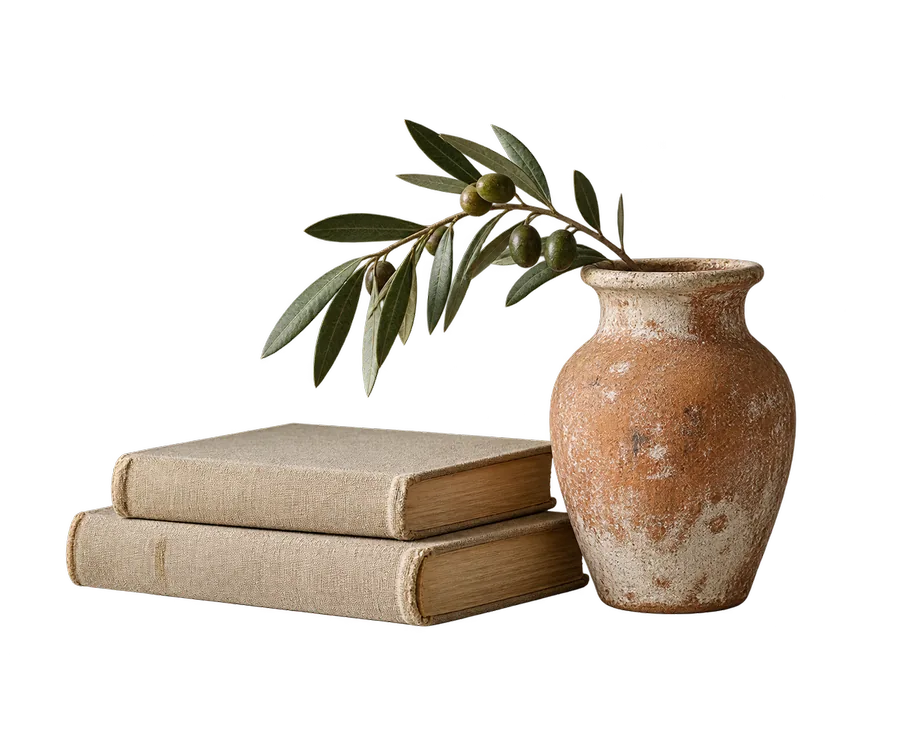
Already in the house -
Part four
Before you start
Dry means dry. Terracotta holds water for hours after the outside feels dry, and paint over trapped water lifts in flakes. Mix small. Paint with baking soda in it stiffens in the jar within an hour, so mix a spoonful at a time. Do the brown while the cream is young. After a few hours it will not rub back. Seal outside or at an open window, on newspaper, with the pot turned as you go. Not food safe, not watertight. This is a finish for dried stems and for standing there looking good.
-
Part five
Why this works in a rental
There is no surface in the apartment involved at any point. No wall, no wet work, no smell beyond ten minutes of aerosol at an open window, and nothing a landlord could have an opinion about. It is also the fastest way to put age into a room where every single object arrived new, which is the problem with most rentals and one that no amount of shopping solves. And it moves: wrap it in a towel, put it in a box, unwrap it on a different shelf.
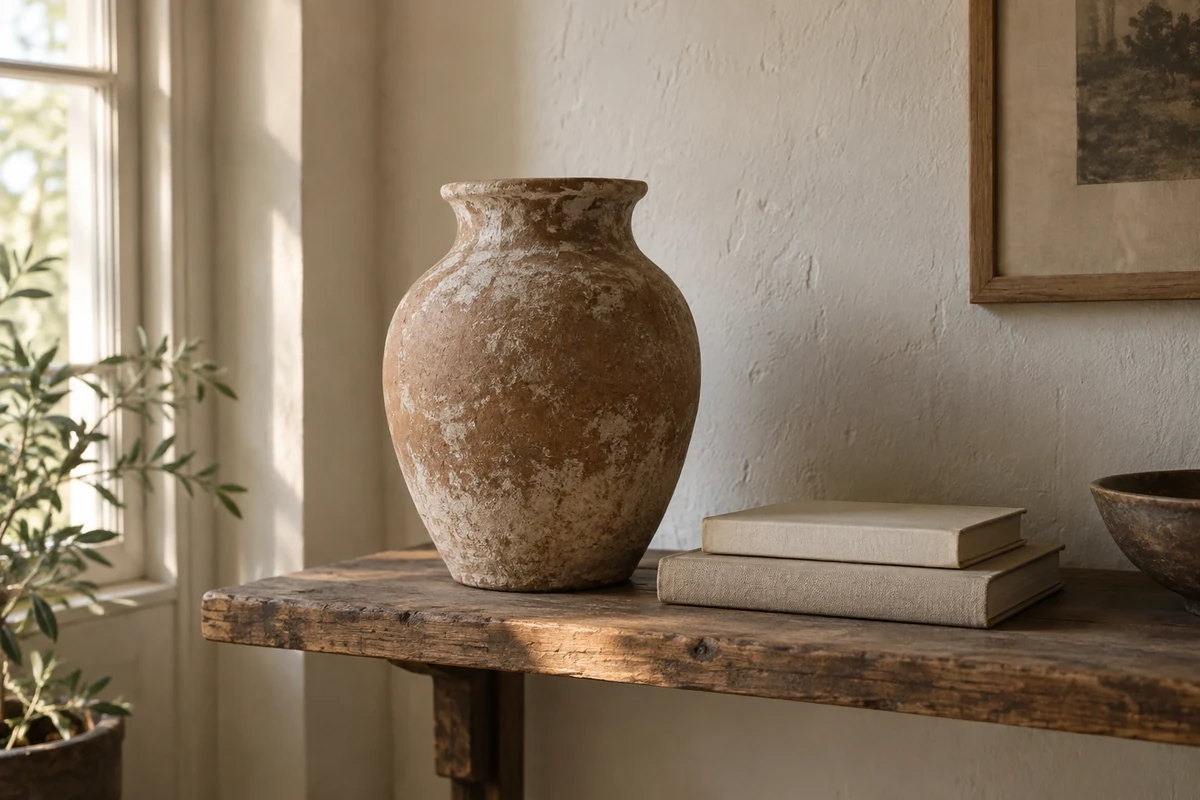
Age, in a room where everything arrived new
-
Materials
$30 to 60
A plain pot, two small pots of paint, a can of sealer. The baking soda is already in your kitchen.
-
Hands-on time
45 min
Fifteen minutes of that is the sponge. The rest is waiting with your hands clean.
-
Waiting in between
3 hours
An hour between coats, two after the sealer before anything touches it or goes in it.
Nothing here is attached to the apartment. It wraps in a towel and goes in a box, and it is the cheapest way I know to put age in a room where everything arrived new.
The whole build
Four steps, and the fourth is the one that lasts
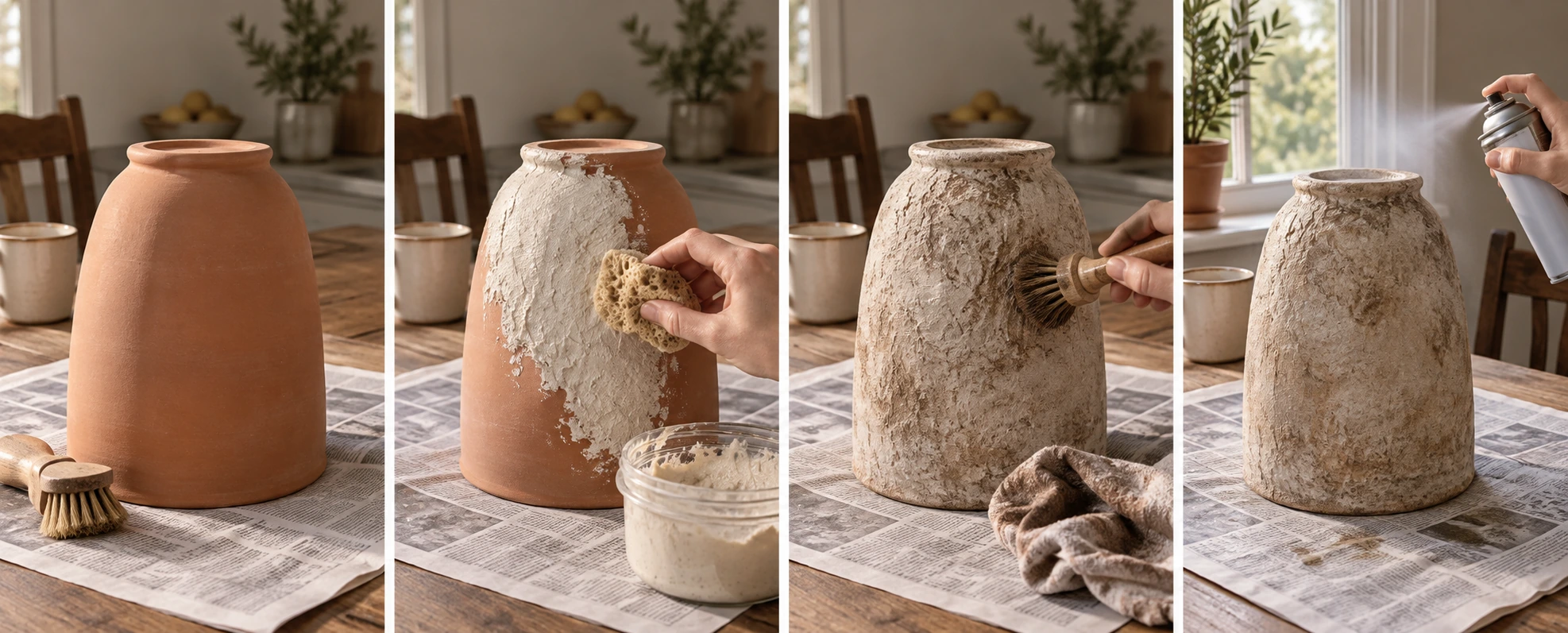
Same sheet of newspaper, same lamp, same camera height in all four photographs, so the only thing changing is the pot. The mono line under each step is what goes wrong at that step.

-
1
Clean
Scrub the pot under warm water with a stiff brush, no soap, and let it dry all the way through. Terracotta is porous and comes out of the box with a fine clay dust on it. That dust is a release layer: paint that lands on it lifts off in sheets three weeks later.
What goes wrong here
Painting it damp. Terracotta holds water for hours after it looks dry, and trapped water pushes the paint back off from underneath.
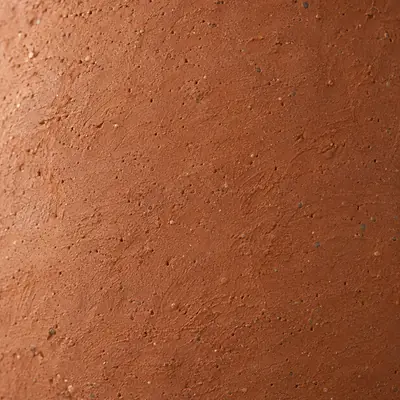
Dry, all the way through -
2
Sponge
Stir baking soda into the cream paint until it is the texture of thick yogurt, roughly two parts paint to one part soda. Dab it on with a damp natural sponge, never a brush, heavier around the rim and the base where lime and hard water would build up. Leave bare terracotta showing.
What goes wrong here
Even coverage. A pot that is evenly chalky reads as a painted pot. Age is never even; it collects where water sat.

You are making it dirtier on purpose. I have questions.
-
3
Age back
Once it is touch dry, about an hour, load a dry bristle brush with the earth brown, wipe most of it off on the newspaper, and drag what is left across the chalky texture. Then take a damp cloth and rub some of it away again, hardest on the parts a hand would touch. Taking off is what makes it look old. Putting on just makes it dirty.
What goes wrong here
Waiting too long. After a few hours the cream has cured and the brown will not rub back, so you are stuck with whatever you put on.

Taking off, not putting on -
4
Seal
Two light passes of matte clear, twenty minutes apart, outside or at an open window with the pot on newspaper. Light passes, from about a foot away, moving the whole time. This is the step that turns a finish that comes off on your fingers into one that survives being picked up, dusted and moved.
What goes wrong here
Skipping it. Unsealed, the chalky layer powders off on every hand that touches it, and in two weeks the pot is bald where people pick it up.
Same pot, 45 minutes apart
The one on the left cost the same as the one on the right
Drag the handle. Same pot, same shelf, same light, photographed from the same spot before and after. What changed is a cup of paint with baking soda in it and a brown you mostly wiped back off.
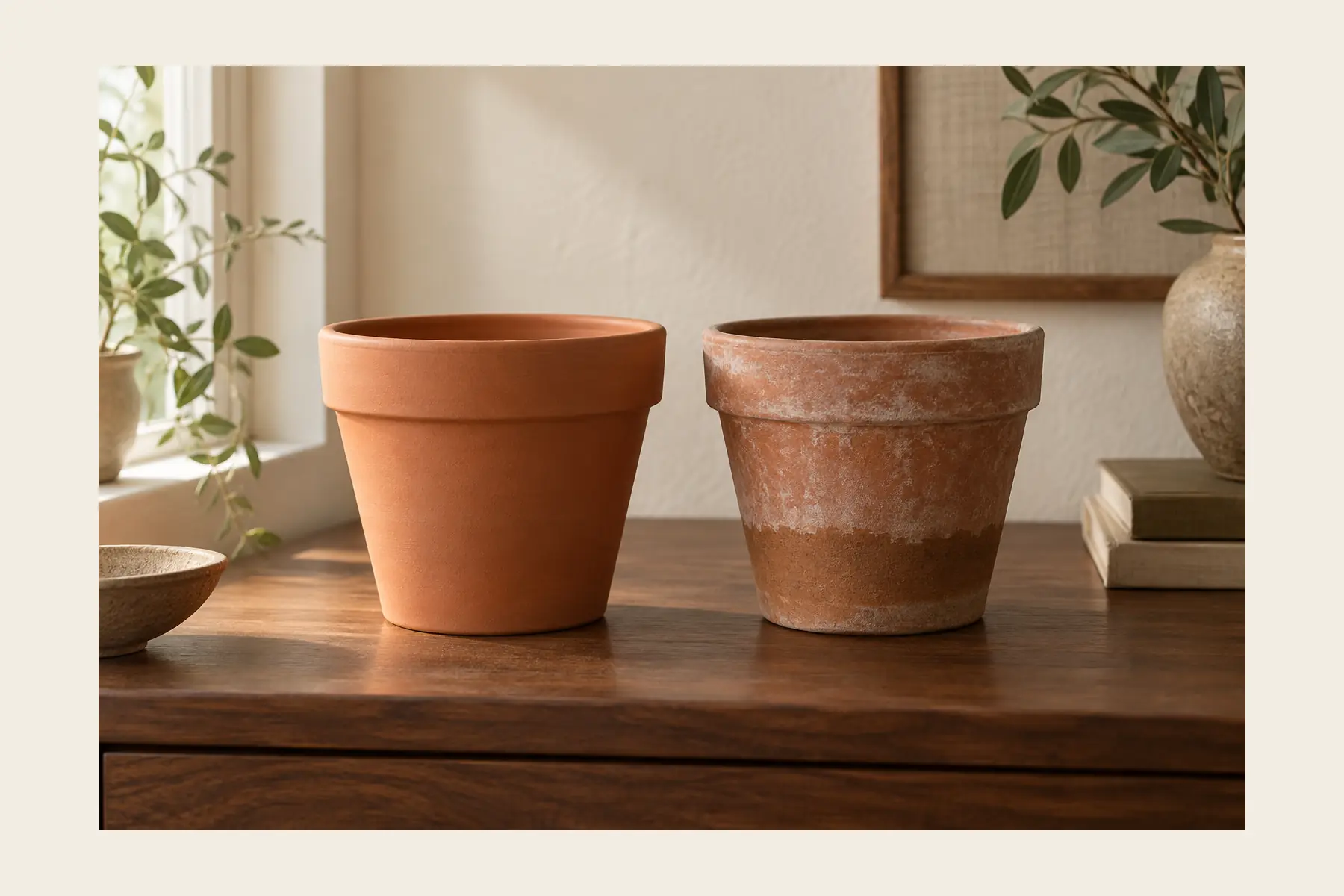
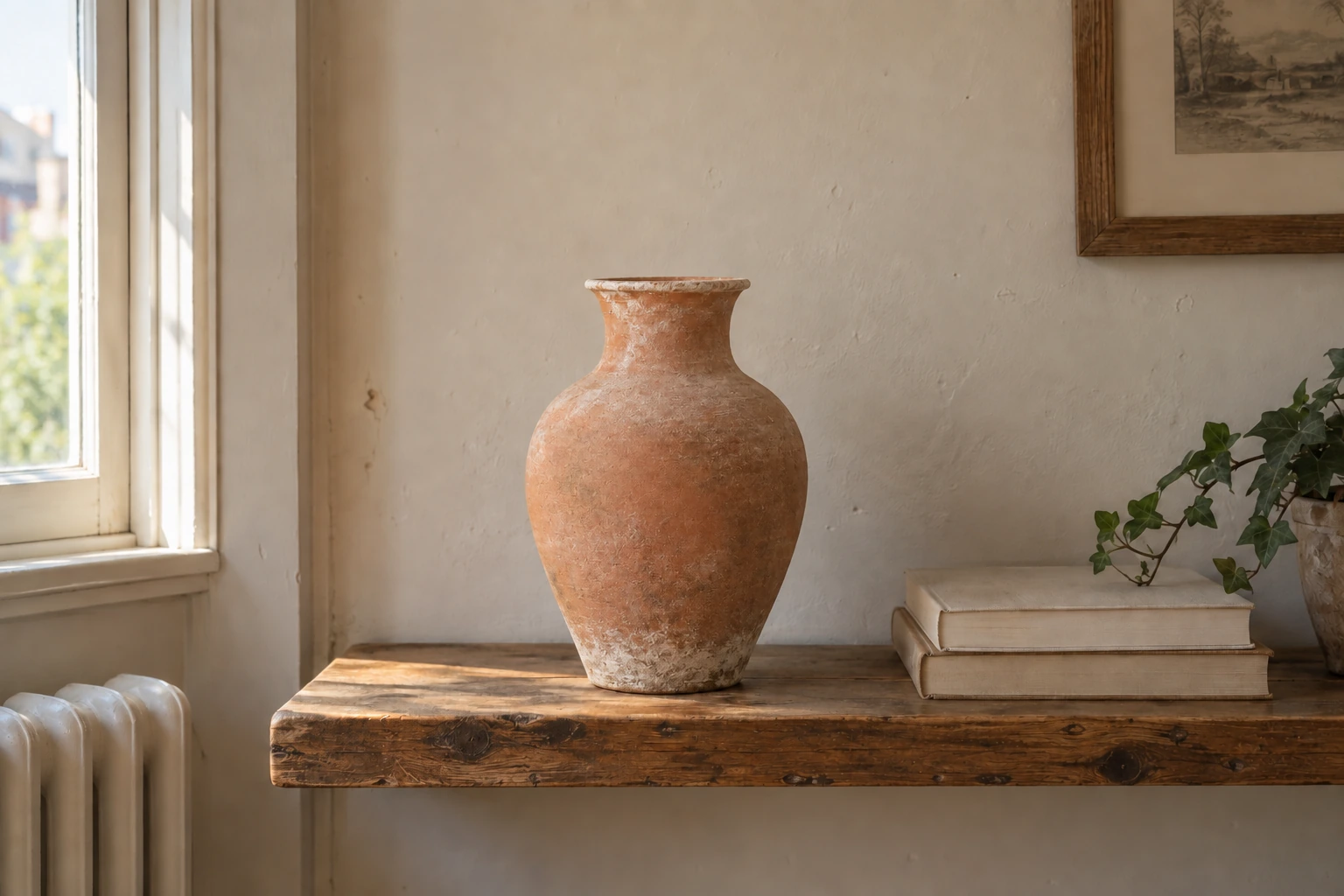
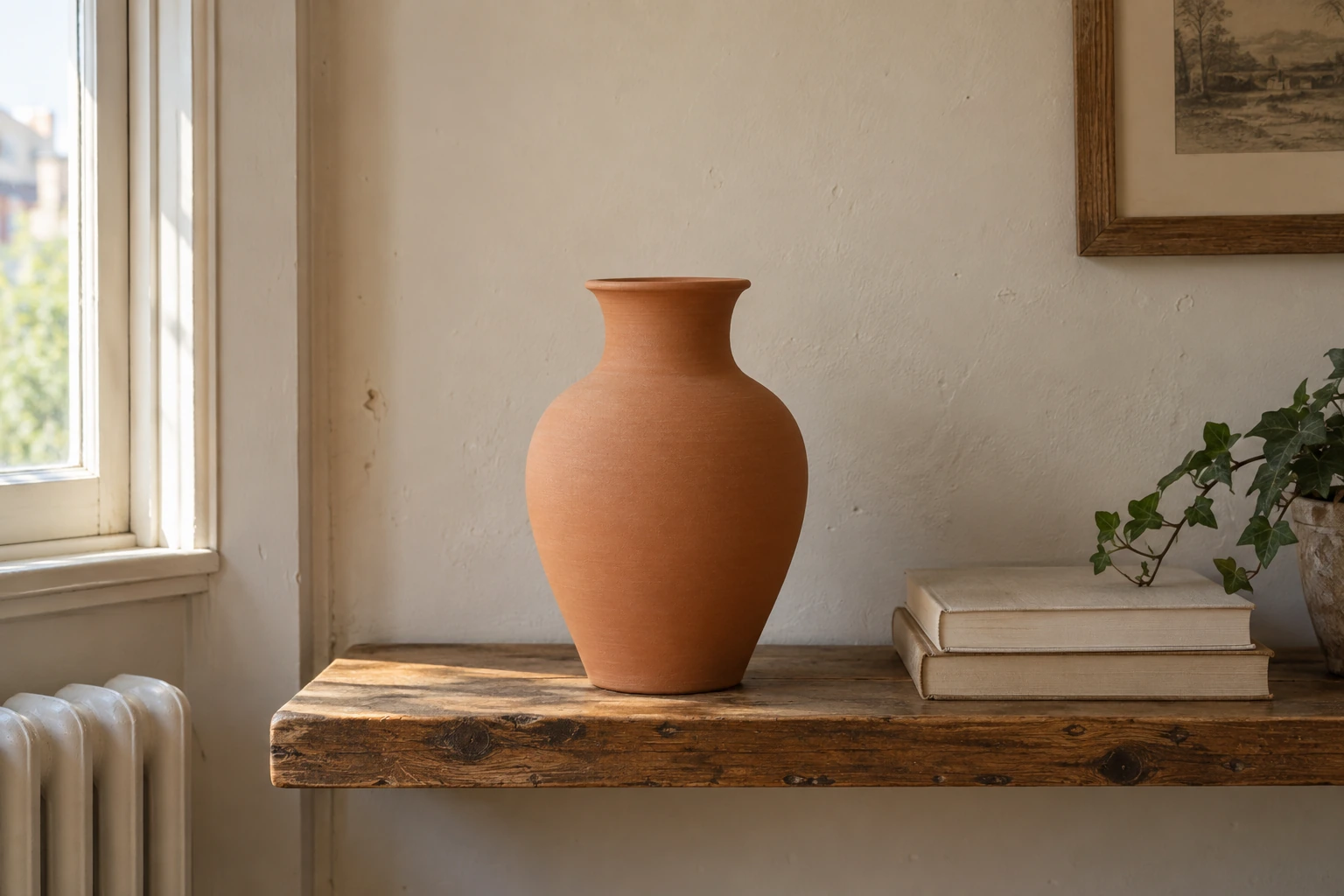
Out of the boxAfter 45 minutes
The reason this matters in a rental is not the money. It is that a room where everything arrived in the last eighteen months has nothing in it with a history, and one object that looks like it has been somewhere does more for that than three that do not.
Where it looks best
3Everyone teaches the finish. Nobody tells you where to put it.
A beautifully aged pot in the wrong spot looks like clutter, and the spot is decided by three things that have nothing to do with paint. This is the part of the project that costs nothing and changes the most.
-
Grouping · n24
Odd numbers, and never two the same height
One pot reads as an object. Three read as a group. Two that do not match read as a mistake, because the eye pairs them, sees they do not match, and keeps going back to check. Group in threes or fives, put the tallest at the back, and let the shortest overlap the one behind it rather than sitting beside it in a row.
Big to small, back to front is the same rule that governs sofa pillows, which is why the drawing next to this is a stack of cushions.

Three is a group. Two that do not match is a mistake. One is me.
-
Height · n10
What hangs above decides how tall it can be
Art over a console sits 6 to 8 in above the furniture, and that gap is the ceiling for anything you stand on the console. A 10 in pot under a piece hung with an 8 in gap collides with it, and the collision is what makes a styled shelf feel crowded even when nothing is technically touching.
On an open shelf, the working version of the same idea: leave about a third of the shelf opening as air above the tallest thing. A shelf packed to the top edge reads as storage.
-
Color · n27
A vase echoes the ten
Sixty percent of a room is its dominant color, thirty is the secondary, ten is the accent. Terracotta is an accent, and a strong one, but a vase is small: three aged pots on one shelf only echo the ten. A floor pot with a tree in it, like the one in the finished room, gets much closer. Three on every shelf in the room is a pottery display, and at that point the color has quietly become the thirty.
If your room is already warm and beige, the aged cream finish is the reason this works: it cools the pot down enough to sit in the scheme rather than shout across it.
And if the shelf is a floating one you hung yourself
The shelf itself follows the wall numbers: art and objects live around 57 to 60 in to their center, a little below standing eye level, and a shelf of pots at chest height gets looked at while one at knee height gets kicked.
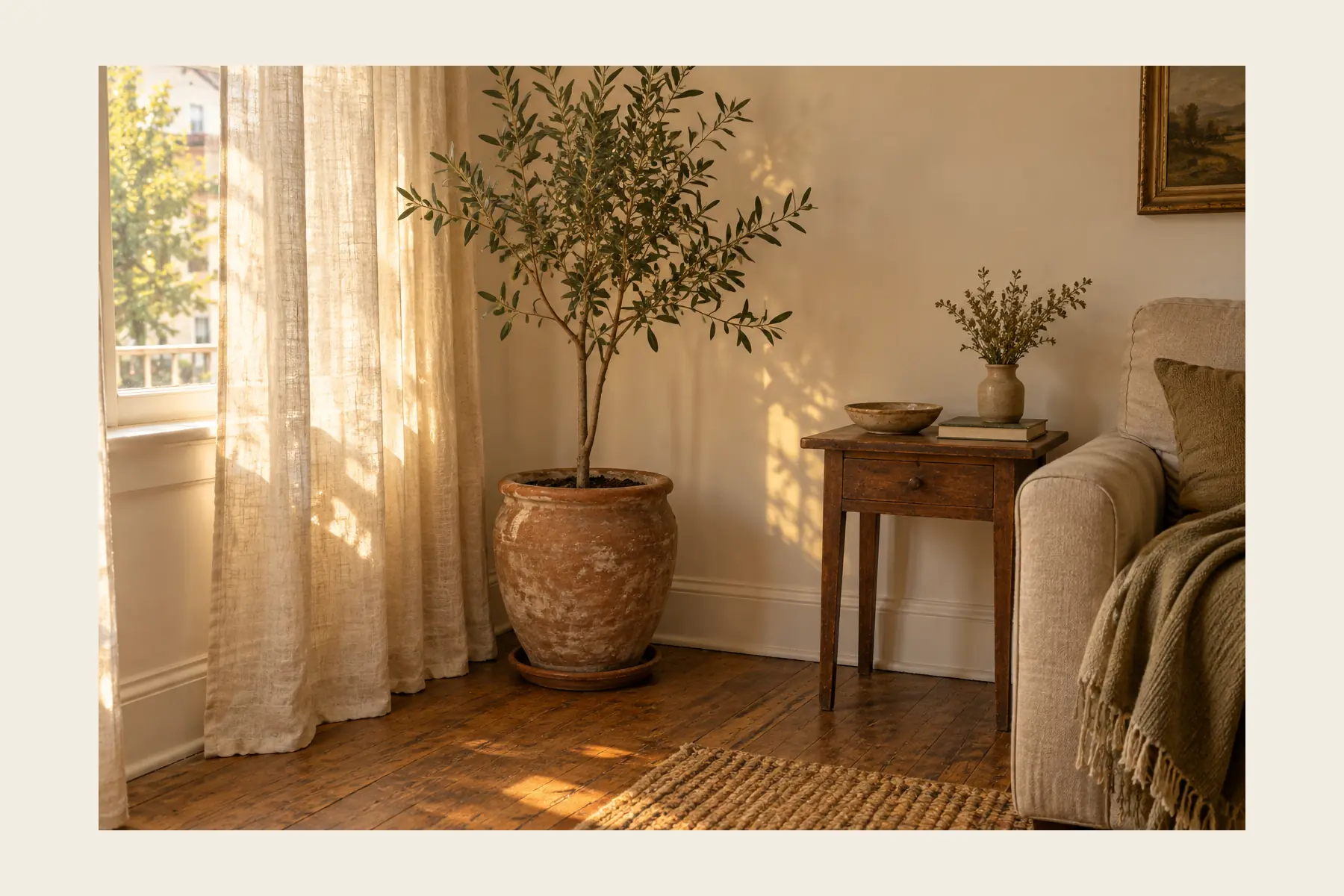
Quick answers
Six things people search before they start
Sponge on a cream matte paint thickened with baking soda, unevenly, heavier at the rim and the base. Let it go touch dry, then dry brush an earth brown over the texture and rub most of it back off with a damp cloth. Seal it matte. The whole thing is 45 minutes of hands-on work, and the rubbing back is what sells it.
Baking soda, roughly two parts paint to one part soda, stirred to the texture of thick yogurt. It turns a smooth coat into a gritty, absorbent crust that catches the brown and holds it. Flour, cornstarch and fine sand all work; sand is the coarsest and the hardest to control. Mix a spoonful at a time, because it stiffens in the jar within the hour.
Yes, and this is the step people skip. The chalky layer is deliberately loose, so unsealed it powders off on every hand that picks the pot up, and within a couple of weeks there is a bald patch where people hold it. Two light passes of matte clear, twenty minutes apart, at an open window.
Not well. Glaze is a layer of glass and the chalky mix has nothing to grip, so it sits on top and chips at the first knock. If the pot you own is glazed, scuff it all over with coarse sandpaper and use a bonding primer first, at which point you have added an hour and a purchase to a project that was meant to take 45 minutes.
Treat it as a cover pot. Keep the plant in its plastic nursery pot and drop that inside, so water never reaches the finish from either side. Watering straight into a painted terracotta pot pushes moisture out through the clay from the inside, which is exactly the thing that lifts the paint.
Three, in different heights, and put them on one surface rather than spreading them around the room. Odd numbers group; even numbers pair up and look like they are missing something. Beyond three on a shelf you have stopped decorating and started collecting, and the terracotta stops being the accent color.

Doing it this weekend?
Tick what you still need
Leave anything that is already in a drawer. The rest goes to your Amazon cart in one tap.
Amazon shows you the cart first; nothing is bought until you check out there. As an Amazon Associate I earn from qualifying purchases.
Where next